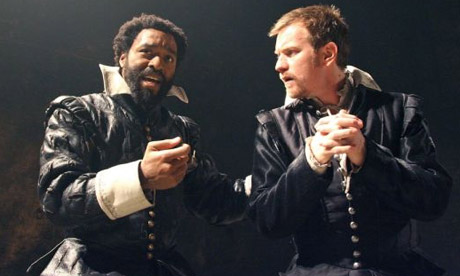
Playing Othello here is Chiwetel Ejiofor, who starred as Solomon Northup in 12 Years a Slave, one of last year's best films. Iago is portrayed by Ewan McGregor, who played Obi-Wan Kenobi in Star Wars. Type 300+ words on a specific time (one day maximum) in your life that included a lot of connections to the action or themes of The Tragedy of Othello, the Moor of Venice. Include a couple more specifics than you're used to sharing. A sort of "confessional" task, perhaps. Why not? You have but a month left of high school...to heal, connect, forget, remember, solve, resolve... (No, this task cannot be like the others.)
OR
Discuss statements on the Othello Anticipation Guide in 300+ words. Why do you dis/agree with them?
A place for critical reading, compelling writing, and analytical thinking.
Showing posts with label Shakespeare. Show all posts
Friday, March 14, 2014
Friday, January 4, 2013
Thoughts Thursday--due May 9
Select a Common Core State Standard (other than 12.4, which was the last one) to demonstrate in 300+ words, using Othello as your focus:
READING : LITERATURE (GRADES 11-12)
Key Ideas and
Details
RL.11-12.1 Cite strong and thorough textual
evidence to support analysis of what the text says explicitly as well as
inferences drawn from the text, including determining where the text leaves
matters uncertain.
RL.11-12.2 Determine two or more themes or central ideas of a
text and analyze their development over the course of the text, including how
they interact and build on one another to produce a complex account; provide an
objective summary of the text.
RL.11-12.3 Analyze the impact of the author’s choices regarding
how to develop and relate elements of a story or drama (e.g., where a story is
set, how the action is ordered, how the characters are introduced and
developed).
Craft and
Structure
RL.11-12.4 Determine the meaning of words and phrases as they are
used in the text, including figurative and connotative meanings; analyze the
impact of specific word choices on meaning and tone, including words with
multiple meanings or language that is particularly fresh, engaging, or
beautiful. (Include Shakespeare as well as other authors.)
RL.11-12.5 Analyze how an author’s choices concerning how to
structure specific parts of a text (e.g., the choice of where to begin or end a
story, the choice to provide a comedic or tragic resolution) contribute to its
overall structure and meaning as well as its aesthetic impact.
RL.11-12.6 Analyze a case in which grasping a point of view
requires distinguishing what is directly stated in a text from what is really
meant (e.g., satire, sarcasm, irony, or understatement).
Integration of
Knowledge and Ideas
RL.11-12.7 Analyze multiple interpretations of a story, drama, or
poem (e.g., recorded or live production of a play or recorded novel or poetry),
evaluating how each version interprets the source text. (Include at least one
play by Shakespeare and one play by an American dramatist.)
RL.11-12.9 Demonstrate knowledge of eighteenth-, nineteenth- and
early-twentieth-century foundational works of American literature, including
how two or more texts from the same period treat similar themes or topics.
Range of Reading and Level of Text
Complexity
RL.11-12.10 By the end of grade 11, read and comprehend
literature, including stories, dramas, and poems, in the grades 11–CCR text
complexity band proficiently, with scaffolding as needed at the high end of the
range.
By the end of grade 12, read and
comprehend literature, including stories, dramas, and poems, at the high end of
the grades 11–CCR text complexity band independently and proficiently.
READING : LITERATURE (GRADES 11-12)
Key Ideas and
Details
Craft and
Structure
Integration of
Knowledge and Ideas
Range of Reading and Level of Text
Complexity
Labels:
Common Core,
Othello,
Shakespeare
Thoughts TUESDAY--due April 30
RL.11-12.4 Analyze the impact of specific word choices on meaning and tone, including words with multiple meanings or language that is particularly fresh, engaging, or beautiful (my underline for emphasis).
= Write 300+ words on selected sections of The Tragedy of Othello, Moor of Venice, making a "Top Ten" (start with 10 and count down) of the lines you find to be most beautiful. Translate and analyze. Give the act and scene number to help us all study the play more closely--and, hence, perform better on the test. Thank you for working diligently; just glance back down this site to realize how much we've examined.
| Great Movie Stars, Chiwetel Ejiofor (Othello) & Ewan McGregor (Iago) |
Labels:
Common Core,
Othello,
Shakespeare
Monday, March 26, 2012
How is Othello similar to/different from Rider? Due Tuesday, April 3
Write 300+ quality words (no fluff or filler) explaining how Othello in The Tragedy of Othello, the Moor of Venice by the genius William Shakespeare is similar to/different from Rider in "Pantaloon in Black" by the great William Faulkner.
Consider small, symbolic connections like the handkerchief. Consider major, motif connections like emotional, mental trauma.
(Also, how are these two Williams using their protagonists in similar ways?)
Labels:
Othello,
Shakespeare,
Short Stories
Wednesday, January 14, 2009
Othello Blog Exercise #2: Due Wednesday, January 28, by Midnight
Type 100+ words directly from Othello--verbatim (word for word).
- Translate Shakespearean English to 21st Century Brandon English (also 100+ words). You do the translating; do not copy/paste a translation from a website. This will not take you all week/night.
- Type 100+ more words, personally attaching to this scene or verbal exchange. How does this scene or verbal exchange relate to you or your world? In what ways are you wiser--and therefore more aware--because of what this scene or verbal exchange has made you consider?
300+ words = 30 points (This is a picture of the ever-important symbol, the handkerchief.)
Tuesday, January 13, 2009
In-Class Genuine and Free Forum: Completed During Class Tuesday, January 27

This is the third major work by Shakespeare you have studied during your high school experience. What do you genuinely think, (with no fluff or b.s. permitted)? Why Shakespeare at all? How is he/is he not genius? Is his language relevant? If you despise Shakespeare, why do so many people enjoy his works? If you love Shakespeare, why do so many people loathe his works? You may type as much/little as you like, as long as you are honest and invested. Say something that really matters to you here.
You must respond to this post and to two other student comments, which will make this a legitimate discussion forum. A good way to get someone to respond to your comment is to include a question for someone to directly answer. Or, be boldly opinionated enough--without being childishly offensive--to generate a response.
Here's some boldness: Some people would say/think these things; I would not. "If you cannot or will not appreciate and love Shakespeare, you are an idiot." or "If you love Shakespeare, there is something wrong with you--you are out of touch with reality and need your brain examined (you might need a lobotomy, in fact)." or "If you don't like Shakespeare, you are not a human being, because human beings feel emotions and Shakespeare's plays are packed with emotional scenes and speeches." or "If you love Shakespeare, you are not tough, manly, or cool." or "If you do not love Shakespeare, you do not fully live." or "If you enjoy Shakespeare, you are wasting your time with out-of-date language and stupid stories of love, revenge, and so on, that will never help you think any better or get anything you don't have already. WASTE OF TIME."
Are we becoming academically lazy? Or would more interesting, relevant, and current material help us THINK CRITICALLY (the main purpose of this class) well enough and/or better than Shakespearean material? For instance, what would help you in life better, a Shakespeare semester course elective, or a film history and criticism
semester course elective? Couldn't we learn about evil through/with "The Hills Have Eyes"? Couldn't we learn about love through/with "The Notebook" or "Twilight" or "One Tree Hill"? Be "easier" and better, right? Maybe we cannot get emotionally involved in Othello, because we are too busy trying to understand what is being done and said?! Maybe we shouldn't even try to get emotionally attached to Shakespeare, but isn't that the point of drama?
Maybe we should cut all that is too tough: Anatomy, Trigonometry...?
Othello Blog Exercise #1: Due Saturday, January 24, by Midnight
Become any character in one of these three ways (300+ words & 30 points):
- Write your thoughts as you are off the screen/stage. What is bothering you? What do you know? What do you not know? What are you pleased about?
- Write an autobiography of your past, prior to the action where Othello starts. Where are you from? What has your life been like? Who has been good/bad to you? What has happened to you to shape your current behavior and thinking?
- Write what a bystander (really minor character not even mentioned in play) would be thinking, observing, but not saying. Why are you not intervening? What should you do, but cannot because you are not important enough? (I had a student be a spider in a corner once; you could be a guard, friend, maid--let's see who is creative.)
Characters to choose from:
Othello
Iago
Desdemona
Roderigo
Cassio
Emilia
Montano
Brabantio
Bianca
Lodovico
Duke of Venice
Tuesday, January 29, 2008
Harvard's Implicit Association Tests
Saturday, December 15, 2007
Semester in Review
What was the best experience you had this semester in College Bound English 12? Why was it enjoyable or productive? Or, what was the worst experience you had this semester in College Bound English 12? Why was it not enjoyable or productive? How could either experience be made better?
Labels:
Kesey,
Shakespeare,
Shaw
Tuesday, November 20, 2007
Othello and Orientalism
What is Orientalism? Search the web for a clear definition; Edward Said is the primary source for this topic. How does Orientalism apply to Shakespeare's Othello? Orientalism is a way of studying how the "West" looks down upon, and misjudges, the "East." The West (The Occident--Europe and North America) writes about its notions of the East (The Orient--Africa, The Middle East, Asia) and misrepresents people and customs of the East. Applying this theory to the play: Shakespeare is showing a bias against the East in the way he makes Othello inferior, rash, illogical, overly passionate, even animalistic. The ethnocentric Elizabethans would think the Spanish and Italians were backward and uncivilized, but the Elizabethans would have believed that Africans or Arabs were barely human. Is this an interesting concept to you? I think Orientalism is highly useful when looking at today's world. It is applicable to any war with the Middle East, that is certain.
Monday, November 19, 2007
Othello
If we are rational, thinking beings, how can jealousy and other emotions get the best of us?
Labels:
Othello,
Psychology,
Shakespeare
Subscribe to:
Posts (Atom)