Othello Task--due April 17
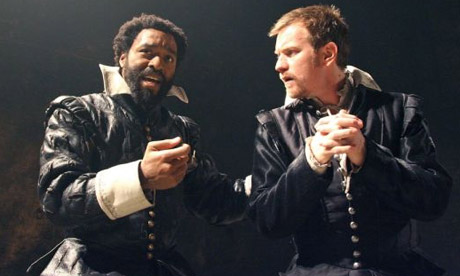
Playing Othello here is Chiwetel Ejiofor, who starred as Solomon Northup in 12 Years a Slave, one of last year's best films. Iago is portrayed by Ewan McGregor, who played Obi-Wan Kenobi in Star Wars. Type 300+ words on a specific time (one day maximum) in your life that included a lot of connections to the action or themes of The Tragedy of Othello, the Moor of Venice. Include a couple more specifics than you're used to sharing. A sort of "confessional" task, perhaps. Why not? You have but a month left of high school...to heal, connect, forget, remember, solve, resolve... (No, this task cannot be like the others.)
OR
Discuss statements on the Othello Anticipation Guide in 300+ words. Why do you dis/agree with them?

83 comments:
Stensrud 5
The play “Othello” is fueled by jealousy. I believe Iago can represent many teenage females. Throughout the play it is evident that Iago’s jealousy is ruled by his insecurities, which causes him to act the way he does. Although Iago acts like a conniving lunatic, many high school girls learn to suppress their jealous emotions, and insecurities unlike him. Looking back at my Freshman year of high school, I find a different person than I am now. I was young, I worried about what other people thought of me, and often compared myself to people who I thought were “prettier”, “skinnier”, and “smarter”. Fast forward three years, and you will find a completely different person. I feel I am more independent, confident in myself, and am not afraid to voice my own opinion. I was riding in the car with my mom one day, and like always she began to rattle off different pieces of random advice. I learned that being hard on myself and letting jealousy and insecurities get the best of me would never allow me to be happy. Just as Iago is jealous of Othello, I to was jealous of other people, and was constantly comparing myself. My emotions Freshman year are probably comparable to most teenage girls at the time. I can’t say now that I’m never insecure or jealous, because that would be highly inhuman of me. I have learned over the years however that surrounding yourself with the right people can allow you to freely express yourself. Losing insecurities also comes with age, it’s amazing what four years can do. Although my mom’s random advice can often be annoying, and corny, it often helps me through many things. Unlike Iago, we must learn to love ourselves, and surround ourselves with positive people to help eliminate jealousy and other hatred within our lives.
Murtha 5
I believe that we can all learn from the play, The Tragedy of Othello, The Moor of Venice. If Othello would have trusted Desdemona and his friend Cassio he would not have ever believe the lying Iago. Trust is a big part of any relationship: family, friend, or love. I have lost friends in my four years of high school due to a lack of trust in our relationship or the trust we had became lost in the business of life. As young adults we often become surrounded by gossip and trust is broken. With one slip of my tongue my junior year I lost one of my good friends. One little sentence cost me a friendship. The trust I had built up with this person was now broken. I know now that it will never be rebuilt. Othello lost trust for Cassio because of gossip; gossip that was not even true. This play that we have been studying should really emphasize to us as we depart for college and the rest of our lives that trust is very important to any relationship. Trust in Othello’s case was life or death. In a less dramatic case (the majority of our lives) trust can be the difference between happiness, laughter, memories and complete and utter loneness. Relationships may come and go due to things we won’t be able to control like going off to college and the distance, but it is silly to lose someone because trust has been lost. These four years have really showed me that being trustworthy is a very important trait to carry in life because with trust life is a like a big playground. You can cut up your knee due to a little fall, but you will always find time to laugh and smile while on a playground.
In many ways, readers of any age at any time period can relate to the events in Othello’s tale. Not to say that all—or even most—have listened to a liar that convinces them to kill their wives, but the emotions and the attitudes of the characters are all too well known.
Even though we wish he didn’t, I feel as though Iago is quite similar to everyone. Iago is jealousy and knavery personified. Every time anyone acts out of jealousy or to create mayhem, they act in the ways that Iago would. He does everything he can to be the best by making other people look bad.
No one probably wants to admit this act, but most probably could. I know that I can. I have acted out of jealousy and the want to be the best, luckily my actions never left four people dead on a bed.
Especially looking back to when I was a child, I can see many instances in which an action was made out of jealousy. I feel like this happened a lot with my brother, and many of the actions were reciprocated. In the scene where Iago tells Othello of the fight between Mantano and Cassio, Iago spins the details of what happened to benefit him. I can think of times when my brother and I would get in trouble by our parents and when asked to explain what happened, I would tell the truth…just in a way that made me look less guilty than my brother. This is like what Iago did. He told Othello part of what happened, but in a way that left him out of the chaos and put Cassio in a bigger role of it than he really was.
Every time we act out of jealousy, we relate to Iago. Every time we only listen to some of the details of a story, we relate to Othello. Shakespeare did a very good job at making his play connect to all ages.
Kruse 1
A major theme in Othello that nearly everyone our age, and even older and younger, can relate to is the theme of identity. Throughout the play, everyone’s identities change. More specifically, Cassio has lost his reputation, and part of his identity along with that. His status made him who he was, and when Othello took that rank away from him he lost a huge chunk of his identity. The things we do define us. Cassio’s work defined him, a lot like how students’ identities are determined through their extracurriculars. I think all students struggle with identity at some point, and upholding a reputation. Many keep up a facade, and others are more genuine. I personally struggled most when I first entered high school. I was a great distance runner, and I think that if I had continued to compete I would have been a completely different person--different friends, interests, and scholarships, too. However, my ankles were not strong enough to keep doing the sort of running I loved, so I chose to enter into the performing and visual arts instead. I am very glad that I did, because it has shaped me into a person that I am proud of being. There have certainly been times where I have wondered about my identity, and even wanted to change it, but I know that I am who I am. (See what I did there?) There arts have given me a second family that I have really connected with, one that I may or may not have had if I had been more involved with Track and Cross Country. My reputation has been built up, and I do not intend to lose it like Cassio did his. My identity has changed throughout the years. I have become more outspoken--confronted conflicts with courage. All of this change in identity so that I could become “me.” Fortunately, I feel that the changes have been for the better.
Anderson 5
There are many different actions and themes that seem to happen in “Othello”. There are some that can make connections to times and events nowadays. One of these themes I found has happened in my life, was how Desdemona felt when Othello was mad at her. She did not know how to react when Othello yelled at her for what she thought was no reason at all. She did not know why he was mad at her; it was a mystery to her that she could not solve. This feeling of unknown anger has occurred many times in my life but there is one that sticks out the most in my mind. It happened when I came home from school one day when I was younger. I did not think I had done anything wrong; actually I was sure I had not, but my little sister was so mad at me she would not even look at me. She just ignored me the whole night. I continued to ask her what I had done wrong, but no reply. I was in a state of confusion, just as Desdemona had been in with Othello. This confusion begins to make you feel as if you did something wrong but you cannot figure out what. For me, this confusion did not end until the next morning when I woke up and my little sister was perfectly normal. She talked to me just as if she had not ignored me the whole night before. I still have not found out why she just randomly ignored me that night. For Desdemona, the confusion and guilt of feeling like she had done something wrong ended in death, so she too never had the chance to find out that she had not done something wrong. This is just one example of how the actions in “Othello” can still be seen today.
Zahn 5
I think that we can all relate to the Tragedy of Othello, the Moor of Venice in some way shape or form. We have all been jealous of something or someone at one point in our lives. We have all trusted someone and because of it, it turned our lives upside down. If Othello would have believed his wife in the first place that there was nothing going on between her and Cassio, this whole mess could have been avoided. Trust is a huge thing in relationships, whether it be a friend, family, or love relationship. Trust is vital. If there is lack of trust in a relationship it most likely will end soon. The things we say or do can cost us sometimes. When we gossip or talk behind someone who we call a friend, you might not think so, but it will come back to that person who are you talking about. After you lose that person’s trust, sometimes its hard to rebuild what you had before and the person may not trust you anymore and they have the right not to. Jealousy in this play is another thing we can relate to. Iago was so jealous of Othello that his hatred towards him was so deep. His hatred and jealousy lead him to act before he thought it through carefully. I feel like a lot of teens are also this way. I have been guilty of doing something just because I was jealous. Jealousy can get the best of anyone but you have to learn how to deal with it rather than just to act through it right away without thinking. If you take nothing more out of The Tragedy of Othello, just remember to think before you act. Don’t be like Othello and not trust your wife, who you’ve vowed to love. Don’t be like Iago and let your jealousy take over you. Think and learn to trust yourself and the people you love.
Arens 2
In Othello a common theme is manipulation. Everyone has manipulated someone or something at least once in their lives. Iago manipulates someone almost everyday in this play it seems like. He makes Othello believe that Desdemona has cheated on him with Cassio without any real proof. Iago is so deceptive that no one knows if what he is saying is true or false. This theme can relate to teenagers and young adults in many ways. Teenagers deceive and manipulate their parents everyday. They may lie about where they are or even have others cover for them. Just like Iago planned out every scenario that he manipulated, teenagers plan out what they are going to say to their parents before they even know exactly what they're going to do. I can remember one time when I was going to go to one friend's house but I didn't want to tell them who so I told them that I was going to another person's house. I thought I was a BA and I believe Iago did too, until he got caught in the act and was killed.
Another theme I find in Othello is jealousy. Jealousy is a very strong feeling that causes people to sometimes do what they know is wrong but do it anyways. Iago is a great example of this, he knows lying to Othello is wrong but he hates Othello so he is going to do it anyways. As a teenager I experience jealousy all the time, except I don't deceive people the way that Iago has. I can remember a time I was very jealous of one of my friends. It was a really stupid thing to be jealous of because it was over a boy. She had pretty much worked her way into our relationship so she was the more important one to him. He cheated on me with her and I was very jealous, I just joked around with her and tried to make her feel bad but it didn't work.
Both of these instances I have spoken of were all the same day. I lied to my parents and then caught those two talking to each other about their relationship. Similar to Iago, I have committed these same "crimes" because of jealousy and manipulation.
Martinmaas 2
In The Tragedy of Othello, the Moor of Venice, Othello put his trust in the wrong person: Iago. He was able to be tricked by Iago’s lies because he didn’t have enough trust in his own wife, Desdemona, or his good friend, Cassio. He assumed that everything he heard from Iago was true, without even asking for Cassio or Desdemona to explain themselves. If Othello had reacted differently to Iago’s gossip instead of reacting rashly, he could have been able to fix his unstable relationships. This relates to a lot of relationships today, whether it be romantic or between friends and family. Trust can be broken easily through lies or gossip. A lot of people act on the gossip and confront the other person before hearing the other person’s side of the story, like Othello did in the play. Othello also chose to trust the wrong person, Iago, over his own wife which happens in relationships today. When I was younger, I was like Iago, and would use my sly techniques to get my brothers in trouble. My parents would trust me over my brothers because I never caused trouble and was the youngest. If we began fighting or something happened, my parents would always ask me how it all started and whatever I said they would believe. At the time it was a good idea but sometimes my plans would backfire on me like Iago’s did and I would end up being the one in trouble. I think the play is also pointing out that we should be careful who we trust too. Iago seemed like a honest and loyal friend but in the end he turned out to be Othello’s enemy who destroyed his relationship with his wife and Cassio. The play may be saying that trust is important but also the people we allow ourselves to be surrounded by are also vital in strong relationships.
Bingen 7
While I was going through the anticipation guide for Othello, I realized that there were several statements that I had strong opinions about, but I found that one particularly stuck out to me. Specifically, I found that I strongly disagreed with the statement “Dads should protect their daughters ruthlessly.” This statement reminds me of the stereotypical overprotective dad intimidating his daughter and her new boyfriend at the front door with a shotgun, which seems totally ridiculous to me. Often, dads will claim that they know what teenage boys were like when they were kids, and that they want to protect their daughters from that. Not all teenage guys are jerks like such dads would like to believe, however. Obviously, I cannot speak from personal experience, but I think that if you raise your kid right, you should not have to worry about who she brings home because she will not waste her time with anyone who does not qualify as a “nice guy”. Also, I think that it is possible to be a loving parent while still allowing your child to experience real life and the challenges that it brings. These experiences are vital to personal growth, and whether dads like it or not, they have to learn to let their daughters figure some things out on their own. If dads do too many things to protect their daughter, they are also holding them back from reaching their full potential. Also, if this type of paternal behavior is so common between fathers and daughters, why is it not reciprocated between mothers and sons? Sure, moms want to protect all of their kids, whether it be a son or daughter. However, a mother ruthlessly protecting her son from the behavior of teenage girls that she knew when she was young is very rare. Sadly, I think the root of this behavior comes from the fact that women are still seen as inferior to men in modern society. Whether they realize it or not, many dads feel that, being women, their daughters are so incapable of protecting themselves that it is their duty as fathers to do it for them. This behavior can only be described as egregiously sexist in every sense of the phrase, and, therefore, a change needs to happen.
When I think of the play Othello, I think of absolute drama that creates chaos. It is amazing how much damage one single person can do. Iago is truly the perfect villain—he seems to be all-knowing to the characters and uses this to his advantage. For some odd reason, everyone in the play turns to Iago to solve their problems; when in fact, it is Iago who is causing them all out of his own selfishness and vanity. He believes he is far more deserving of Cassio’s rank as lieutenant, and I’m sure he believes he is also more deserving of even Othello’s rank. So, he will do whatever he can to get the positions he wants. I don’t think there is even one person that Iago likes in the play. He hates all of the characters and he uses them for his own benefit. He is a cunning actor; he easily convinces everyone that he is trustworthy and dependable. Iago reminds me slightly of one person that I have grown up with at Brandon Valley. She was cunning and manipulative; a truly toxic friend. But she was so shrewd with her behavior that I continued to believe that she was a good friend of mine. Of course, this was back in middle school—when I was much more naïve than I am now. Yes, the drama-filled days of middle school. That is one thing I will not miss. She was tricky and very self-serving. She only had her own interests in mind, and did not care for the “collateral damage” that she caused along her pursuit. And she was manipulative. She would leverage any power she thought she had among our group of friends to make everyone turn to her for support. She’d tell lies about me and others to other people to gain support from those people. I had an inkling this was going on, but I didn’t make the move to ditch that toxic friend right from the get-go, and that was my fault. I ended up getting burned for it, however. She taught me valuable lessons about friends, and so her awful behavior actually created something positive in my life, ironically.
Pearce 1
Othello is a play that is famous throughout the world. One reason for that is the themes that come from it and how relatable these themes are. One of the biggest themes in this book in jealousy. Jealousy is a very relatable thing as everyone experiences it at some point in their life and more than likely everyone experiences it multiple times in their life.
One experience like that in my life that sticks out to me is when my twin sisters were born. I was in first grade at the time and had been an only child all my life. While it was a great thing to have a sibling now--two to be exact--I was also jealous of them. Up until that point in my life, all of my parent’s attention was directed towards me. I was an only child so I received attention from both my mom and my dad everyday. When my sisters were born, things changed. No longer was I an only child. No longer was I going to be receiving all of my parent’s attention--something a first grader really wants, especially when they have had it their entire life so far. Being twins, my sisters took up all of my parents time, and then some. My life changed when this happened. Yes I was only six years old and I didn’t know much or do much, but I no longer had the complete attention of my parents, and I didn’t like that. This made me jealous of my sisters. They took all the attention that I felt was meant for me and took it for themselves. I distinctly remember at one point in elementary school we had to write about an event in our lives that we wish we could change. And I wrote that I wish my sisters weren’t around. That was what I felt at the time, because I was jealous of my sisters. Looking back at that now I see how stupid I really was and I 100 percent regret writing that. That is one way that I can connect the play Othello to my life.
Smith 2
For the most part my life seems very uneventful compared to the tragic lives of Desdemona and Othello. Although as I have gotten older my parents and I have not been getting along as we used to. I have been trying to branch out and do more things with my friends, and this seems to be an issue with them. I can relate to Desdemona in her struggle to gain a life separate from her father. I think it is equally hard as hard for my dad to let me go as it was for Desdemona's father. Although I am not trying to run off and get married. For example, a couple of weeks ago a group of friends and I went laser tagging. A very harmless activity. Even though I had told my parents that I would be coming home later than my curfew they freaked out. Both of my parents were texting my phone continuously. Our laser tag session went from ten p.m. to twelve p.m. We had also planned on going and getting good after our games. My parents were aware of where I was, and who I was with, and should have not responded to the situation as they did. When I got home that night my dad was waiting for me. Like Desdemona's father he was very upset for me not being home. He continued to yell at me as I walked downstairs to my room to get ready for bed. His yelling reminded me of Desdemona's father publicly disowning her. I can relate to her with her sadness she probably felt after that. When my dad gets mad he just tells you how disappointed he is. For me that is almost worse than him yelling. I am such a daddy's girl too that it is almost painful. I can't imagine my dad telling my husband that I would be unfaithful to him. That would hurt me so much.
Dreyer 2
Sometimes there are people in our lives that are not who we think they are. People who we think we know, but find out that they aren’t the people they used to be. Its very common to have different friendships throughout one’s life. Maybe its moving to a new school, having a friend move away, or just simply growing apart. Sometimes you may even know this person for so long, you cannot believe things would ever change, but they change, you change, and you figure out what is really important to you. The day I realized my best friend from kindergarten and I were no longer connected anymore went a little like this. We changed.
In Othello, the characters do not know the true side of Iago. He seems honest and kindhearted on the outside, but is conniving and deceitful on the inside. He plots against the other characters in the play, giving them no notion of what he is actually up to. In the end, when they figure out Iago’s evil plan, they are appalled. Appalled that such a reliable guy like Iago could perform such trickery.
We were best friends, my first long-lasting friend actually. All the way from scheduled play dates to teenage hangouts, we were together. We shared secrets and even had our life as best friends planned out together. As silly as it sounds now, we planned to both get married, but our husbands had be twins--then retire at the same time and live in adjacent nursing home rooms. I never thought we would be apart. But in the beginning of high school we began to grow apart, and one day I realized that we didn’t speak as much as we used to and we didn’t hang out anymore. She began to make choices I didn’t approve of and it just kind of ended. I am not resentful or angry with her for what happened, and I hope she does not think so. We both ended up where we needed to be and that is okay.
I am kind of a best friend type of person. My current best friend and I will soon have to face not being together every second of every day. For this I am afraid. I hope we do not change and grow apart. But I am sure we will not let this happen. As scared as I am, I know that we are both making choices that are right for our futures, and I have to trust that we will make our friendship last forever. The theme of trust in Othello applies here. Trust who you know you will trust you, and never let that trust be broken wherever life may lead you.
Van Egdom 5
The Tragedy of Othello fixates on the consequences of isolation. Othello, being differently colored, must face the complete solitude. Everybody—including his wife—refers to him as the Moor, which signifies the constant discrimination. Roderigo relies on Iago, but even Iago has nobody else. Iago views Roderigo as merely another pawn in his scheme. Roderigo will be killed by Iago, which depicts his true loneliness. In order to execute his conniving plans, Iago must distance himself from all others. Once they reach Cyprus, they are cut off from everyone else. All in all, most of the characters are thoroughly isolated.
I am an introvert. I get nervous if I have to talk to strangers. I do not like to talk in groups—which anybody in my class would know—I hardly talk during forums. Thus, throughout my high school career, I did not gain many friends. During senior retreat, everybody enjoyed themselves. Yet, I did not. Everybody had wonderful memories of high school with their peers. Yet, I did not. Everybody, even new kids, had friends at Brandon. Yet, I did not. Loneliness hardly bothers me anymore, just like it did not seem to bother Roderigo or Othello. I embrace my solitude. Writing short stories and listening to music elicits more satisfaction than talking to anybody at school.
I empathize with Iago, Roderigo, and Othello. Isolation causes destructive behavior. Iago skillfully manipulated all the other characters. Roderigo wanted to be Iago’s friend, even if that involved killing Cassio. Othello did not know better than to listen to Iago. These three characters would have caused less harm if they had a couple of friends. Iago would have seen the error of his ways. Roderigo would have someone to soothe his torment and lead him towards better activities. Othello would have discussed his marital problems. Isolation—although tempting—will only culminate in disaster.
Berberich 7
The story of 'Othello' can be tremendously related back to the unforgiving place of middle school. In the story, Iago makes up a ton of lies and spreads them wealthily around. In the school I went to, Iago was a very common person among the sea of students. There was over 500 of us, so regardless the roomer, each story was twisted bigger and bigger than the one before it. However, this one day sticks out to me particularly. I was getting on the school bus to sit next to my best friend when I tripped over another girls feet. I thought nothing of it-those type of things happen all the time. When I sat down in the seat, my friend would not look at me. I could not understand why. Then all of a sudden out of the middle of the silence shared between us, she started throwing insults at me. Blaming me for being an awful friend and saying that I had done so many horrible things. Defending myself, I denied everything that she threw at me. I was not a horrible friend, but the exact opposite! I was a great friend. I asked her where she gained all of these horrible facts about me. She said, "From Mallory, up front." The girl who tripped me walking in. I turned and glared at her. Why would she say such things about me? I had done nothing to her. After I heard all of this, my best friend stood up and walked up to the front of the bus to sit with the devil. There were little red horns protruding from her head.(Lago) The devil told my friend that I would try to deny everything that she would blame me of. I felt so awful, I wanted to cry, except for the fact I was on a bus full of kids. In the end, it was probably about two months later that my best friend apologized to me. She learned that everything she was told was a complete lie. For the longest time, my best friend refused to talk to the devil(Lago). This has been by far the longest forgiveness journey I have ever done. I have just recently forgave this horrible girl. This is going to sound cheesy, but I said happy birthday to her on Facebook. I hope that is the farthest I will forever carry that relationship. Like I said, there is a Lago in every middle school, egging on the wrong idea. They will always want to make people miserable and enjoy doing so. My forgiveness for her was difficult, but I knew it was necessary for me to do, to show that I am and will always be the better person.
When I read Othello, I see a tragic story of misplaced trust. Othello allows others to manipulate his thoughts and actions, while failing to recognize what is honest. He is blinded by superstition, and when he realizes what he has done, he cannot live with himself. On the opposite side, Iago is possessed by his own ambition and jealousy. He maliciously causes not only his own demise, but also the death of Othello, Desdemona, Roderigo, and Emilia. His confidence throughout the play places him one step ahead of everyone else. Everything he does is meticulously planned and carried through. However, his plan could not possibly have been to incarcerate himself, could it? Did he simply (rather uncharacteristically) lose control of the situation? We, as readers, are left to determine what Iago’s motive could have been and how any human can be so manipulative. We are also left hoping for a different ending, wondering why Othello could not see through Iago’s lies.
Based on my own experiences, when your trust is broken, sometimes the best thing to do is nothing at all. We will never know exactly why Iago did the things he did. No matter how hard we try or how many questions we ask, we cannot change the outcome of the story by simply wishing it never happened. Personally, I found myself in a situation similar to Othello’s. I can understand Othello’s pain as he realizes that every word, every promise he had ever been told was actually a lie. Feeling useless and cheated, you begin to hate yourself for being so easily deceived. However, time really does heal all wounds. As you forgive yourself, you start to forgive the other person as well. I no longer need an answer. It would just be another meaningless “because…” We cannot always justify others actions, only understand that much of the story is not ours to be read.
Wright 1
Whether some of us would rather convince ourselves that everyone is corrupt with jealously, while others simply believe they are nothing but an observer/victim of unethical "crimes". Neither individuals should (and will never) receive pity or sympathy from me. We all express envy passionately on a daily basis. Unconscious or aware, it is our human instinct to feel jealous of what others have, what we cannot bear, why someone looks more attractive than we do, how our body cannot physically mimic another, and so on... Perhaps my examples are a rather extreme. Take lunchtime for another illustration, reaching the table you drop the food tray and slam your gigantic (though no one would dare say it is truly bigger than it appears in your mirror at home) booty on a plastic chair. Automatically, your eyes begin to scan clockwise around the table noting every article of food on each tray. Reaching the tray beside you, God's gift is present in a golden wrapping: POPTARTS. Almost instantly feeling your brows scrunch together in anger, "Why didn't you see them when you walked by, Paige?! Gosh, you're an idiot. You deserve to eat the warm, chewy, outdated milk glaring straight into your black soul." Without knowing, jealously and envy arose in a minor situation. The Tragedy of Othello, the Moor of Venice, is a bit more intense than my prior reference. But nevertheless, when life or fate does not plan accordingly to our preferences and accommodate our own lives correctly, we attempt (and sometimes succeed) to modify fates-- though it may end in despairingly. The events are unfortunate for most of the characters, although all fatal mistakes and injuries could be replaced with love and happiness if lago was not selfish or exiled. The moral of Othello's tragic tale is if one knows another of lago's kind, either (a) take him/her to discussion group therapy four times a week while limiting the interaction with the humans he/she envy the most... Which is quite possibly the whole human race. Or (b) exile the individual to the vegetation island to live along side with Pi and Richard Parker. Quite positive that a tiger will fix, if not, destroy their behavior existence.
Love is the most powerful emotion--for it is the provider of all other existing emotions. From love grows jealousy, anger, joy, hatred, agony, fear, and trust. Though these other emotions can surely exist without the foundation of love, the most potent of these cultivate from the boundless care, relentless faith, and resilient attachment that is love. Shakespeare’s Othello encompasses numerous themes of love: Othello’s jealousy, Desdemona’s trust, Roderigo’s lust, Brabantio’s despair, Cassio’s honesty, and Iago’s hatred. However, there is one theme that is not plainly present nor openly focused on that continually tugs at my mind throughout the play: betrayal. Iago’s actions are sincerely pure evil—-and he intends for them to be that way—-but his wickedness must have stemmed from some existing emotion. Love-—but his love was betrayed.
It is a common event to be betrayed in life; after all, we are humans—-inconsistent, foolish, and ignorant at times. But when the betrayal comes from someone you love, it is overwhelmingly devastating—-of which I can personally relate to. I have a friend, one I truly love, who abandoned me. Though this personal betrayal was far more complicated and far more deserving, Othello’s betrayal to Iago is very similar. Friends in war, comrades at heart, Othello did not choose Iago as lieutenant but Cassio—-an outsider. His abandonment triggers Iago’s love into madness, insanity. From this loving madness, Iago builds hate and disgust, and then evil. My friend’s betrayal did not drive me to evilness but rather to sorrow, for one person’s passion of love is never quite the same as another’s.
From all of this, I think one thing is certain: love creates the most passionate feelings, no matter which direction the emotion may take. After my friend’s betrayal, I found myself hating him for it. But how could I hate my friend, whom I still care about? Well, I think it is simply because it is only emotionally possible to hate someone that you love. To have such passionate abhorrence for someone, I must care enough to let him occupy my thoughts. And so, Iago must have loved Othello to have hated him so obsessively, intensely, and passionately.
West 1
The statements on the Othello anticipation study guide were all thought provoking. For almost all of them, I had to stop and think about both sides of the statement. This being said, there were a few that stuck out to me
I disagree completely with the statement “race will always be an obstacle in marriage.” The older generations are comprised of the racist people. My generations grandparents and older are the people that are most racist, my generations parents are the people that are only slightly racist, and my generation, from my experiences, are barely, if at all, racist. I believe that the generation below mine or the generations soon after them will be not be racist at all, so it will obviously not be an obstacle in marriage.
“War can bring out the best in people.” I agree with this statement. When people think of war, they think of devastation and horror. The think about the killing and destroying. But there also is much helping and saving. War could easily bring out the best in a soldier. He could risk his life trying to save another soldier's life. There is nothing more a person could put on the line than his life.
I agree completely with the statement “Most people are followers, because it is much easier to follow than lead.” It says it all. Good managers, captains, and leaders are valuable and hard to find for a reason--most people are followers. I would even take it a step further by saying almost all people are followers.
“The power of the pen will always be overcome by the power of the sword.” This is another statement that I agree with. The pen can write laws to ban weapons, but weapons enforce that law. So if it was the pen versus the sword, the sword will always win because the pen can not enforce the law.
Hindbjorgen 1
I intended to write about a connection my life had to Othello, but it seems there are very few connections between the “Life of Annika” and the “Life of Othello.” Other than the fact that I have dated a black man (which no one seemed to care about), I have never been deceived, jealous, or murderous in a relationship--especially considering that I have only dated one person. With that in mind, I decided to write about a statement from the anticipation guide. I was raised Christian, and am very strong in my faith--therefore, I have strong opinions on a few of the statements on the anticipation guide. The first statement that stood out to me was “Seeking intimacy outside a marriage is only a natural, instinctual behavior.” I believe this is utterly false. God created humans, and gave us laws to follow. Humans are to remain celibate until marriage, and then stay loyal to their spouse for life. Of course, Satan tempts us with lust, jealousy, and greed--but that does not make seeking intimacy outside of marriage natural or acceptable. In Othello, Desdemona is amazed that a person would ever cheat on a spouse, but Emilia believes confirms it, as she confesses that she has been with other men while married to Iago. I don’t think it is an instinctual behavior, as humans mate for life--as do several other species of animals. Another statement that caught attention was “Most people are followers, because it is much easier to follow than lead.” I believe this statement is both true and false, varying on what is being followed. Many times, being a follower is just as difficult as being the leader, as one must be agreeable and stand up for what the leader believes in. In biblical times, Jesus was the obvious leader, and his disciples were the followers. Did the disciples live an easier life than Jesus? Jesus undoubtedly lived a difficult life, and was eventually crucified for his beliefs. To be a follower of Jesus was possibly just as hard, or even more difficult, as many of them had to give up everything they once knew and risked their own lives. Many of them were killed just as gruesomely as Jesus. I wouldn’t go as far to say that it is harder to be a follower than a leader, but I would attest that both roles are equal. Just as the term leadership exists, the term “followership” also exists. Reverend Paul Beedle defines it as “a discipline of supporting leaders and helping them to lead well. It is not submission, but the wise and good care of leaders, done out of a sense of gratitude for their willingness to take on the responsibilities of leadership, and a sense of hope and faith in their abilities and potential.” Without a leader, there would be no followers; without followers, there would be no leader--the roles are of equal importance. Having immense faith in someone or something to follow can be very difficult. Barbara Kellerman once wisely stated, "Followers are more important to leaders than leaders are to followers.” Her quote holds truth, as neither can exist without each other.
Grage 2
Important material gifts are essential to a relationship’s success.
I believe that material gifts should not be essential in a relationship’s success. People shouldn’t have to buy their loved ones gifts just because they feel like they have to but because they want to and feel like their partner would be excited to own this gift. A relationship is based on your compatibility and happiness with one another not who can buy each other the most expensive gift. Instead of buying your spouse/partner a gift you could put more thought into it by making memories instead and taking them out on a well thought out date that suits their personality and passions. Most people in a relationship should prefer to spend more time with you and less on the gifts they possess from you. Love each other not the gifts they provide.
Seeking intimacy outside a marriage is only a natural, instinctual behavior.
I disagree with this statement. I think that if you are not satisfied with the person that you promised to be with for the rest of your life that you should get a divorce. You should not want to seek out other people once you have found the love of your life. They should be everything that you hope for and need to be happy. You shouldn’t want to go seeking other people for satisfaction when the person that you love the most should be pleasurable enough for you. If you have a natural behavior to look at other people and not only look but desire to be with them then you should either control yourself or tell your spouse about what you are going through. When you swear to you spouse and read them your vows you should know all of the strings that are attached to them. Including adultery.
Marais 1
Jealousy is among the core, innate human emotion. We can’t help but get jealous. Think about it. When you look at some social media thing and look at your new feeds and see that someone has tagged your partner in a picture. You automatically go look at it. You get a little bit upset many be angry. Why? Well that’s the glorious thing about jealousy. It is possible that you might feel jealous – jealousy is broadly defined as the response to a real or imagined threat to a relationship, whereas envy is the desire for another’s possessions - after all, seeing your partner with an attractive rival is one of the main triggers of jealousy. But is jealousy like salt in your water that you drink?
I don’t believe that it is necessarily a bad thing. It helps us keep our partners because we become more attuned to potential threats to our relationship. A partners jealousy can been seen as a sign of love or affirmation of commitment. However, a little jealousy might be alright at remind our partner that they don’t want to lose us, but too much jealousy seems to be bad for relationships. Jealousy is more often associated with arguments, breakups, and aggressive behavior, and when we feel jealous we may question the level of commitment in our relationship.
A little jealousy can remind us that our partner is important to us and that we value our relationship with them. But, more often, jealousy seems to be associated with relationship displeasure, feelings of insecurity and conflict. Most important, it seems that the degree of impact that jealousy has on our relationships is strongly influenced by how we respond to feelings of jealousy. Othello should of confronted Desdemona and told her what is going on instead of taking action and destroying the person who loves him the most.
Shakespeare's Play “Othello” deals a lot with the themes of honesty and trust and how they can easily be broken or how one can easily be mislead. In this case, honest Iago is the instigator while Othello is part victim but also part mislead while being blinded by the lies Iago puts into his mind. I have experienced a situation in which these themes can be found and compared to “Othello”. Two years ago I would consider myself the stereotypical, naive, young teenage girl who had “fallen in love” for the first time. Yet, my boyfriend at the time, was not liked by my parents or any of my family/friends. No one trusted him and no one could understand why I was with him; they thought he treated me horribly. But like Othello, I was blinded and could not see what my family saw. Yet, they were right and I was wrong. The day started off like any other day, I had to work and so did my ex-boyfriend(we worked at the same place). My shift had gone well until he came up to me and told me he thought he was going to be fired. I asked him why which he responded by taking me up to the office and showing me a note he had found in one of the money bags. The note read, “Whoever is reading this now, will be fired.” Apparently one of the employees had previously stolen money and the owner had placed this note to find the offender. When my ex read it, he immediately thought he would be fired. But he told me I had to believe him, that he would never take money from my family’s business, and then blamed it on another employee. I, being naive, believed him and immediately spoke to my family about what had happened and that there was no way he could have done such a thing. Turns out, I was wrong. A hidden video camera, set up by my grandpa, revealed that my ex-boyfriend had indeed taken money from the money bag, as well as my family. I was devastated and heart broken. I felt stupid for not listening to my family and for believing him. It was an awful experience for me to go through but one that taught me various lessons. My ex can be compared to Iago for being dishonest, disgusting, and wrong. He manipulated people and told numbers of lies in the same way that Iago does. I can be compared to Othello because I refused to see/accept the truth until it was thrown in my face and pain had already been felt. My family/friends can be compared to Desdemona as they were the victims. They had to suffer through their own pain but also watch me go through mine. The most important lesson I learned from this however was trust is not freely given, it must be earned; and once lost, it is even harder to gain back.
Elizabeth Bowen once wrote, "Jealousy is no more than feeling alone against smiling enemies." This simple statement sets a perfect scene in our minds of what jealousy feels like; Others are happy, overtly joyful or secretly mocking, while we are left alone to look like a fool. However, what drives us to feel jealous and suffer over this stirring emotion isn't always the "smiling enemies" we formulate in our minds. The "sexy secretary" and "ex-girlfriend" are rarely the threats we think they are, but the overwhelming, possessed state of suspicion we enter because of these characters, can be a real hazard to our closest relationships. Othello really speaks to me, not because of his violent end, but in how he was driven mad by his own mind (sure, Iago helped). Jealousy itself can take on a sort of wicked presence in our lives. Jealousy isn't something we have much control over. In truth, it is a natural, instinctive emotion that everyone experiences at one point or another. The problem with jealousy is that it masks other feelings and attitudes that are even more hurtful to us and those closest to us. Its intensity is often shielding deep-seated feelings of possessiveness, insecurity or shame. I believe that what lies at the heart of jealousy very often isn't the threat itself, but a drive we have within us to torment ourselves and berate ourselves with self-critical thoughts. Perhaps Othello was insecure -- he believed he wasn't "as good" as smart, white, good looking Cassio. This negative self-coaching accompanies us into our personal relationships and instills in us a level of doubt and criticism that keeps us from perceiving ourselves as truly lovable. It reminds us to be suspicious with thoughts like, "She doesn't really care about you" or "You can't trust him. Just keep him at a distance."
I think all of us have had to deal with a “Iago” at some point in our lives. Most of us recall a person who always seems to pit people against one another and make the worst of any situation. Such individuals can have a variety of motivations for starting unnecessary drama or conflict. Some do so out of their own insecurity or jealousy, and destroy good relationships that others have simply because they will not be able to experience them. Others pull the strings because they feel the need to be in control of something. Having the ability to destroy someone’s life or friendship is an opportunity most power hungry people will not turn down. However, some people misuse their influence and intelligence simply to “watch the world burn.” These people are purely destructive and are by far the most dangerous types of manipulators. In Othello, Iago does not display any clear motive. Some would say it is monetary due to his work with Rodrigo, but many of his other schemes provide him with no monetary gain, while bringing maximum damage to his victims. I believe that Iago committed his crimes purely out of his own destructive nature. Despite having every opportunity to amend for his sins and nowhere near enough cause to justify his actions, he saw his destructive plot through to its bitter and deadly end. People like Iago live in our world today; some of them are obvious instigators, while others mask themselves in truth and good intentions much as he does in the play. The only way to combat such cunning people is with the truth, and with trust. If we lie ourselves, then we are just as guilty and only bring about further damage. However, telling the truth does little good if we do not trust one another. Know who your friends are, believe in them, and ask that they do the same of you. When combined with trust, honesty and truth can prevail against even the most cunning deception.
At some point in each of our lives, a dispute has aroused with one of our siblings. Growing up with a younger brother, countless disputes occurred over the past 16 years. Most of these fights were over trivial things. Just like Cassio and Montano fought over their dispute with swords, Andy and I would settle our fights the same way (with much more dull and flimsy weapons). I would scavenge our weapons box for the best shield and sword first because I was the oldest. Andy would pick after me and scrounge up whatever he could find. After we had found our weapons, we would then commence to look for the best armor: chest plates, helmets, and leg pieces. We would venture to the basement and the fight would commence. The first one to get “stabbed” would lose. Naturally, I would win because I was two years older and much bigger than he. After the battle, there would be some hard feelings, but these would subside after a couple hours. Looking back on our battles now, I see many similarities to the battle of Montano and Cassio. These two, who had been on great terms just moments before, turned rapidly into enemies. After everything had settled down they were back to being friends again. Their fight was started over virtually nothing and quickly escalated to injuries to both the body and reputation. Although our fights never resulted in any injuries, they were still fierce nonetheless. Although violence is usually not the answer, I believe males will continue to solve their problems just as Andy and I did, just as Montano and Cassio did, and just as all males have been doing for millions of years--through fighting.
Ode 5
While I was reading through the Othello Anticipation Guide responses, I found that I had stronger opinions about some statements rather than others. One response that I wholly agreed with was that Italy is the most cultured, gorgeous country on Earth. I think that Italy is by far the most gorgeous country in the world. There are many historic cities in Italy -- Venice, Rome, Florence, and Milan. There are few countries in the world that have cities nearly as beautiful as these let alone four. Italy also surrounds Vatican City. Vatican City is the smallest country in the world with its area accumulating one-hundred ten acres. This is very small considering that Thomas Jefferson’s acreage, Monticello, was five thousand acres. I specifically think that Florence is gorgeous. Florence was the birthplace of the Renaissance. The Renaissance was a rebirth of the arts, essentially. The Renaissance brought beautiful art, architecture, and literature, and Italy was where it was all happening. I wish to one day visit Italy and tour to its most historic landmarks. Another response that caught my attention was if you go to plays in Sioux Falls, Corson, Worthing, BVHS, and elsewhere, you will learn a lot about the world. I think that if you go to only these local places you will not learn much if anything about the world. You must go places far from home to learn about the world. Even in America there are differences in small things that effect how you view the world. If we lived Africa we would not view the world through the same lens as a senior football player from Brandon, South Dakota. I would not want to go to anything in Corson because I would be afraid of getting shanked by one the ruthless Corson Cutthroats.
Baum
There are many lessons to be learned from The Tragedy of Othello, the Moor of Venice. Throughout the play there are many scenes where Othello lacks trust with Desdemona. I believe trust is a key part in any relationship. Along with lack of trust, jealousy plays a major role in the downfall of Othello. I can more easily relate to the jealousy side of things rather than lack of trust, as I have always been one to believe what others tell me. Middle school was a time where I not only had low self-esteem, but I was also dealing with false friendships. As high school came along the pressure to be “perfect” or “pretty” became more prominent. I would constantly compare myself to other girls, mimicking what they wore, or how they acted, so I too, could be seen as one of them. I remember going home one day after school upset because some immature guy made a rude comment to me about how I looked that day. My mom, being the consoling person she is, helped me through it by giving me advice I still remember to this day, “people will tear you down Jen, they do it because they can. They feel more powerful by pointing out other’s flaws because they are insecure about their own. Just remember that these people are not the ones you want to aspire to be. Use them as an example of what not to be. Once you have confidence in yourself, no one will be able to take that away.” It took a while but I finally gained the self-confidence my mother always talked about. Since then I no longer let other people’s opinions affect me. I still compare myself to others but not in the way I used to. I realize everyone was created differently for a reason. Unlike Iago and Othello, I have learned to not let jealousy consume me, like all men and women should.
Presler 2
On the anticipation guide, we were asked in one question whether we agreed or disagreed with the theory that most white people could outsmart most black people. I wholly agree with this statement. Do not think me a racist though. I also wholly agree with the reciprocal idea: that most black people could outsmart most white people. To reach this conclusion, merely consider the vaguery of the statement; specifically, consider the importance of the word "could" in this context. The statement does not use the phrase "would typically" or "would often tend to," but simply "could," which suggests that under some particular circumstances, most white people could outsmart most black people and vice versa.
To further view this point, imagine first that you are on vacation in an African country where little English is spoken, and you know nothing of the native tongue. The odds are quite good that any local vendors or merchants could potentially cheat you as you purchase food or other necessities. Now imagine that a native African with no knowledge of the English language or culture comes to America, alone and with limited resources. Surely, even some of the dullest white Americans could use their knowledge of the language to "outwit" the inexperienced African. As a side note, likely the best fuel opponents would have against this theory is whether or not knowledge of native tongue is considered wisdom; in my view, even though almost everyone speaks some native tongue and learns that language usually without excessive strain, such knowledge can still be deemed "smarts." Hence it can be used to "outsmart" someone who does not know the language.
Since the vast majority of the world's black population resides in Africa, and a significant fraction of that populace speaks no English, we can safely theorize that most white people could outsmart most black people. Correspondingly, since an even more significant fraction of the world's white populace speaks no African dialect, we can even more safely theorize that most black people could outsmart most white people.
Kramer 2
Throughout Othello we can collect the common theme of jealousy. More importantly, I picked out what jealous leads towards--a competition in rank. The competition is fueled by jealousy but deployed by manipulation--another common theme in Othello. Iago is the prime example of such schemes--he lie to Emilia, Cassio, Roderigo, and last but not least, Othello. Iago becomes jealous of Cassio’s rank as lieutenant; therefore Iago develops a complex theme to knock Cassio out of his position thus earning him a promotion. Iago manipulates Othello, who seems to trust him the most, by getting him to believe Desdemona’s infidelity with Cassio. Iago also causes various acts of manipulation such as the drunken brawl, alerting Desdemona’s father of the wedding, etc. Roderigo is swindled out of his money by pursuing his love and confiding in Iago. All in all, we can see that Iago manipulates those who trust him the most and invest the most into his lies merely for his own benefit. This competition for rank created a distaste in trust all because that little green-eyed monster.
Teenagers can easily relate to this--it seems as if our entire high school career is a competition. We compete for grades, reputations, athletics, etc. One I can relate to is the manipulation in order to achieve a meaningless social rank. I lied and “bent the truth” when telling my parents of my nightly plans. All for what? So my friends would think I’m “cool”? Or maybe just to know I could get away with it. Either way, I broke my parents trust for a night of fun, in hopes of maintaining a social image with my friends. In the end my parents found out and my friends didn’t think it was so cool I had to sneak my way around the rules in order to hang out with them. Just like Iago--Othello and all of his other victims eventually found out--putting an end to his schemes. I committed a form of social suicide that night, while Iago was sentenced to death for his actions and he took his own life.
Fritz 5
As a high schooler, I believe a lot of knowledge can be gained from studying the play, The Tragedy of Othello, the Moor of Venice. Trust and jealousy play a key role throughout the whole play, just as they do in every teen’s life throughout high school, especially girls. Walking through the halls, one can hear gossip of who did this and who has the best stuff. Lago, being the queen gossiper throughout, can be compared to many girls throughout any high school. He acts as Othello’s honest, right-hand man, when really he hates him; everything he does is for his own benefit and to ruin everyone else’s lives. Just last year, I learned for myself how these people work. They come in, acting like your best friend, while secretly tearing you down. By taking what you say, they twist and turn it into a false rumor and allow it to spread like wild fire, not caring about the consequence. At the same time they’re building up your trust, just so they can tear it down again. This is exactly what Lago did during the play; he gained Othello’s trust and falsely accused Desdemona of cheating on him. As we all know, this trust was later broken at the end of the play as Othello found out that Lago had lied. I believe every girl has once had a friend just like Lago, I did. At the beginning of junior year, a girl and I became very close. We were inseparable. She gained my trust and I told her things I had never told anyone before… Those things I told her soon came back to me, she had told. She took what I said and turned it around, making me look like a terrible person. However, it later got resolved and just like Lago, she became known as a liar. Both this story and the Tragedy of Othello, have made me question who I trust and have made me on a stronger look out for gossipers in the world.
Gingles 7
I once had the opportunity to compete at a wrestling tournament that would take two days to compete in. As is ritual for every day of competition, I made myself a bowl of Wheaties, but this bowl of Wheaties was not what it appeared to be. I woke up that morning after a good night’s sleep. It was only six in the morning because we had a long way to travel. I sleepily turned my loud and obnoxious alarm off. The floor was cold, as all hardwood floors are generally cold in the middle of December in the midwest. I stumbled my way to the bathroom, relieved myself, washed, and meandered into the kitchen for my breakfast. I opened the cupboard that contained the arsenal of breakfast cereal and found the Wheaties. I crossed the kitchen to the cupboard with the plates and bowls in it. I then found myself a good middle sized bowl from the cupboard and filled it with the flakes of multiple grains. My next task was to go to the fridge and find the 1% lowfat milk, but to my dismay, we had none. Skim was my only choice, but I needed my Wheaties to do well in the tournament, so I decided that it would have to do. The milk glided over each flake gracefully and saturated my cereal. I found our sugar shaker and poured a generous amount on the flakes, as the flavor of them alone is slightly bland. I plunged a silver spoon into my bowl and gathered a large scoop of cereal. As it went in my mouth, I realized that something was horribly wrong. Instead of the sweet taste of sugar on my Wheaties, I found myself with a mouthful of salt. I rushed to the sink and spat it out immediately.
I think that the salt, much like Iago, looks very promising, but can instead be very deceitful. I also learned to never store the salt and sugar shaker next to each other, since they are identical.
Tellinghuisen 5
Much like our unfortunate friend Cassio, as humans we are exposed to many unhealthy things. These sometimes become terrible vices. Rarely does an addiction or vice do good for anyone. Cassio’s vices may have seemed harmless, but if he didn’t have those—weaknesses—the issues of the plot might not have ever happened. Iago wouldn’t have had an alleyway to use Cassio. His lack-there-of ability to handle alcohol but still want to drink it, alongside of desires for the opposite sex contributed just as much to his fall from Othello’s grace as Iago manipulating everyone into chaos. The alcohol that Iago toys in front of him makes him very drunk and short tempered, leading him to pick a fight (after some persuasion from Rodrigo of course) with what I read to be a legend in Cyprus. So what choice did Othello have but demote him? I don’t believe he had one. During the same drunken event, we meet the lovely Bianca, who fuels Cassio’s second vice: Women. A night of bad choices, clever conversation by Iago, and Othello’s selective hearing makes Bianca seem like Desdemona. This is what almost gets Cassio killed by the heartbroken and extremely peeved Othello. If he would have never been so weak to these things could not have happened so easily to Cassio.
I know it seems redundant to recite this part of the play. One that I am sure you all know I have no doubt. However that is the point; us as high schoolers today unfortunately know a lot about problems like these that Cassio experienced. I myself have struggled with an unhealthy vice that led me down a bad road for the majority of the past four years. It is something I am pretty sure almost no one knows about. I feel it might have destroyed many opportunities that I could have had. With that being said, since then I have turned things around, and I have tried very hard to make my senior year the best ever. It has worked, and thanks to all of you guys for helping me do it.
Eigenberg 1
Throughout Othello, many of the characters are plagued by jealousy. Othello is jealous of Cassio, Roderigo is jealous of Othello, Iago is jealous of Cassio, and the list goes on. So it came as no surprise when jealousy was a theme in many of the statements made in the Othello anticipation guide. One such statement we were to take a stance on was “Jealousy is an extremely childish emotion.” I would have to wholly disagree with this statement. Although children can be easily influenced by jealousy, so can adults. Children get jealous over toys and games, while adults get jealous over vehicles, jobs, relationships, clothes, money, and other belongings. While what people become jealous over change over time, the fact that jealousy is a childish emotion is completely wrong. If it was a childish emotion, only a few adults would experience it, however this is not the case and every adult will experience it at some point. Thus making jealousy an extremely human emotion. Another statement, about jealousy, we were to disagree or agree with is “Jealousy is among the core, innate human emotions.” I completely agree with this statement. Since every man, woman, and child on this earth experience jealousy almost every day this statement must be true. Every day I am become jealous of other people’s belongings, friendships, and talents. No matter how hard I try, I cannot resist becoming jealous. Core human emotions cannot be stopped and controlled, so that is why jealousy is among the many other core, innate human emotions people experience. The last statement I will discuss that deals with jealousy is “there will always be people who start rumors/drama through talking and texting…” Although this statement doesn’t specifically cite the word jealousy, it can be implied that jealousy is the starting point of a lot of drama and rumors. Either someone is jealous of a relationship and wants to spread false rumors to end it, just as Iago did, or someone creates drama because they are jealous of what others have and they don’t. There always has and will be people who start drama and spread rumors, and I agree with the statement that it will continue to be that way.
John Bachman Pd. 1
In my handful of years on this planet I have experienced many of the tragedies and themes with Shakespeare’s Othello. The heartbreak of a betrayal of friends that can lay havoc upon your feelings. Or perhaps the embarrassment of being taken for a fool, tricked by someone you trusted. Summing up these themes into a composition with a time frame of one day is no easy task. However on my trip to Brookings last year for the annual physics competition, such a tragedy had taken place. The Engineering Expo, as it was also referred to, is held every year by South Dakota State University. It is composed of many different categories from which you may choose to compete. The event I had signed up for was a building competition, similar to the one we conducted earlier this year in class. Except we were not given the specifics of the structure or materials that would be provided, so the task was to be impromptu. Well as I was foreign to this competition and was an outsider in this competition of excellence; similar to Othello (who was not accustomed to the Venetian way of life), I began find allies that have perhaps participated in this competition years prior, and could give me some insight on possible tasks. One gentleman that I became acquainted with, his name was Alex, seemed friendly enough. He had similar interests as me and we commenced in conversation. Amongst the small talk, I he mentioned that he had competed in this competition several consecutive years in a row, and that every year the impromptu design competition was the same. The task was to build a bridge that could support various objects being rolled across. I had trusted this fellow with the livelihood of my aspirations in this competition similar to the trust Othello bestowed upon Iago. When the competition began, and I had already conceived a plan for victory, I noticed that Alex was also competing this year. They announced the competition to be a tower building competition instead. Alex had betrayed me, by feeding me false information that would distract me from his true intentions winning the competition.
When I immediately thought of my life in terms of comparison with Othello, I will be honest in that I was completely lost. I had no idea how I was anything involved with “The Tragedy of Othello, the Moor of Venice.” However, after quite a while pondering the topic I came to an understanding that it is not as much about the story itself as it is with events in the story. The story can be broken down into multiple themes and ideas, even messages in which are much easier to relate. For example, one key item in the story is that of jealousy. I think that everybody in the world certainly has a connection to jealousy. Jealousy has been a part of everybody’s life in one way or another, and everybody has been jealous multiple times in their life over either material objects, other maybe more successful people than themselves, or even a relationship. In Othello, Michael Casio is obsessively in love with Desdemona, who has unfortunately just married Othello the moor. I have been in this situation more than a few times, just as many others have. I think most everybody has had a time in their life when they have had a “crush” on somebody that is either seeing another person, or is in a relationship with another person. This works the same way with celebrity obsessions as well. For example when a young teenage girl is obsessed with Justin Bieber, but then he goes off and dates Selina Gomez, I can imagaine lots of death threats to both parties. Jealousy is an unfortunate part of everybody’s lives and it will continue to be since it is nearly impossible to get rid of.
Rykhus 1
To limit this to one simple day, one specific time in my life; that I cannot do, nor will not do. For I am Iago. Yes I will embrace the confessional aspect of this blog to the fullest and hope you will respect the privacy of what I have to say in here. In order to understand why I am who I am, you must first understand those who are around me. I was born to a good family, the last son of three, with a successful father and a wonderful stay at home mother. Now meet the characters, my brothers. Austin was the oldest, a classic case of ADD and Eventually a college drop-out who lives with us again (he is now back in classes). My other Brother, David, has mental disabilities; he has Cerebral Palsy and dyslexia, along with a case of poor impulse control. These characters where ripe for my manipulation.
Let me be clear, this is not a narrative complaining about my situation because I would never trade a second of it, but it has made me better person, and sometimes a much worse one…
I learned fast as a kid that I was as intelligent as my brothers, and what I made up for in strength, I always made up for in wit. It was never the younger brother who got blamed, because he was the one crafting plans of how to get out of this trouble we got ourselves into. I never got stuck with anything. Unfortunately looking back, I got out of some things on David, which he agreed too much like Rodrigo, or Othello when his mind was dulled by rage. I actually was admiring Iago during the first part of the movie for how brilliant his manipulation was I am not proud of what I did as a kid or the other countless times I have manipulated people for my benefit, it isn't right. For that I apologize. I strive to no longer embody the treacherous traits that make up the most heinous villain of all time. To no longer be Iago.
Lusk 5
Throughout Shakespeare’s play Othello, many themes are presented that can relate to everyday life in some way. Jealousy, for example. I do not know a single person that has never been jealous of someone or something in his or her life. We are seen in the play, that jealousy can be a corrupt characteristic. Iago was so jealous of Othello that he let it control his life. He lived everyday trying to think of a way to manipulate Othello’s life. Once he put in Othello’s head that Desdemona was having an affair, Othello went crazy. Another valuable lesson is taught here, Othello had lost trust in Desdemona because of Iago. He never let Desdemona even try to explain without him completely snubbing it. The jealousy that he had in him outweighed the trust that he had in Desdemona. I believe this is something everyone can learn from. Coming to the end of my high school career, I look back and notice how much I have changed as a person. In my opinion, I am now a better person due to my four years at Brandon Valley High School. I was able to grow and learn from the role models that were around me. Coming in as a freshman, I remember being so scared of what everyone else was going to think of me, and worried that they wouldn’t like me. I would be jealous of the girls that everyone loved and wanted to be friends with. I learned that if your jealous of everyone around you, then you will never be satisfied because will are only focusing on how your life could be better, instead of looking at how great it actually is. Trust is another thing I learned to appreciate in high school. I found it easier to trust someone if you give them a chance to talk and don’t just keep your assumption that someone else told you. Girls in high school can get very gossipy and once they hear something it spreads like a wild fire. I found the best way to understand what the truth is, is to not just hear the one perspective of what happened and not listen to anything else, but to hear all perspectives.
Ellis 7
When the English teacher passes out one of Shakespeare’s plays there is always a few sighs in the class, and maybe a vocal, “Uuuggh!” A friend of mine even threatened to burn her book. Contrary to popular belief, I find Shakespeare’s plays to be fascinating. I love the action, the old fashioned comedy, and the ornate language and because of all these assets, I believe Shakespearean sonnets and plays are extremely important to English literature. A study of Shakespeare belongs in every high school and every college, because not only do his plays provide a beneficial literature lesson, these plays become history, culture, and creativity lessons as well. All of Shakespeare's plays are fiction, but they reveal a lot about the royalty and the gossip while they were written. Macbeth was written to please the current king. Hamlet was written shortly after the death of his son, Hamnet. Through his plays, Shakespeare also created and preserved the way of life in the Elizabethan era as well as the culture of the lower and upper classes of the day. We learn about the life of a soldier, a king, a black man, a teenage girl and boy, and many other lifestyles of the time period. His plays also teach us about the time period’s values. Iago in Othello was constantly called honest, and in Midsummer night’s dream Hermia is obligated to follow her father’s wishes or live her life in a nunnery. Shakespeare’s plays can also be a benefit to present day lives. If talk and text was expressed in a more-Shakespearean manner it would stimulate the mind and improve everyone’s thinking process. The lazy reader only finds the verbiage confusing, but Shakespearean language is beautiful. Every syllable was debated over until a perfect story was created. If he could not find the word he needed, he created one. If every person put that much thought into their words, we would all be as brilliant as Shakespeare.
LienM 5
The main portion of this story was Iago turning one side on the other by playing the friend to both parties. A similar situation happened with me, except the thing in question was not an affair but activities that were going on in another room. My group was informed that the other group had drugs and "Iago" was telling us that they are using them and they are worried we were going to tell the adults who were near by. Then "Iago" left the room. We sluffed it off because they weren't harming us and we had no proof. When "Iago" came back, she informed us that the other group was throwing around my name to be the one to tell. Instantly I felt like Cassio--'my reputation will be ruined!' I dropped to my knees in astonishment! I didn't know what to do, what to think, how to act!
Later on in the evening I was talking to someone from the other group and was explaining my side of the story; somehow it came up that "Iago" was the one to bring up my name! Oh boy was I heated! I won't say anymore as my blood pressure is rising just thinking about it!
Unlike the play, no one was killed or even hurt (I locked myself in a room ;) and I think everyone is cool now except for me and "Iago."
Antrim 5
Everyone's lives is full of many challenges it is hard to give a specific day that challenges us. Things might way over our heads and girp our shoulders with hurt and pain. It is difficult to describe just one day with many connections when the connections run through your entire life.
Not many people know this but I am adopted. As a baby my biological father didn't want me and wanted my mother’s husband to adopt me. It didn't take much for the adoption to happen but growing up I had never known who my biological father was. The constant question hung over my head for thirteen years. Would my life been better if I wasn't adopted? I discovered the answer when I met my biological father in seventh grade. No. My daddy I have today is an amazing man. Especially compared to my biological father.
Not knowing who my real father is no longer hangs over my head. My siblings hang over my head now. My brother has depression and is in college for music recording. With the occupation he is going into, he has decided to take up the habit of smoking. Him being in college, smoking and depression, I worry about him daily. My little sister struggles with school. People used to make fun of her and call her retarded. I worry that some day that her past will become her future again. Struggling with school is something that connects me and my sister. My struggle is not as sever as hers but I can understand where some of her struggles come from.
With my brother struggling with depression and my sister going through school with her learning disability, I have learned to be supportive and positive to help them through with their lives. They have helped shape me into the young woman that I am today. Their struggles will help them grow into successful people, just like my struggles will help me grow into my successful future self.
Although the scale is much smaller, I can recall a time in my life where I could’ve, had I known of the play, related to Othello. This event occurred on a spongy, September day in the year 2009. For the past year, I had been discovering the works of Kanye West. In all honesty, I adored his first album, College Dropout, due to its honest and simple lyricism that seemed to point towards a brighter future for Hip-Hop. In particular, the songs “Jesus Walks” and “Family Business” were my favorites. The Kanye West of the early 2000’s doesn’t come close to resembling the Kanye West of today. The greedy, attention-hogging, garbage-spewing Kanye of today.
College Dropout was released in 2003, and just two years later, he released his second album, Late Registration, another gem. Although some of the subject matter grew increasingly “iffy” (a song included, “Crack Music”, outright accused the Ronald Reagan administration of placing crack in Washington, D.C. ghettos) and had an air of slight black supremacy, it was still marvelous. It was rich, the guest appearances were immaculate, and most songs inspired positivity. The focus wasn’t on fashion, but on family. In short, Kanye was making great music; not so-so, not good, but great.
His third and fourth albums were good but not great. Then came the incident with Taylor Swift at the MTV awards. I was not exactly shocked, because his behavior had grown more and more like someone I’d never want to be around. After a hiatus, Mr. West released his fifth album, My Beautiful Dark Twisted Fantasy, that had some remnants of his past achievements. I didn’t love it, but I could listen to it without shame.
What I’ve been building towards so far is the total loss of respect for Kanye West. It wasn’t exactly a betrayal, as I never knew who he actually was, but it was nonetheless angering and disappointing. It happened gradually, but the instance when I realized I had lost all respect for him was when I heard the title of his latest album: Yeezus. He had grown so arrogant, egocentric, narcissistic, selfish, etc., that he thought himself if not on the same level, at least close to the status of, Jesus. I’m not particularly religious, but this sickened me. Egomania to the max.
It’s nothing like the atmosphere of the play, and violence between Kanye and me is somewhat unlikely, but it gives me some sense of what Othello could’ve gone through.
Hatred has a cause, a concrete event or insult that inspires an abiding rage. But in Othello, the villain, Iago, is motivated by a hatred that eludes all reasonable definitions. Iago's hatred and his determination to destroy Othello seems outlandish when compared to the reason he gives for it: anger that Othello did not promote him. Iago's loathing redefines our understanding of hatred, making it seem more like a self-propelling passion rather than the consequence of any particular action. Hatred is a predominant theme in Othello. I do not often feel hatred or even intense dislike toward people. One memory I have when I have acted out of spite would be playing Call of Duty Modern Warfare during middle school. I was playing this game with my brother, Ben Jackson, possibly someone else, and me. It was not one sheer moment, but a build up of events. Wherever I went, everyone treated my friend Ben, siding with him in every situation. This never really upset me, I was at his house and his family sided with him, no big deal. . . when we were at disagreement his family wouldn’t quite scold me, but would tell me to go with Ben's side. Then when we would go to my house and we would end up in disagreement sometimes, I figured my family would side with me as that is how it worked at his house, but to no avail, my family sided with Ben as well; they said he is our guest and deserves better treatment. I was befuddled. Everyone treated Ben better than me, wherever I went Ben was always privileged, I wasn’t. Jealousy also played a role in this, I never really reacted to this newfound feeling of being treated less than my peer. I was at my fathers house and Ben and I were in disagreement (I don't even recall what it was we were fighting about) then my brother told me not to be so rude, and I am not sure why this threw me over-the-top as this is not the first time it has happened. I immediately swore at my brother (which is extremely odd, as I do not cuss very often, even in my senior year of high school it is essentially nonexistent) and I stormed downstairs not talking to my brother or Ben for the next few hours. When I look back, I feel bad for Ben as it was very brash. Ben would have been at my fathers house, but not with me and not talking to me. After that, I didn’t act that way again, as I realized I am extremely lucky to have my extra family, the Jacksons, take care of me. Their treatment of Ben was very rational as he has had a very unfortunate life, having cancer, a few broken bones, and glued to a wheelchair for a solid chunk of his life. Helping me see my life as a lucky one, Ben’s life showed me I didn’t have an unfortunate one. I have been very fortunate to have Ben as one of my best friend. Ever since the second grade he has helped me sculpt my life and identity to what it is now.
Much of my life has been filled with jealousy followed by its successors hatred and despair, but this is undeniably a part of everyone’s lives. Othello contains much of this in it’s characters such as Iago’s desire to become lieutenant and Roderigo’s lust for Othello’s wife, Desdemona. Jealousy for me has always been ever lingering as I constantly think of others who are better in mental capacity, appearances, social situations, skills, and many more things. Since this is a constant feeling for me I have had to pick a more recent event in that past semester that has had a more emotional toll. Recently, I had auditioned at SDSU for a music scholarship with Brahms Rhapsodie Op. 79 No. 2. The audition and interview had gone well, and Dr. Walker, the director of keyboard studies, had told me that he would recommend me for the Woodbine scholarship, which was one of the most prestigious letters in the music department. I had thought to myself that there was a high chance that I did get this award, and my parents had assured me too as that is what parents do. About one month later I had come to learn that I did not receive this scholarship but instead a two-thousand dollar scholarship. I was devastated as this seemed like yet another major loss in my senior year losing streak that I felt I was having at the time. The only thing I could think was that I would soon be leaving my small-town, high-school safety bubble in which I’ve had the support of friends and family, whom I thank very much, to leave for an entire world of people I would encounter that are ultimately better than me in some ways. This type of jealousy has haunted me almost for my entire life since I have taken up an art which I hold close to me, but it was this last occurrence that has pushed me out of this cage and taught me to endure these feelings and either use them to my advantage or push them to the side and let me accept the fact.
Stenrburg 7
“Seeking intimacy outside a marriage is only a natural, instinctual behavior.”
I pick this statement to talk about because I was surprised by the amount of people who disagree. Honestly, I am really confused by why anyone would disagree. My guess (hope) is that people misinterpreted the question. First of all, the question is not asking about the morality of premarital sex. What the questions is asking is whether you think that it is natural or not to want to have sex out of marriage, not if you believe it is right or wrong. Frankly, this is not really up for debate because the answer is yes it is natural and instinctual to want to have sex. If anyone has forgotten, we humans are living beings and like all other living beings our evolutionary purpose in life is to pass on our genes. Anyone who says this is false is either a robot or a liar. The need to procreate is the most basic and therefore the strongest motivator of life and it exists in every life form, even microscopic bacteria. Another thing to note is that the urge to have sex is and instinct and that means that people will feel the urge regardless if they are married or not.
“Dads should protect their daughters ruthlessly.”
I pretty much agree with this accept I don’t think “ruthlessly” is the best word. Whenever I hear this type of thing I always get a little irrigated because it gives off the feeling that daughters are some sort of property. While I believe a parent’s job is to protect their children, I also believe that parents should respect their kids as people who are able to think for themselves and protect themselves. This type of statement also gives me the image of a dad holding a shotgun as his daughter’s boyfriend takes her on a date, which is also stupid. Can’t fathers just teach their daughters right from wrong? Can’t they just teach them how to make responsible decisions? The idea that I am getting is that girls are too stupid to think for themselves so their fathers must protect them like prized livestock
One of the most blatant themes in the Tragedy of Othello, the Moor of Venice, is one in which racist comments are most prevalent. The racist remarks and beliefs that Brabantio held when his wife was stolen by the Moor make the distaste of foreigners, especially colored foreigners, immediately noticeable. With the distaste of the protagonist in the beginning, it draws the reader closer to Othello and makes them want to sympathize with him completely as one can only assume that the discrimination he faces in front of everyone is only more effective in the private setting. Some readers may have taken the other side of that argument however, and due to their engrained ideals disliked Othello from the first moment of other characters making him a lesser. I was the second person of those two. Being a healthy, white male, I feel I am superior to other complexions and when I last visited Las Vegas with my family, the first time we walked down the strip on the third day out there, I realized I could not stand to see other people, that were less than I in color and their skin only proved that they were dirtier and filled with impurities, be so successful and happy. The people I run across on a daily basis that lack the perfection that I am are less of an issue now as they are no different due to the fact that the whiter population of Brandon has influenced them, but when I go in to Sioux Falls and the people in the mall cannot speak English I find myself filled with a desire to yell, hate, and show utter disrespect for them as they don’t deserve it. Most of the time when my family is with me, we are split upon our beliefs as my dad is just like me, yet the women of the house, including my brother, find nothing wrong with them, and the issues I face daily are whether or not they truly deserve to be considered on the same level as all us other whites or if they are truly different. The way Othello was pushed around with his emotions by Iago proves to me that Shakespeare was indeed slightly against blacks, and with the other race being considered lower back then in intellect I feel like some of my opinions are slightly justified.
Klamm 2
“War can bring out the best in people.”
I disagree with this statement very much. War, while having the ability to raise men to the level of heroes, breaks the will of most average men. PTSD is rampant throughout our military. The men who have gone to war come back different and not for the better. War also highlights the differences between peoples. Most groups have more in common than they think but when you are trying to kill each other it is hard to see them as people and the enemy is transformed from humans to lesser beings. This is a coping mechanism. If you aren't killing an equal human being you can feel less regret and sorrow for taking their life.
“ Jealousy is among the core, innate human emotions.”
I agree with this statement. The fact that people are born unequal breeds jealousy from birth. If we were all given the same abilities, the same circumstances, the same opportunities what would we have to be jealous about? This, however, is real life. There is always going to be someone who is better than you in someway. It is inevitable. Jealousy, then, is bred out of the desire to be like the person who is better than you. While jealousy can be avoided and controlled, it will continue to exist as long as there are differences between people. This then is why jealousy is an innate human emotion.
“The power of the pen will always be overcome by the power of the sword.”
I have to disagree with this statement. While the sword is a very powerful tool that can bend the will of people through fear and intimidation, I believe the pen is a much mightier tool. This is seen in the American government. The president has the power of both the sword and the pen. However, the pen is used far more often to keep peace in both domestic and international affairs. The sword is a last option because war is an expensive and costly endeavor in so many ways.
Spurlin 5
There are several themes to be observed by The Tragedy of Othello, the Moor of Venice. One in particular speaks to me personally: trust. As a person with good morals and character I have always found it hard to believe a somebody may be lying to me. Everybody wants to believe their friends and family members who are closest to you. At times it can be difficult to call out a lie or take somebody’s word.
In Othello Iago displays how trust can be misplaced (can you sense a tragic ending already?). He puts on a good face and gains a reputation of honesty; Iago is referred to as “honest Iago” on several occasions. His friends trust him--wrongfully so. It reminded me of an experience I had in high school. There has been one person in particular who I have known for many years and had a close relationship with. One night I discovered they had befriended some people who would not necessarily be “mother-approved” and they had been caught in the act of using illegal drugs. I was flabbergasted. This was somebody I never imagined would be involved in drugs. Turns out it was not the first time either. I have learned it is not easy to trust this person anymore. It really is unfortunate to lose so much respect and trust for somebody you used to be very close to. In Othello, Iago’s deceiving schemes skim along undetected. Othello wants to believe his wife is faithful and would never ever have an affair. Yet, he only sees evidence that proves Desdemona is unfaithful and slept with Othello’s good friend Cassio. Othello was enraged and, you know, murdered his beloved wife. The truth is not always easy to exhume from a network of lies. However, the reality of the situation may not be that what we see and hear are not the same thing.
Smith 7
I believe love is a very import value and characteristic to cherish. The saying “we hurt the ones we love the most” seems to play a huge factor in many lives, especially for Othello and Desdemona. The Moor and Desdemona were in an extreme love with each other, but jealously and the lack of trust got in the way. Why human beings reason that being jealous will solve problems is unfathomable. However, it seems almost as if it’s jealously is a trait that we all contain within our imperfect minds. The specific event in my life that can relate to the themes within Othello also contain a large amount of jealousy and lack of trust. Growing up my parents always taught me and my siblings to be trustworthy and humble, just like Brabantio expressed to Desdemona to be. Especially since I have recently grown up to be a young adult, and had the chance to experience emotions I have never before encountered, I am uniquely very protective of the ones I love and my surroundings. And since I was beyond fortunate to have the blessing of being a twin, I have always felt the need to not only worry about myself, but more so my sister. This characteristic, which is similar to Othello’s, can be very destructive or it can be beneficial. Othello seemed to worry about his loved one more than himself, which turned into an obsession of jealously. As my sister and I grow up, grow apart, and meet new people, I have the desire to feel jealous. Specifically with significant others, I feel the need to be very protective. I don’t want my sister to ever get hurt and feel unhappy, which is more likely to happen at this time and age. Othello smuggled his lover as an outcome of jealously, but I’ve learned that a respectable amount of freedom and independence is healthy and effective. By knowing this and surrounding yourself with positive and loving people, one can eliminate a large amount of jealously and untrustworthiness others commonly portray.
Dietz 7
A similarity between Othello and my life is that we both have wars going on. Othello has the war in Cyprus that he has to handle and I have a war with my mother constantly. Both of our “wars” will come to an end at some point. His war was a little shorter and he won. The ongoing war with my mom will soon come to an end in 2 months! I am pretty sure the war in Cyrus did not last 3 years. My mother did not do what was best for the family so I had to hold the family together and be the strong one. This is not easy. Othello has to be the leader and win the war.
Othello is in charge and makes all the commands to his soldiers that will help win the war in Cyprus. Recently, I was a leader because I take care of my brothers. They do not do something without my approval, because that is what they are used to. One specific incidence that shows that this is true is one day at church I was walking around with my sixteen-year-old brother, Isaiah. We were randomly stopped by an elderly lady that wanted to talk to him. I sat there, politely, while she was asking him a question about whether or not he would be available to help out with a project or something. I was not really listening that well because she was not directly talking to me. Then Isaiah looked at me and stared. I asked her to repeat the question and I answered the question saying that yes he would be able to do that activity because we had nothing going on that weekend. He would not answer her question without my approval and thoughts. This is a daily occurrence. I do enjoy my leadership role in my family, but it comes with great responsibility, similar to Othello.
Paul 2
As I filled out the anticipation guide I realized I have strong opinions about several of the issues, most of them dealing with relationships. I noticed that reading through them after studying Othello strengthened my opinions considerably. “Important material gifts are essential to a relationship’s success,” was the first one. I mostly disagreed. Gifts are a way to show that you care and although every girl loves receiving flowers and chocolate, it is not the only way to display affection. Holding the door open for me is equally important to giving me a teddy bear on Valentine’s Day. For me the little things matter the most, whether it be verbally or through action. I also disagreed to, “Jealousy is an extremely childish emotion.” Jealousy in a relationship is just another expression of affection. I would much rather have a boy be jealous than not care at all. However, jealousy can be taken too far as we see in Othello. When you act on the jealousy without communicating it becomes childish. The final relationship statement I felt strongly about is, “A lack of communication is why many relationships, families, societies, agreements fail.” I strongly agree because of the abundant possibility for misunderstanding, communication is a must in all situations. Othello is the best example for this, if he would have just sat down and discussed his concerns with Desdemona they could have most likely figured out the faulty information Iago was providing. I was frustrated for most of the play for this reason. Even if Othello would have talked to Cassio when he had the handkerchief in plain view, the situation would have had a better outcome. I feel lots of drama not only in relationships but in families, work, and society as a whole occurs due to the absences of communication. Misconception happens regularly but the fights that result from them can be avoided.
In my opinion, the largest them in the play Othello is jealousy. Jealousy is one of the most powerful, evil sins that man is born with. We covet the new things we do not yet have, the wealth of others, and the relationships around us. Iago has such an intense jealousy of Othello, that he loathes everything about him. He is bitter about not receiving the promotion that Cassio received, even though Iago had fought by Othello’s side for years. This deep seeded anger drives Iago to tear apart the Moor’s life, and the people around him. He is deceitful, while hiding under the guise of honesty, and manipulates Roderigo into being his slave for the love of the beautiful Desdemona. He sets Cassio up to get demoted. He uses Emilia to get the handkerchief to frame Cassio. He plants the seed of doubt in the mind of Othello. While it is painful to admit, I have done evils of this nature in my life as well. I am a jealous person. I covet people’s smart phones, athletic skills, and their happy relationships. I have manipulated my siblings countless times into doing tasks for me that I am simply too lazy to do. I have framed them as well for lamps that I broke, furniture that I scuffed, and dog poop I tracked into the house. I have manipulated friends into breaking up with girls I was interested, and deceived girls into breaking up with their men, acting as if it was the best choice for them. I have placed doubt that is one-hundred percent untrue into the minds of people who were already anxious about nonexistent problems. I am despicable. I have yet to kill anyone, but are my covetous sins not the equivalent of murder in my heart? While I do believe people to be coherently good, I also believe us to be born in sin and the battle we fight every day is that to be just and do good. I’m just trying to not be Iago. Except in Todd’s upcoming film I will try to be Iago there.
I want to start off by saying that I am very thankful that we have had the opportunity to read othello, it is honestly one of my favorite stories, and by William Shakespeare nonetheless. I am thankful that I have had a such a good teacher as well. Moving on.
Othello is a story of Love, Jealousy, and manipulation. High school, although not filled to the brim with it, has the same traits. Jealousy and manipulation start out, and love rises from the aftermath. My own story of "Othello" has had more love than jealousy and manipulation. I would place myself as Othello, and Shannon as Desdemona. (Note** I have no intention, nor any of the sort, of murdering Shannon.) When she and I started dating, I was very afraid of her father, as 14 year old boys should be. I guess one could say he was Barbantio. Barbantio is a high up member of society, just as her father is. He is a doctor, which is usually thought of as the top of the ladder. (Note** I am not saying anything bad about Mr. Hegland, he is a good guy, I was just had an irrational fear at the time) He didn't forbid me to date his daughter or anything, but I am guessing Othello felt an uneasiness around Barbantio for quite some time. I know Othello never saw him again, but I would guess he had eerie feelings at some point. Also, Barbantio is probably very different from what Othello ever saw as a male figure in his life. Same goes for me. Her house is kinda overall more sophisticated then mine. They have a wine rack, we have beer coolers. Billiard table, potato gun. It is just a different atmosphere, just as Othello probably felt. I big difference for Othello and Desdemona is that Othello is Islamic, and everyone in Italy was Catholic. I am actually quite surprised that didn't come up as more of a problem in the play.
Shakespearean literature is easily one of the most culture-filled forms of literature. It should be taught to everyone, for it shows not only how the English language has evolved over time, but also gives the reader a taste of what entertainment was like back then. Shakespeare plays were a very common source of entertainment back in and after his time. Although most of Shakespeare’s plays are tragedies, their plots are truly magnificent, as well as their characters. Although his writing style was legendary, I do not believe that we should talk like this today. Sentences would be full of unneeded “fluff” and would filled with extravagant words. This would almost make it seem like something to be desired, for it breaks the monotony of regular speak. Exotic and new things are more attractive, right? In most cases, yes, for it livens up the mood of people that would normally be dull and boring. In the case of Shakespeare’s writing style, the answer would most definitely be no, for reasons I have already stated. Jealousy is extremely dangerous, and Shakespeare does a great job portraying this in Othello. Among human’s core emotions lies jealousy, the longing for something that is not your own. In the case of Othello, jealousy kills three people, although some were indirectly killed by it. The reason that it’s so dangerous is that everyone experiences jealousy, which can be easily used for evil. Iago takes advantage of Othello’s jealousy to get the promotion he always wanted. What he was unable to see, however, is that eventually people would put two and two together and figure out that he was behind it all. Iago shows how miscommunication can easily break any relationship. Throughout Othello, I grew increasingly frustrated, for Othello hid the reason as to why Desdemona was “guilty,” which is one of the reasons, if not the only reason, as to why she died. Desdemona also did a pretty terrible job trying to proclaim her innocence.
Mutschelknaus 1
When analyzing the anticipation guide, one statement that stuck out to me was, “Jealousy is among the core, innate human emotions.” I completely agree with this particular statement. I have not known one person in my life who does not feel a bit of envy towards another individual or group. Jealousy ranges anywhere from a better job, being better at a particular activity, or having more money. Jealousy is a natural emotion all humans feel and there is no way of changing that. Some people let their jealousy get the best of them just as Iago did. There is a fine line between being jealous and being hostile and many people cross that line. When they do, they let their envy control all their other emotions and become focused on one thing.
Another statement that caught my attention was, “War brings out the best in people.” I completely disagree with this statement for many reasons. War can be a bloody and gruesome event that not many individuals will willingly embark on. That being said, war brings out the worst in people. People must do many objectives that test their mental fortitude and morality. Some objectives exceed their morality bringing out a completely different person. Most of the time, this person is not the best, but the worst. Also, war involves many casualties among both sides. These casualties are caused by the action of other human beings. Killing is not a better quality humans have, so to say war brings out the best in people is wrong.
The last statement I noticed was, “The power of the pen will always be overcome by the power of the sword.” Sadly, wars are started over ignorance between two groups. Most of the time, their discrepancies can be solved by sitting down and communicating their thoughts on the subject and revising their differences. However, they see war as being more fit to solve their differences, which is unfortunate. It is unfortunate to admit to, but the sword will always conquer in solving disputes.
Henderson2
Like fellow classmates have already posted. I too have had moments in my life when I was jealous. During the play, multiple characters are driven by jealousy. Iago is jealous of Cassio, Rodrigo is jealous of Othello and Othello is jealous of Cassio. This jealousy creates the plot. In my life I have situations where jealousy has overcome my well being. The one day I would talk about ranks itself as very memorable. I was in Las Vegas last year for a soccer tournement. It was sunday, and we had just got done playing our last game. I had played spectacular, outplaying anyone who dared to cross my path. A striker by the name of Adam Belhaj on my team had played an average game but he scored a goal. After the game the University of Nevada Las Vegas coach approached my coach and asked to talk to Adam. My coach announced it to the whole team. Instand jealousy started to grow upon me. Why was he noticed and not me? The answer to that question remains as he is tall and fast, you are too short. To make matters even worse, Adam did not even make a move to possibly play college soccer. I have been working my whole life to play college soccer. I have been rejected by many coaches only because my height. I have been jealous of tall people because they do not understand what they have. They are given opportunities because they are tall. The short people of this world are scratched off the list before they have even been given a chance to play. Many times have I been told that I am too short. Everytime someone tells me I am too short the jealousy inside me grows. This may have taken place over many years but on that day in Las Vegas. I almost let it get the best of. I thought about just giving up. This is where Othello and I are different. I didn't give up on what I love. I decided to let it go and keep trying to prove I am good enough. Othello killed Desdemona because he gave up on everything.
I am fortunate to not have been severely exposed to themes from Othello. Even so, everyone has mild examples of jealousy, betrayal, or prejudice in his or her life. Though I do not feel as if I have been a victim of betrayal like that of Iago’s supposed friends, I have felt that pang of unexpected hurt.
In oral interp, we compete against many of the same students week after week. In a given round I will know what school each person goes to and I may be able to quote their pieces. We have friendly chatter and while I do not know many of my competitors beyond oral interp, I enjoy seeing them and giving compliments in our positive conversations.
Over the years, I have seen my biggest competitor in drama at each tournament. On several occasions I have stood beside him at awards ceremonies as first place is announced, and in individual rounds I dread being placed in the same room as him because I recognize that I am being put against his undeniable talent. He is an impressive performer who will leave his audience in awe. This friendly rivalry brewed for four years, and anyone on my team--and possibly other teams--can give a recap of this competition.
As I prepare to graduate, I have started a list of people who I want to thank. My list includes teachers, friends, coaches--and my oral interp rival. I planned to thank him at our last tournament for pushing me to work harder and to become a better performer. I planned to tell him how much I admired his talent. I planned to give him the respect he deserved. Unfortunately, my competitor lost respect in my eyes when word of his cheating in the national qualifier tournament arose. My team discussed how the cheating would have impacted the entire year’s tournaments; would results have differed and would his performances have changed otherwise? The painful feeling of betrayal hit in the aftermath of our “friendly” rivalry. Days after our national qualifier, I was appalled and hurt to hear from my coach that she was notified of an obviously false rumor that I had cheated in oral interp. Of all the interpers, I was unjustly chosen as a target. Someone who I had prepared a thank-you for turned around to made my heart ache. I believe my competitor did not want to sink alone.
When I was notified of the lie involving my name, I felt like I had been tricked into friendship. This Iago executed actions that could damage his reputation, he gained my respect, and he hurt me in the process. That day remains in my memory as the first true sensation of betrayal I have felt, but I pull lessons from the experience. Unlike the characters betrayed in Othello, I can move on from this experience with new knowledge. While I was upset, my friends were furious on my behalf, and the bonds within my team and in the oral interp community persisted. Though the relationships in Othello were ruined, my love for this activity and for so many people involved is undying. Moments of betrayal arise unexpectedly, but the true strength is evident in poised response.
Peltier 1
Othello revolves around jealousy in the anticipation guide we are asked to state our beliefs on jealousy. When thinking about my beliefs I have decided jealousy is not a childish emotion. Jealousy is not an emotion that is only for children, it is an emotion, which presides in everyone not matter how old due to the human want for more than what they have. Running strait through the core of every human this emotion even if not acted upon is present. It is my belief jealousy is an emotion is something we al have and cannot get away from yet what we do with the jealousy can prove to be our downfall or our greatest motivator.
Jealousy is a main flaw of Othello but his war skills are what lead him to be sent to Cyrus in the beginning of the play setting the backdrop of the whole play. However, no fighting actually happened between Othello’s army and the Turkish fleet; Othello had plenty of fighting among his men. Iago is the initiator of these fights as he tried to break up Othello and Desdemona, Shakespeare wrote the whole play with never really giving a reason why Iago was so intently trying to get rid of Othello. Iago gives a fine example of why I feel that war does not bring out the best in people. Iago certainly shows his true colors in war but not necessarily the best. War calls those involved to give up their humanity and do what it takes to win, without humanity you lose sight of what is truly important, opening you up to actions you normally wouldn’t do. These actions in war include killing though you may need to kill to ensure your own survival, killing someone injures who you are as a person once you have killed someone you can not go back to the way you were before. Killing leaves a mark on your soul, which cannot be reversed. Talk with anyone who has been in a war all say they come back changed, they see things in battle that you normally do not see and these images scar those who come back from a war. Though war is not physically present, Othello emotionally has a war going on as he fights against his feelings of jealousy, when he thinks Desdemona is having an affair with Cassio.
Jealousy plays a part in war that can go unseen. Jealousy could be the cause of many battles as leaders strive to obtain land, which belongs to someone else. The leaders who strive to get land from others are like Iago, who is trying to get the position he does not obtain but envies of Cassio. His opponent is Othello who is fighting to sustain the fact his wife is faithful to him; the battle is lost the moment Othello gives into the idea Desdemona has cheated on him. Cassio and Desdemona are the weapons; Iago uses to win this war. Othello’s military position is the land Iago tries to obtain.
My beliefs on jealousy are only ever more proven after reading through Othello. Jealousy is not a childish emotion as it motivates or destroys those who succumb to it. War has been a constant throughout the years as countries battle for land or right for people, though war never brings out the best of those involved. The anticipation guide helped me to look more deeply into my beliefs on war and jealousy, which in turn helped me to understand and draw similarities between war and Othello.
Dykstra 5
The Tragedy of Othello is certainly a play whose themes are themes are most far-reaching. Although written centuries ago, this play is still applicable today. Its themes of jealousy, trust, and betrayal probably can connect to many peoples’ lives, and mine is certainly no exception. One example of this is the summer after my sophomore year. During this time, I nearly lost one of my best friends due to a situation not unlike that which Iago and Othello find themselves in in this play. At this time, I had begun to experiment with many things that my friends and family would not and did not approve of, like boys, sneaking out at night, etc. I told all of my escapades to my best friend, believing that she would hold this in confidence. One day near the end of the summer, I began to get in a lot of trouble with my parents. They screamed at me that night, and my parents had never before yelled at me, not even when I was little. It seemed that they had lost all patience with me for no reason; my mother even said the words I will never forget: “I give up on you.” I discovered that this was because my “best friend” had been telling them everything I had done, practically since I had begun doing it. Naturally, I felt very hurt and betrayed, and didn’t trust anyone for a long time. My parents finally forgave me, mostly because they thought my friend had been telling them things to create drama due to her jealousy over my life. Eventually I made up with this friend, and we remain good friends, but the situation still impacts me today and I think of it often. This example from my life shows all the themes explored in Othello: betrayal, trust, and jealousy.
McIlravy 2
Often times in life we come across people we think we can trust. We think we know them and who they truly are, but sometimes it doesn’t always turn out that way. It is common to have many different friendships throughout a lifetime for various reasons. I think the majority of us has had that friend that you thought would never lose your trust or leave your side, but does.
The characters in Othello think they know who Iago is. They think of him as kind-hearted and honest, but he is truly cunning and a liar. He sets himself up to make sure the other characters have no idea what he is up to. Nobody knows who he really is. Sometimes Iago went so far that I don’t think he even knew who he was. He was unsure of himself.
I have had many different friends in my school years. With one specifically, I have learned that not everyone turns out to be who you thought they were. I have learned that when trust is broken, there is not a lot to do about it. I will never know why my old friend did the things she did, just like we are unsure why Iago has this two-faced personality. No matter how much I wished things were different, the outcome cannot be changed. Othello was told lies by his greatest friends and deceived by the people he trusted, just as that can happen in all of our lives.
Smith 5
Many relations are pointed out when dissecting this play, “The Tragedy of Othello”, but one that can be easily related is trust issues. Iago’s lies are deceiving. He has the perfect reputation of being godly and sincere. The thought of ‘honest Iago’ lying was not even mentioned until it was too late. It is hard to believe that everyone has the ability to lie and manipulate one another. Lying to ruin reputation. Lying because of the source of jealousy. There are unlimited variables of why people lie, making it part of life. Being lied to by a loved one seems surreal, but unfortunately, it has occurred and is much expected throughout peers. Love is strong and powerful. No one can or wants to be abused by love and when Othello was drained from Iago’s persuading of Desdemona’s sexual relationships, he did not even want to get involved with it. It was over, right then and there. In relation of my life with The Tragedy of Othello, the Moor of Venice involved with the ones I love the most like as Othello being fondly in love with his spouse, Desdemona. Finding myself with friends I love and creating relationships, I was introduced to an enemy that spawned up lies to put tension between people I was affiliated, thus putting me in Othello’s position (excluding the act of killing). It is hard to believe everything once put in that certain situations. You constantly feel lost and skeptic about everything and to this day, trust is so important to me. Othello was obscured from trust and so was I.
Woessner 7
In Shakespeare's Othello, there are many different themes and actions. Some of the main themes involve lying, trickery, and identity. It was very tough to try to relate this play to my life in some way. I think one event in my life that relates most closely to Othello is when I lost one of my good childhood friends. The theme I would relate this to is the unknown madness/hatred that Desdemona sees in Othello towards herself. Othello started to have outbursts at Desdemona and he started to always scream at her, one time even physically abusing her. Desdemona had no idea at all why Othello started to behave like this, and neither did her mistress Emilia. They thought that it was news of the war that was angering Othello. They did not know that Iago was spreading a whole bunch of rumors about everyone, mainly about an affair between Desdemona and Cassio, and that this is why Othello contained such rage. Last year, I was on mostly good terms with one of my childhood friends. But one day, he started to act differently. He did not wave to me in the hallways or text me back. I had no idea what was going on. I would ask him what was up and he would just pass by, ignoring me completely. I even heard rumors that he had been saying that he wanted to fight with me because he hated me so much. Then, one day I finally figured out what was making him so angry. I had started talking to a girl that he had a crush on for a very long time. Luckily, I found out what was the source of the anger early enough, so the actions did not escalate into what happened between Othello and Desdemona. I am happy to say that we have solved our conflict, and we are friends again.
Fortunately for me, yet unfortunately for this assignment, I haven't been filled with illogical jealousy or incredible, murderous rage. My feelings are mostly happy. So, I'll go to the anticipation guide to guide me through this blog task.
"Most white people could outsmart most black people."
False. Most white and black people are stupid and couldn't outsmart a rock, let alone each other.
That was a joke.
"Black people are more hastily brash—heedless of consequences; full of fresh, raw vitality; lacking restraint or judgment; uninhibitedly energetic or demonstrative—than white people."
True.
This is not a joke.
You never hear of a sassy white woman. You never hear a white person talk (constantly and naturally) like a gangster or hoodlum. You never see a black person (especially women) who don't tell you things how they see it; they don't beat around the bush; they tell it to you straight. You never see a white person tell it to you straight. They always hide what they truly want to say. They always sugar coat their words or use fancy names to take the pain of the words away. Never, therefore, the statement is true.
Is this stereotyping? Probably. But have you ever seen it? Neither have I. How do you know then that its even a stereotype? Because the tv told you? Your parents? Bah Humbug. That's accurate. Yeah. Real accurate. So is this really stereotyping? For a stereotype to exist, a majority must exist of the stereotyped, otherwise the stereotype wouldn't exist. A non majority stereotype would defy the definition of stereotype. So, is this Guide's question and my answer really stereotyping? No. I think not.
Williams 2
The Tragedy of Othello, the Moor of Venice has themes that relate to many of our lives. Jealousy, dishonesty, and greed are all major themes that weave the story all together. One that may be over looked is the trait of being naïve. Many of us like to think that we are too smart and cunning to be considered naïve, myself included. Yet, we have all experienced a time in our lives, like Othello, where we were easily pulled into the trickery of people around us, some that we even considered friends. In my freshman and sophomore years of high school, I was extremely naïve to treatment I received from some of my friends. After sharing memories that were typical of young high school girls; sleepovers, movie nights, hanging out during the summer, the need of a higher “status” was needed by some. The idea of popularity became more important than the close friendships that had developed among all of us. The changes were subtle, but being the naïve girl, I didn’t pick up on the cues… at first. They became larger and more obvious until the talking stopped and eye contact in the hallway became the most awkward moment of the school day. I finally realized that I had let myself get treated unfairly only because I continued to wear rose colored glasses through the entire situation. This is similar to the idea of Othello being misled by Iago in order to receive a higher ranking. I learned a lot from this experience, but I’m sure it won’t be the last to occur in my lifetime. I’ve learned a lot about the value of a true, meaningful friendship and the importance of being aware of how others treat me. Luckily, I was able to learn my lesson with a different outcome than Othello. With the help of family and new friends, I learned to surround myself with people that truly care about me and not about the popularity contest in high school.
The Anticipation Guides that we go through at the beginning of a book are always fascinating to me. I enjoy making decisions through my own logic and then seeing what everyone else in my class thinks. The answers are always interesting and although I often have strong opinions, other times it is hard to make a decision, since the topics vary so much and include such debatable topics.
The one statement that was the hardest for me to decide on was “Seeking intimacy outside a marriage is only a natural, instinctual behavior. “ This statement was hard to pick an answer for because I think it can be viewed in several ways. You can view it technically by examining the the human brain, and what is technically a “natural” or “instinctual” behavior. It makes sense, when you look deep down at any animal’s drives, to want to be “intimate” or procreate with as many suitable mates as possible. So technically, I think yes, it is a natural behavior. However does being “natural” make it an OK or understandable thing? If the question was desiring intimacy, I would certainly agree with it, but it states seeking intimacy, which gets more complicated. From there, you have to look at the statement from a more human relationship based viewpoint. The structure of relationships that we have created in our society disapproves of this kind of affair, for a wide variety of reasons, some of which would also be considered instinctual emotions (like jealousy). Many would argue that the entire structure of marriage was meant to get rid of this sort of affair and to attempt to give two people a loving, structured, carefree, and safe relationship (the reasons marriage was established are arguable) without worrying about this intimacy seeking. Many others would argue against infidelity because of religious reasons. I believe that we should not seek intimacy outside a marriage almost purely because we should care about the other person. Along with this desire for intimacy comes so many negative emotions for the partner. Simply stated… cheating hurts people. And fortunately, humans also come with compassion, a natural emotion fighting against these desires. In my opinion, all of these reasons combined end up with the compassionate human answer of no, seeking intimacy should not be considered “only a natural, instinctual behavior.”
Heidbrink 1
A theme that struck me while reading "Othello" was the destructive power that blinding rage can have. The plot of the play is fueled by Othello's passion and anger; he is like a boulder perched precariously on a cliff, with one push from Iago, his rampage leaves everything in his path, including himself, destroyed. I am far too familiar with that same feeling of thought suppressing rage. For me, all it takes is an "Iago" (either human or inanimate) to set me into a fury that lasts for hours. Although these episodes don't happen very often, they leave a wake of destruction after them. The worst part is that I feel nothing for the duration of the episode. All thought is lost, all emotions other than rage are forgotten, and all pain is ignored. Just like Othello, I can't stop myself to see what I'm doing or to check the facts of the situation until the fit is over. Rage is a scary thing: it can take down all of your walls and filters and turn you into something animal. My rage has had its victims, though not as severe as Desdemona or Cassio. In the end, the one who is hurt the most by my anger is me. I can clearly remember one instance where some trivial remark or action put me so over the edge that I wound up in a fist fight with my older brother. (It's embarrassing for me to be better able to recall the fight than the reason for it.) The fight ended only after a deep cut in his scalp caused the loser to acquiesce. The fight left knuckles bloodied, eyes blacked and each of us very shaken up. The worst part of the fight was not the injuries, it was how I cussed out my little brother for trying to break us up. I will never be able to forgive myself for that day, even after I made amends with both of my brothers. Rage can numb the brain, and now, I always try to remain calm before I make a decision.
Rohrbach 5
I have thought long about how my life compares to the tragedy of Othello. I discovered that I really do not relate well to many of the characters. I am not brash and strong like Othello, not cruel and deceitful like Iago, not as pure as Desdemona, and my lack of a love life secures that I am certainly not Cassio. Strangely enough (as pitiful as it might sound), I find myself in the position of Roderigo; let me explain.
Set aside the fact that Roderigo is a rich and foolish man, above all else, he was trusting. Of all the characters in the play, he trusted Iago the most. While Othello needed some kind of proof. “You villain, you’d better be able to prove my wife’s a whore! Be sure of it. Get me proof I can see. If you can’t, trust me, you won’t want to feel my rage!” Roderigo is trusting to a fault. I can say that in the past, I too have trusted like this. It’s an amazing thing, to find someone whose can still wholly believe in another person, and expect only good out of others. Unfortunately, it is this generously given trust that has burned me more than once.
As I had mentioned above, I am no Cassio. My love life is very similar to Roderigo’s. He falls in love with someone, develops a crush only to be shot down. In the play, Roderigo falls head over heels for Desdemona and goes to great lengths to for her. Despite how hard we try, Roderigo and I seem to always get stuck behind someone better. We are good, just not good enough to become more than just an option.
Lastly, Roderigo is always forgotten. You can tell from the play, he becomes the last thing on anyone’s mind. Even as a reader, you tend to forget about him. This tends to be my situation. I easily sneak past, hide away, and remain unnoticed until I make my presence known. On more than one occasion I’ve had someone ask where I was while standing right in front of me.
Despite all this, I think that deep down we are all a little like Roderigo. We all have a small part of ourselves that is insecure, foolish, and blindly optimistic. I personally will learn from Roderigo’s mistake, and never sell myself short.
Rohrbach 5
I have thought long about how my life compares to the tragedy of Othello. I discovered that I really do not relate well to many of the characters. I am not brash and strong like Othello, not cruel and deceitful like Iago, not as pure as Desdemona, and my lack of a love life secures that I am certainly not Cassio. Strangely enough (as pitiful as it might sound), I find myself in the position of Roderigo; let me explain.
Set aside the fact that Roderigo is a rich and foolish man, above all else, he was trusting. Of all the characters in the play, he trusted Iago the most. While Othello needed some kind of proof. “You villain, you’d better be able to prove my wife’s a whore! Be sure of it. Get me proof I can see. If you can’t, trust me, you won’t want to feel my rage!” Roderigo is trusting to a fault. I can say that in the past, I too have trusted like this. It’s an amazing thing, to find someone whose can still wholly believe in another person, and expect only good out of others. Unfortunately, it is this generously given trust that has burned me more than once.
As I had mentioned above, I am no Cassio. My love life is very similar to Roderigo’s. He falls in love with someone, develops a crush only to be shot down. In the play, Roderigo falls head over heels for Desdemona and goes to great lengths to for her. Despite how hard we try, Roderigo and I seem to always get stuck behind someone better. We are good, just not good enough to become more than just an option.
Lastly, Roderigo is always forgotten. You can tell from the play, he becomes the last thing on anyone’s mind. Even as a reader, you tend to forget about him. This tends to be my situation. I easily sneak past, hide away, and remain unnoticed until I make my presence known. On more than one occasion I’ve had someone ask where I was while standing right in front of me.
Despite all this, I think that deep down we are all a little like Roderigo. We all have a small part of ourselves that is insecure, foolish, and blindly optimistic. I personally will learn from Roderigo’s mistake, and never sell myself short.
Alana 2
The Tragedy of Othello, the Moor of Venice can easily be related to any gender or any aged person in their daily life. A theme that is commonly show throughout this play is manipulation. The two most common types we see in this script are manipulation through distrust and manipulation through jealousy. As a teen in high school I daily view and go through both. Distrust comes in many forms. In high school however, the most common form would have to be losing trust with the people such as your friends. It starts with a secret told to your best friend and before the day is over the entire school knows your deepest darkest secret. No longer can you trust the one you count on the most to help you through situations like this. Then there comes jealousy, a terrible inevitable. Jealousy can come through intangible and tangible forms. In high school as a girl we get jealous over clothes, boys, food, grades, literally anything. It’s something we grow up with and it truly can never be taken out of the society. Whether you show it or keep it within jealous grows amongst us. The jealousy then manipulates us to become someone we are not. It shows greed and makes us look bad. Both of these characteristics are found in everyone’s daily life. The best thing to do is try not letting such things get to you and become a better person. Overall, if there is something you could take from this play it would to be kind and compassionate to the people around you. Why be mean to the people that mean the most to you? It clearly didn’t work out for anyone in this play and wont for you either.
Schroeder pd. 2
Throughout Shakespeare’s play Othello, a couple themes stick out to me. Jealousy and trust go hand-in-hand in the play, along within my life. Trust is a very important factor in any relationship and that is made obvious when Othello starts to doubt Desdemona. Whether jealousy or trust comes first, Othello is a victim of both. I do not want to victimize myself, but I feel like I have been deceived to some extent like Othello was in Shakespeare’s play. Last year I was in a relationship where trust began to fade and jealously ran rampant; a bad combination for any relationship. I started to assume things and once my trust with him was gone, I became very jealous of other girls. Later on in the relationship, I found out some of the situations that I assumed had happened actually happened, my trust was gone completely. Many fights ended in screaming and tears, I soon realized I could no longer keep myself in that situation. I was not expecting or wanting marriage out of this relationship, but regardless: being betrayed by someone so close feels absolutely terrible. Iago being betrayed by Othello may have felt similar. They were comrades, and now enemies because of simple action. Although we were not at first, my past boyfriend and I are now civil friends. Having built up anger inside of me did nothing but make me sad and regretful. As soon as I let go of those feelings and forgave I would say I have become a much happier individual. With each relationship lessons can be learned; I am sure there will be more relationships to come and go and with every one of them I hope to keep trust evident.
Jackson 2
On the Othello anticipation Guide survey the form requires you to answer to either kinda agreeing or agreeing and the same with disagreeing. I really felt that there are circumstances and additional information that would need to be said to answer it to the fullest. like the statement, “soldiers are sexier,” this is a very vague generalization. Soldiers in general would refer to any person in a military service. This would include Hitler’s Nazis and Stalin’s Red Army that some might consider to be great looking but most, at least for Americans, would not agree because of their notorious reputation. I believe the soldier has to be fighting for the same the same beliefs as the person who is judging them. If this does occur, the common beliefs that the soldier is fighting for will show the admirer that this person is willing to fight with their life for a cause. If this were a relationship the admirer would see that the soldier can take care of them and wants to fight for, in this case, the admirer.
The statement, “race will always be an obstacle in marriage,” I completely disagree because generation after generation of people, we are becoming more tolerant and it shows with the more rights that are given and the adjustment time to them. I think homosexuality is also following this exact path as it, at one time ,and still is for some a big deal but more and more people accept it and will move on because it really does not even make a difference in their lives unless it is them that are in the relationship. Race and homosexulaity will eventually become close to us American’s view of putting Japanese americans in concentration camps just because of their race. I've heard quite a few scholarly people and students say that putting them in camps was one of America’s worst decisions in our history. It was rash, and unjustified just as future generations will think of our discrimination of race from our ancestors and what has trickled down to us today.
The play of othello has many themes that are dissapointing and demoralizing. They resignate not suprisingly, very understandably by the audience. The feelings of jealousy, hatred, and even madness often times influence our dicisions. Jealousy tears apart countless relationships. Divorces break ups, and seperations in general occur everyday because of jealousy. Pruett Pd. 5. My best friend as a child all of a sudden stopped talking to me, simply because her boyfriend didn't approve of it. Jealousy, an emotion I only rarely felt myself, ruined a relationship with someone I thought was a lifelong friend. Othello experiences jealousy, too. Iago tells him that Desdemona is cheating on him. This instirs many rampant feelings of jealousy torwards Cassio, which shrowds his perception. This misunderstanding is a direct cause of both hatred and madness. The hatred toward Cassio and Desdemona was fueled on by the madness that encased his mind. Thia all created by a simple emotion we know as jealousy. Unfortunately, cases like Othello's still take place all the time. Hopefully this misunderstanding of thoughts will eventually work itself out of humans, but unfortunately until then we will have to deal with it just like those in Othello did.
Long 1
I think that many people can relate their past experiences with themes from Othello. I, in particular, can think of numerous examples. I specifically remember being told something other than the truth, and believing it. One of my biggest bothersomes in life is when a person has to lie to someone in order to cover up their actions. High School is a time where we find our true friends, and sometimes that means having to go through a lot of hardships as well. I, kind of like Desdemona, was accused of doing an act that I had not partook in. Gossiping is a big thing in high school—so many people are guilty of it. I was blamed for “gossiping” about a person, when I did no such thing, and with that had to face consequences for actions which I did not even commit. It was really hard to wrap my head around the fact that some people have to do certain things (lie) in order to protect themselves and their reputation. Facing consequences that I should not have had to do really bothered me then, and still does to this day. Like Desdemona, I lost the trust of people that meant the most to me and it is a really heartbreaking feeling; like I had no other choice than to take in the rude things I was being told. I feel that I can really relate to Desdemona’s character—strong willed, misused, and guilty of innocent actions. However, without this unfortunate event happening in my life, I would not be where I am today. This is another thing I truly believe in—“Everything happens for a reason.” While I don’t think Desdemona’s death was a justified consequence for what she did (which was nothing), it did happen for a reason. On the final note, Othello has a lot of life lessons and themes that can relate to almost anybody that I do or do not know.
Buse 2
Othello is such a well liked and well known play because people can relate to being told lies, lying, or blowing things out of proportion. My experience that helped me connect to Othello did not particularly revolve around lies, I just realized I had Iago as a friend, and I realized that my Iago only used me and my friendship to better herself. My Iago did not lie and scheme, but abused my friendship just like the real Iago. I was always the backup. I was never her first choice to do something with, and when we did do something, she made me feel as thought she was hanging out with me because she pitied me. Because she was so far above me. For a while, I brushed it off just telling myself that is how she is and we have been friends for a long time, but one day I realized that I don't have to put up with it. I didn't make a dramatic scene like in othello, I just told her I had to go and left her house suddenly one day. And then I didn't talk to her for months. Oh those were the best couple months. But I felt remourse for just leaving her, so now I pretend to be friends, and sometimes I think we are really friends, but then she makes me feel like a charity case again and I realize how much of an Iago she is and how naive of a Desdomona I am. Because no matter how hard I try to act like things never changes, the swords were already drawn and already thrusted, and I was the one who got hurt. But I am not Desdomona, I realized my friendship meant nothing to her, so I left. I did not sit while someone told me they were going to murder me. And I went out and found real friends. Ones who actually value me and do not treat me as a charity case, and those friends, are making my senior year.
Onnen 7
The Tragedy of Othello, the Moor of Venice is filled with family issues, jealously, and continual, malicious lying from Iago. We see family issues between Desdemona and her father when he publicly disowns his daughter, and says she will most likely end up cheating on Othello. Jealously is seen in this play by most Iago, and also we see jealously from Roderigo(who wishes he could be with Othello).
While I have had the big father, daughter issues that Desdemona has been through, I have dealt with jealously in my life. This jealously is never to the extent that Iago's jealously is though. Every person in their life goes through jealous; it is trait that all humans deal with. I think teenagers have the most jealously. I can think of a time when I was so jealous of someone, that I decided I didn't like them or even want to associate with them merely because of my jealous.
My freshman year of joining marching band I was a above-average player and I was really looking forward to where the next year would take me. But, Mr. Miller had been telling us about a girl in the grade below who was an amazing player, who was playing much higher than people her age. This caught the attention of the majority of my section but I think I became the most nervous and jealous of the upcoming freshman. I in way wanted and underclassman to join marching band and get a better spot then me, or beat me out for the instrument I wanted to play. I knew this girl from when we were younger, and we used to be friends. But, none of that really mattered because my jealously of her was greater than anything. I didn't think I would even speak to her once she joined band because we all assumed she would be cocky about her playing ability.
I ended up becoming very good friends with this girl. Her name is Tate Green, and she since then has been told the story about how we were all kind of scared and jealous of her. She had no idea we all disliked her from the moment we heard about her. She actually wasn't wanting to steal any of our spots or beat us out for an instrument, she was just wanting to play and do her best like the rest of us. I let my jealous of Tate take over before I actually met her and was put into the situation of deciding if we would get a long or not. Just like Iago being jealous for reasons that are unclear. I believe this situation happens to everyone. We let jealously, a very strong emotion, take over before we actual know how a situation is going to work out.
Swanson 7
In Shakespeare’s tragedy play write of “Othello”, family issues, jealousy, and lying is easily seen present. Honest Iago is indeed the opposite of what others think he actually is. Othello continues to believe in Iago throughout the play and eventually finds out that Iago is not honest at all and is in fact a liar. All of the drama of the story starts with Iago and Roderigo peeping through a window as Othello and Desdemona marry. Roderigo is jealous of Othello being with Desdemona and he needs the help of Iago to get Desdemona with him instead of Othello. Once they see that the two are now married, they go and find Brabantio, Desdemona’s father and also a senator, and tell him of the terrible news that “an old black ram is tupping his white ewe.” This makes Brabantio very angry and he goes to the Duke of Venice and wants a stop to their marriage and Othello to be gone.
On the anticipation guide, there was one question that stood out to me more than the others. The question was: “Italy is the most cultured, gorgeous country on Earth.” This shined brighter to me because of my interest towards geography and different cultures of the world. My answer is that I wholly disagree with that because in my opinion, there is not one specific culture and gorgeous country on Earth. Every culture is unique and special in its own way. Each country has its gorgeous places and showings of its own culture. Many people may believe that Italy is the most gorgeous countries with it being rich with its culture and that is very true, but Italy is also one of the most well-known countries. Every country has its own culture and that makes each country special and cultured and gorgeous. Though Italy is indeed one of the greatest places to travel, but in my mind, each country has a special value of greatness towards it with their own unique culture.
As bad as it sounds, I can probably relate to Iago more than any other character in Othello. Of the entire cast, he is by far my favorite character, manipulative and evil though he may be. A story's only as good as its villain, anyway. He is able to take a small event and blow it drastically out of proportion for his own means. In the play, this leads to Desdemona, Othello, and Emilia's deaths. I'm also good at inflating stories. It's what makes me a good writer, if a somewhat untrustworthy friend. I can't count the number of times I've said something was worse or greater than it really is. Expanding tales is a bad habit I picked up from fear of being seen as "boring." In reality, I don't do much, and most of my hobbies involve exclusive work on the part of my brain. I don't have any good sports stories or personal experiences to share, so I tend to make them up. After all, there's no way to prove anything I said was incorrect. Back to the play for a moment, there's no concrete proof that Cassio is cheating with Desdemona, but Othello believes it to be true because he trusts his "friend", the "good" and "honest" Iago. To relate to my manifesto, Iago is the equivalent of Holmes's Professor Moriarty. Evil and controlling the web of deceit and crime. Just your all-around typical psychopath.
Berg 2 and McGee 5
The statement from the Othello Anticipation Guide that we chose to discuss is number thirty-one, “European explorers were justified. They had the best culture to spread.” For the most part we disagree with this statement but in some rare cases, there are exceptions. First off, to understand what is being said, one must know the differences between the European culture and the rest of the cultures found in the world. Even though the Europeans believed they were superior, their culture was not as civilized as some of the cultures they overpowered. Being civilized means having a humane culture or society and being well ordered. Looking at both the Native Americans and the Africans we see just how brutal and inhumane the Europeans had been. The majority of the groups of people the explorers came upon had already created their own civilizations, very well organized and seemingly humane. The rare case in which we agree with the above statement is when it came to the certain civilizations that participated in human sacrifices, including the Aztecs who believed it was necessary to sacrifice people to the gods they wished to please. Overall, the European explorers were being extremely contradictory, they wanted to spread their Christian faith but they went about doing so forcefully and ended up killing a lot people.
Unlike disagreeing with that first statement, we agree with statement number seven, “Soldiers are sexier.” We can extend this statement to include all service men, like the firefighters and police officers. A lot of them do look handsome but it goes further than just their looks and goes straight to their honorable heart. They are respectful, caring, responsible, hard working, and patriotic. A soldier learns the value of life and what exactly it means because at any moment that can be taken away from them. They go through the hardships of leaving home, being away from family, and being in an unknown destination for an unknown amount of time. For example, Captain America is the sexiest solder out there. He begins looking emaciated and scrawny but then he joins the army and becomes a true hero. He is fine. His morals are as strong as his muscles. Captain America is a prime example of this statement.
Aw, nuts. I forgot my second blog task of the year, immediately following my first forgotten blog task. I’m very sorry, Mr. C!
“Most people are followers, because it is much easier to follow than lead.”
Although I've been around the kitchen during family holidays enough to know that the phrase, “too many chiefs” holds truth, I firmly believe that most people lack the initiative to be leaders.
This is something that, in my opinion, continues through virtually all stages of life. It begins when we’re young: we enter school with friends, and cling to them for comfort. Even if a leader is not well-liked (i.e. a bossy, snotty girl with a power complex) they will be followed because people are too afraid of the consequences of stepping out of line. Middle school is quite possibly the worst time of a person’s life, and the trait to follow comes out most strongly in these three years. How do trends start? Why must near all the students be expected to be the same?
High school is slightly better, as the students have matured somewhat. People are feeling full of angst, and want to be different. But even that is just a cult of following! How ironic, trying to be “non-mainstream”, just like everyone else, and becoming “mainstream”. The hipster “I’m quirky and unique” persona has replaced the traditional jock as the Don Juan of young adults. Even if we say we’re thinking out of the box, we’re still following the leader.
However, as much as I would like to say that this diminishes with age, I can’t. I work at Tyron Gym most mornings, and some evenings. While working and cleaning around the building, I am able to witness the adults behavior. It surprised me to no end -- although I should have expected it -- that the grown men gossip at the same level of teenage girls! There are a couple pals who LITERALLY follow the owner of the gym around when they see that he is there. In fact, most of the behavior I see, and the conversations I overhear, reminds me of middle school.
With every rule, there is an exception. I hope to challenge this rule.
Polasky 5
The Tragedy of Othello, the Moor of Venice contains many themes that humans must encounter everyday. The after effects of jealousy, revenge, greed, and power are among a few of the teachings throughout this play. However, one of the less discussed themes that plays a large role in many people’s lives is the idea that love can cause people to perform crazy doings. Because Othello loved Desdemona so much, he wanted to make sure that she was never unfaithful to him again-- even if that meant terminating her life on Earth. In a similar way, many parents will commit to doing anything if it benefits or defends their child or children. My mother will be the first person to point out when I have screwed up or have not been the most benevolent to someone else. She has been my second moral compass since the age of 2, telling me to apologize to someone after I hit he or she or set me in time out if I was mean to a playmate. My mom also is the first one to say that I drive her crazy, like any child does to their parent, or get frustrated if I do something I did not necessarily think through. However, she will always be the first person to protect me in any upsetting situation I find myself in. When I was around 5 or 6, I remember a cousin around my age was making fun of me. Though I do not recall what she said, I do remember that my feelings were deeply hurt. I remember my mother immediately coming to my rescue and setting my cousin straight. This action may have been small, and she would have done the same thing if my cousin was picking on any other child, but the impact it had on me held far greater influence than anything positive she could have said. In that moment, I knew my mom loved me and would always be there to support me--even if that meant I drove her crazy.
Post a Comment