A place for critical reading, compelling writing, and analytical thinking.
Tuesday, February 16, 2016
Like No Other--due March 24
Ward Sutton
What makes Beatrice & Virgil like no other art you've experienced? Include your reactions to reviews of this novel found online, many of which are entirely negative.
89 comments:
Anonymous
said...
1 Jacobson
Beatrice and Virgil is different than any other art I have experienced. A huge quality that makes it different is the fact that it is constantly referring to the main character (Henry) in a way that makes you think it is actually referring to Yann Martel. It is also different for the fact that it constantly refers back to Life of Pi. No other novel that I have read has referred to another novel as much as this one. In a negative review Edward Champion states that he wants to chop off Martel's hands and prevent him from ever holding a pen or setting foot near a laptop again. I thought this review was pretty brutal...but once I got more into the book, I can see where Edward is coming from. This book so far (to me) is boring, but that doesn't mean that Martel doesn't deserve the right to write anymore.
I understand we are obligated to like each story read in English classes but Beatrice and Virgil grinds every gear I have. The novel is extremely unique because it is not a typical story for at least the first fifty-four pages. I do not know if you can classify Henry as the main character or narrator--Yann Martel is not writing a story about Henry’s struggles to write a flip book but of his own failures after composing Life of Pi. No other book has ever just told an author’s personal failures for the first quarter with a make believe story of a fan ( other Henry). What if other Henry is actually Henry? Plus all the negative reviews of the book are quite humorous. Not a single compliment can be worded, not ever a positive thing about the font type printed. Some comments are unfortunately true, an example would be the sexist comments directed towards the main Henry. Hopefully the novel builds a bit more and turns into something greater than negative comments.
The novel Beatrice and Virgil is unique in the perspective of the story. It is beyond confusing trying to decipher if Yann Martel is referring back to himself in real life or if it is simply a story. Many parts seem to talk about Life of Pi--another novel written by Yann Martel. Though it is confusing, I do not have deep hatred for the novel as many reviewers have. Edward Champion claims the novel to be "the Worst Book of the Decade" in the title of his article criticizing Martel's book. Champion states the book is "the equivalent to being completely submerged into a vat of shit," quite harsh in my perspective. The novel interests me because I enjoy anything related to the holocaust. Perspective is very unique in this novel because it is not--so far--a direct story from a survivor of the horrible time. The creativity is admirable from a reader's standpoint; I praise Yann Martel for going out of the ordinary and writing something many authors are not able to do in a successful manner. If the novel was as horrendous and critics make it seem. Mr. Christensen would not assign the novel to students to read.
Beatrice & Virgil is like no other novel I have read due to its outlandish presentation, a playfully descriptive and insinuative literary approach that appears somewhat like Inception with the way that Martel writes the story’s protagonist to parallel himself. I utterly adore this presentation and feel that I am able to better connect with the author--both Henry and Martel--because of it. Admittedly, I, like many others, once viewed this as a bizarre construct with a drizzle of distaste, however that drizzle has now acquired a rich, savory tang that I greet with refreshed intrigue. As for the feelings of others, they don’t seem quite so forgiving; many an online review express such vulgar disapproval of the work that I find myself on the verge of laughter. I feel that the negative reviews of the novel almost prove its literary championship. The mere fact that it is not responded to with mass exaltation displays that Beatrice & Virgil is not your typical novel, which is precisely Martel’s intent for this piece of artwork. The author did not want to write any typical, woeful Holocaust story; he wanted to write a Holocaust story like no other, one that went against societal standards. The receival of poor review clearly shows that Martel’s vision of present society was correct--we have been confined to this certain mental preconception of what sort of literature is socially acceptable and what sort is not, and by composing Beatrice & Virgil, Martel has poked this despicable societal confinement square in its ugly face with a bold, red, Howler monkey finger. Speaking from personal experience, perhaps people would come to appreciate the mastery shown happen they read the novel a second time. My first go reading it was similar to many others: I could not quite grasp the concept at my fingertips, and grew to resent the downward tumble of tone that took my emotional stability with it. However, looking back and reevaluating with new knowledge, I am able to note how skillful an author must be to pull off such a captivating feat, to play an audience’s emotions as Martel often does. Looking back, I see the beauty in the structure, in the plot build, and even in the downward tumble.
6 Mullet Beatrice and Virgil is a book I cannot quite pin down yet. There seems to be no plot, and I am already over halfway through the book. The book has little direction and is very transparent. Yann Martel is very eerily similar to Henry the writer. They both are stuck on their sophomore book, unable to think of their next masterpiece. Henry tries for many years, then finally gives up after his publishers shoot down almost every aspect of his book. It is well known that Martel’s sophomore book idea also got shot down by his editor. Then, to go beyond just one transparency, there is the similarities with Henry the writer and Henry the typewriter. They both wish to write a highly fictional Holocaust book, both have editors/publishers that try to change the book, and both become frustrated with whoever tries to change it. So far the book seems to be on a straight path to nowhere. Many others seem to think so as well.
Beatrice & Virgil is like no other art I’ve experienced. A large part of this is because the novel contains no chapters. This was the first book I’ve read written in this way. I like organization and to me, without chapters, the book doesn’t flow as well as it could and makes me feel lost. Along with that, this book is unique because it makes the readers feel as if the author is actually a character in the book. Same with Life of Pi, Yann Martel appeared to place himself within this book. Maybe he does this as a way to show his feelings and his thoughts without telling them to others. A last reason this novel is like nothing else deals with the strange play discussed throughout the book. A play based upon two characters, Beatrice and Virgil, with the purpose of the play to “talk about talk”. It sounds pretty strange to me. Most of the reviews to the novel are negative. I completely understand why so many people have this opinion on the novel. After writing Life of Pi--a well-known and loved novel--one would think that Yann Martel’s next novel would even surpass the previous. Clearly many believe that Martel did not accomplish that. One reader was angry while reading the novel: “I am shaken with rage as the book is one of the most hateful and ghastly jumble of horrors I have ever finished”. Reading a book, with a hidden relation to the Holocaust is not what many people desire. Martel’s novel is not something that I enjoy reading and I fully understand why others feel the same why.
7 Nelson Beatrice and Virgil by Yann Martel is a unique art compared to the other novels I have read throughout school. First off, I have no idea how the book will end. I already knew how Life of Pi would end because I saw the movie and had heard of the book from my older sister when she read the book in school. I knew how One Flew Over the Cuckoo’s Nest because the College Bound class had talked about it before Literature 210 read it. This book seems like one that I would read in my free time but would not analyze as deeply as we have in forums so far. I like that aspect of this novel. The reviews of the book online are more negative than not. As of now I do not have an opinion but I am hoping by the end of the book my thoughts will be positive. What I truly enjoy is how different Yann Martel’s novels are yet have small links to each other that the reader picks out like easter eggs. A review by Ron Charles states: “This awkward mixture of realism and fairy-tale abstraction only gets more annoying as the story continues.” I could not have said it better myself. I like this review because it is not overbearingly negative and does not try to force its opinion on you like other reviews I found. The novel is short and has a long introduction that does not move the story line along in any way or even motivate the reader to continue reading out of curiosity. Finally when Henry the author met Henry the taxidermist is when the novel picks up some momentum and mystery. I do not want to judge the book yet because Life of Pi had a long and slightly boring introduction but turned out to be a great read and I hope this book will do the same.
2 Knutson Beatrice and Virgil is not like any other work of art for a variety of reasons. One reason is the author, Yann Martel, often uses the main character, Henry(the writer), to portray himself. It is often difficult to tell the difference between when Martel wants us to compare Henry to himself and when to look at Henry as just a character in the novel. While referencing himself in the novel, Martel also references his other novel, Life of Pi. I am not a big fan of Martel doing this. I believe, as a writer, you should keep your novels separate from each other and not have to incorporate them into the other novels you write. Another reason is the novel does not contain any chapters. I personally am not a fan of this because I feel as though there is never a good stopping point in the novel(which could be the whole point behind Martel writing the novel this way.) I also, to be quite honest, did not pick up on any of the symbolism or Holocaust references that have been applied up to page 116. I have known all along and before we started reading the book, it was a sort of allegory or least referenced the Holocaust in some way, but did not catch onto certain aspects relating to this. The book also seems to not be going anywhere, plot wise, and I almost yearn for something to happen since I am not enjoying the novel all that much. I am not the only reader who clearly does not enjoy Beatrice and Virgil, as there are a multitude of negative reviews of the novel. One fellow reader even stated that “I think this book now holds the dubious honor of the worst book I have ever finished. It's derivative, dull and pretentious.” I am not sure that I could classify any book as being the worst I have ever read because I think there is something to learn or take from each novel. Though, I do agree with the writer of this review in saying that this is not a book I take pleasure in reading.
1 Peltier Beatrice and Virgil is not like any other novel that I have read. It is unique in the way that the narrator is the main character and also the way that the book refers back to previous novels that he has written, such as Life of Pi. After looking at many reviews of this book there are many negative ones. In one that I found Mark stated, “I think this book now holds the dubious honor of the worst book I have ever finished. It’s derivative, dull and pretentious.” At first read this review seems completely rude and brutal. However I see exactly where he is coming from. When we first started the book I thought it started slow and I gave it the benefit of the doubt and thought it would pick up, but it has not. Nothing seems to add excitement to the read it is all just mediocre and at time I find myself falling asleep to it. Although I do not love the book that does not mean that it is the worst book ever. I am still open to it in hopes that it will soon have a plot twist and liven up. However I am still apprehensive of what comes next. Out of curiousity I looked up good review of Beatrice and Virgil, but they were actually so what challenging to find. Some of them started out by being positive but as you read on they increasingly became more negative. To me that is not surprising but to them it was. They all seemed to have high hopes for the book but ended up disappointed in the end. No matter how many negative reviews I read I am still open to the book and am keeping an open mind and not letting all these other reviews affect my own opinion on the book.
Beatrice and Virgil is a story like no other. It dives deep into the mind of an unspoken old taxidermist that speaks out in his own way. He speaks out through a play that he has been writing for a long time. This art form is in the appearance of a playwright. It is also a unique perspective that Martel has put himself into the book. He makes this an allegory just as he did to the last book. You get a bird's eye view on what he is truly thinking when he speaks of his fans. Also on the terms of how he will write his next book, Henry and Martel, struggle for the path that they should take. They could take the easy route and write something that will be just as descriptive and meaningful to the readers or they could venture out of their comfort zone. Both of them take the route of displeasure among peers. I see it as a way for them as writers to know what heights and depths they will ever reach.
Beatrice and Virgil was probably one of the most bizarre books I have ever read. It was confusing to read at times due to the multiple stories that were being told at the same time. I have never read a novel about writing a play. The characters are also unique both in the novel and in the play. The novel was also different due to the short exciting ending and the enormous not so exciting build up. I enjoyed the novel due to the exciting ending but I wish the whole novel had more action like that. Many critics loathe this book but I found it at least semi-decent. Many readers were disappointed in the book due to Martel’s success with Life of Pi. Many critics disliked Henry due to his self pitying but abundant success with his first book. I was disappointed in the novel because I really enjoyed Life of Pi. I think people are too harsh on Martel and don’t give him enough credit for this book. Although most parts were slow I believe the surprising ending made up for it.
The novel Beatrice and Virgil is different than any other novel I’ve read, but it is not necessarily better. It has a very different style of writing, but it gets better as the story progresses. In the beginning, it seems to be all over the place. There is really no evident story line or plot, but it is just setting you up to meet Henry, the taxidermist. In reviews I have read, it seems that most readers either think it is the best book they have ever read, or the worst. For me, it is somewhere in between. When I first started reading, I thought it was quite boring and hard to follow. Now that I am further into the book, it is easier to follow along with what is happening, and the readers can tell it is leading up to something big.
The book Beatrice & Virgil is interesting to say the least. Yann Martel is back at it again with the blend of fiction and nonfiction, similar in part to his popular novel Life of Pi. Assuming the reader has a basic understanding of Martel and his writing history (particularly surrounding Life of Pi), one could assume that the main character, Henry, is a writer who clearly symbolizes Martel himself. It is not difficult to infer that Henry's troubles parallel those of Martel, as well as his achievements. This is a tactic I have rarely seen, and only in one other author: Stephen King, and not even in such a realistic manner as Martel. King wrote a few novels and stories about writers that clearly represented himself, but of course, usually threw in wild circumstances in which that writer often underwent physical or emotional torment from either crazed fans or the elements of nature. It is the King of Horror, after all. As well as Martel's unique writing style, his story line and plot are something to behold. Consider it either innovative or lackluster, but although I am nearing the end of the novel, there seems to be no sense of resolution approaching at all. Of course, I have yet to finish the book so I cannot make any judgments, but this could prove to be a clever plot technique. That said, it could also prove to be the reason this book will have an uneventful, unsatisfying conclusion, with little to no resolution, explaining nothing to the whole rest of the writing work that came before it, in the same way this comment will.
Oren 2 “Beatrice and Virgil” is one of the most interesting books I have ever read. It is a book about the Holocaust that discusses writing a book about the holocaust. At face value I can see where some people would not like the book. Should someone just read the book without looking into it, it may seem dull and confusing. “Beatrice and Virgil” is certainly no “Life of Pi”. Those with negative views have really negative views. One such view is from literary critic Edward Champion of edrants.com: “When I finished reading this book, I threw it with such force against the wall that a hairline crack formed in the plaster. And even if you have the basest literary taste (no judgment from me, I assure you), that is the kind of thing that this book will do to you.” I guess, according to Ed, I do not have the “basest literary taste” because I believe that I enjoyed it. Allow me to explain, I share the viewpoint of another literary critic, Elizabeth A. White of elizabethawhite.com: “Days after finishing ‘Beatrice and Virgil’ I still can’t decide: do I love it, or hate it?” The book left me with a feeling that I cannot describe because I cannot feel it. All I can say for sure about the novel is that it is interesting and has left me intrigued.
"Beatrice & Virgil" is like no other art I have experienced. This novel is not like any novel I have experienced due to how far down you have to dig to really understand what is going on in the novel figuring out what the characters, and let alone the main character are trying to represent. "Beatrice & Virgil" have many references to another one of Yann Martel’s novel, Life of Pi. Both "Beatrice & Virgil" and "Life of Pi" evolve around each other in many different ways. As the reader, I am able to make connections with the two novels. In "Beatrice & Virgil", the main character, Henry, is resembling the author Yann Martel. One of many negative reviews "Beatrice & Virgil" received was from Edward Champion. Champion bashed Martel stating that Martel had lazy exposition and that Martel kept repeating his words to fill up space. Champion also believed that Martel had poor research obtaining to his novel, "Beatrice & Virgil".
This novel is unlike any other because there is not much action. The entire time the reader is wonder what is going to happen in the novel and I think it receives negative critics because the reader never receives the action they have been waiting for. It is not an enticing story drawing the reader in to continue reading. Edward Champion wrote an article titled, “Why Yann Martel’s Beatrice and Virgil is the Worst Book of the Decade.” Champion lists the reasons why this book is so awful: a terrible prognostic, over writing to expand word count, redundant and imprecise description, lazy exposition, and recycling text to fill up space. I believe that this book is unlike any other because it tells the story of an author of a play and an author of a novel inside the book itself. While searching for an original piece of art to describe I think Yann Martel really just chose a topic that no one cares about. By the topic I mean the two authors trying to write a play, no the holocaust. If he really wanted to write a book about the holocaust then the could have told the entire play in the viewpoints of Beatrice and Virgil. He could have told the world about their struggles of the holocaust. The shirt and all those symbols could be great things that can really make the reader think an analyze the words of Martel. But instead he told the story of two failed authors. That is why it is unlike any other novel. I give him credit for trying to be different but by writing this novel, he himself because Henry, the failed novelist of the book.
After reading Yann Martel’s noteworthy novel Life of Pi, I was quite excited to start his next novel, Beatrice and Virgil. I understand not all novels are going to be good, however, how can one author go from writing something so magnificently clever to something so boring? Beatrice and Virgil is like no other art I have experienced for many different reasons. The first reason is how Martel makes Henry, the main character, seem closely similar to himself. Martel starts the novel by talking about himself but then switches it over to Henry, making the readers confused as to where the actual novel starts. Another interesting aspect of Beatrice and Virgil is that Martel refers to his other novel, Life of Pi, constantly throughout the book. I fully understand as to why this novel has received so many terrible and negative reviews. One reader commented that “Beatrice and Virgil deserves to be severely reviled because this book, which should not have even been permitted even the fourth-class method of self-publication, earned its bumpkin author a six figure sum through indolence and incompetence.” Even though some of these reviews are far too harsh, I understand where they are coming from.
At first I did not enjoy this book,the plot was dry and it was hard to get through the pages. But in the middle of the book it started to get good and Martel's style of writing is unique than any other author that I have read. It flows nicely and it is a quick read. The amount of detail and research that Martel puts into his novels make it more appealing to read. The reviews are mostly all bad, because I think people are offended that it is an allegory to the Holocaust. I enjoy authors like Stephen King, so the gore and hatred in this book doesn't bother me much. Most of the reactions liked the book until the Holocaust allegory was revealed. The torturing of Virgil was hard to read, the detail was frightening. The book shifts dramatically into the torture scene with Virgil. This book is genius, and I don't know how Martel thought up something like this. It is also confusing why he named the taxidermist and the main character'Henry'. I feel like that means something deeper.
Beatrice and Virgil is unlike any other book I have read. Although it was a quick read, I never quite comprehended what was going on. Because both the taxidermist and the author share the name Henry, it got confusing at times trying to figure out who was talking. Also, Yann Martel wrote himself into the story which is unlike any other art I have ever read. I do not think this book has a plot. I think it is just a narrative about a creepy man, a donkey, and a howler monkey. The ending seems random and totally caught me off guard. Life of Pi was so creatively written, researched, and thought out, so, naturally, I had high hopes for Beatrice and Virgil. It was the exact opposite of Life of Pi--slapdash, random, and boring. I felt like I was being told what was happening. I could not picture the scene in my head. Although it contains some unique quotes, it fails to inspire me. I read a review online that wrote “I think this book now holds the dubious honor of the worst book I have ever finished. It’s derivative, dull and pretentious.” I completely agree with that review. I am shocked that USA Today would call Beatrice and Virgil a masterpiece because it is far from. Martel’s ideas about relating animals to the holocaust could have made this book interesting but he did not execute the story the right way.
In my life, I would say I have read a diverse bunch of novels, short stories, as well as poems. So I find myself fairly familiar with literary works and several notorious authors of those works. A name that has recently made its way into the world of literature is none other than Yann Martel. Life of Pi has become one of the most renown novels of the decade and for good reasons. But some believe Martel should have stopped there. Beatrice and Virgil has mustered up numerous of negative reviews... brutal criticism to say the least. In the beginning it was not easy at all to follow along and even to be remotely interested but getting deeper in the novel has sparked some interest. There has been some seriously good reviews that mention Beatrice and Virgil being the best literary work they have come across. And then there are many that have not an ounce of respect towards the book. The layout and the characters are like none other in this novel and with it being based on the Holocaust really helps the interest and the potential.
Beatrice and Virgil is not the typical type of book I would read. In fact, if we weren’t required to read it for class, I probably would have stopped reading it 10 pages in. However, I believe once I finish the book I will be glad I finished it. I am about 60 pages from the end of the book, but it still does not have a plot or a point. It is just a long run on story about Henry’s life. It is starting to pick up a little bit more so I believe that at the end of the book the entire novel will make more sense as a whole. I see a lot of resemblance between Henry and Yann Martel. I believe Yann Martel is Henry as an author who is stuck on what he should write next. I am shocked at the vast difference between Life of Pi and Beatrice and Virgil. There was so much action in Life of Pi, but barely any in Beatrice and Virgil. The most action I have read is the death of Henry’s pets. Life of Pi is by far the greatest book I have ever read, so I had high expectations for Beatrice and Virgil. I am not very impressed so far, but I think that there is going to be a turn of events and everything will make sense, such as the pear, taxidermy animals, monkey, donkey, etc. As of right now, the book is just random words on a piece of paper that has no purpose. According to a lot of articles online, a lot of people agree with me. There are a lot of negative articles saying how it is the worst book on the planet. Hopefully, there is a huge plot movement and everything ends up making sense on why the novel is the way it is. I hope to be impressed with another Yann Martel novel.
1 Wardlow After completing Yann Martel’s novel Life of Pi I was beyond excited to jump into another novel by him Beatrice and Virgil. I read a few reviews online before beginning the novel and was shocked to see that most of the reviews were negative. How could the author of the spectacular novel Life of Pi write such a poorly reviewed novel? One of the reviews I read called Beatrice and Virgil the worst novel of the decade. I had high expectations for this novel, and sadly they were not met. The novel is boring, and takes a long time to become interesting. This novel may fall short of my expectations, however the novel itself is full of art. The allusions and symbolism in this novel is astounding. This novel constantly makes references to Life of Pi. The tiger in the taxidermist's shop is from a zoo in India which reminds me of Pi’s family zoo. Also the symbolism of the holocaust is interesting also. This novel reminds me so much of Life of Pi, which is different than any other novel I have ever read. Overall I am disappointed in this novel.
Beatrice and Virgil is a novel like no other. It was distinctly different in the fact that the book was told by the perspective of the author, Henry, who is much like Yann Martel. Beatrice and Virgil gives the reader so much more insight into what the author is thinking by the first chapters that talked about the author’s feelings of fame and success, and how it did not change him. I would not have expected this book to become an allegory for the Holocaust if I did not have the prior knowledge to what the book was about. There were subtle hints at the Holocaust within the first 100 pages, but then after that I was certain that is what it was about. I have never read a book that tells a story about the horrors faced by many during this time period, and it made me truly think about it and reflect more than I ever have. The section in the back, Games for Gustav, was a section I have never seen in the average book. The “games” really made me think of what I would do if put in that situation. The part that cast an extremely somber shadow on me was that these are scenarios that happened during the Holocaust. It is absolutely appalling the things that humans will do to others.
I read some reviews online and I am astonished that there are so many negative reviews about Beatrice and Virgil. Martel’s previous book--Life of Pi--is absolutely canon, and I think it is unfair to place Beatrice and Virgil with Life of Pi and critique them the same. They are separate books with different qualities and messages that they try to convey, which makes them unique. I firmly state that Beatrice and Virgil is one of the best books I have read, and it is a book that should continue to be studied and analyzed.
6 Bose… In my personal opinion, Beatrice and Virgil has been a book that has been assumed before even read. I too believed that this was an awful book, until I looked deeper into the novel I realized how many symbols and how all of the material in the book connected right to Yann Martel and his writing career. There are many reviews that claim this book is dry, Yann overwrites and uses too many words and also that there is no protagonist in the book. Many other critics, along with myself at first, say that the book is just flat out confusing. There are two Henry’s in the novel and one of the critics from a newspaper article I read stated that, “It almost appears that the Henry character may be the same person, or may be not, it is hard to tell who is talking.” I completely agreed with this, but I don’t think some of these critics pulled Beatrice and Virgil apart enough to discover how extraordinary this novel actually is. I also agreed that this book was awful at first but as I continued to read on, I realized that there were a ton of hidden meanings in the book. If I would have not read Life of Pi before this book I would have been completely lost. Beatrice and Virgil is not suppose to be a sequence necessarily from Life of Pi, but if you had read it, Beatrice and Virgil would make a lot more sense if you did. I really enjoy this book and would have to disagree with some the reviews and that these critics should have an open mind and give Beatrice and Virgil another try.
Beatrice and Virgil is definitely like no other art that I’ve experienced before. It is most definitely the most interesting book I’ve ever read too because of Yann Martel’s use of language. It’s strange how this book is almost relating completely back to Life of Pi. Animals and zoos are incorporated so much into this novel. Also, it is as if Martel is Henry in the novel. A lady named Melinda reviewed the novel Beatrice and Virgil and had a lot to say. She was completely outraged by the end of the novel and said that there was a ton of white space.
After searching review after review, the only criticism I saw was negative. Critic after critic claimed this as the worst book of the decade...The worse book ever written! I for one have yet to fully see the good part in this book, but I also have not gotten to the good part, the ending. I have been told personally by a few peers how this is their all time favorite book; I can not wait to get to the part where I fully comprehend this book and have criticism for myself. I am around page 160 and I have yet to understand the book. Is this book actually written about Yann? It's a very unique form of writing to say the least. All of Martel's books are unique, although I enjoyed our previous novels much better.
Beatrice and Virgil is unique in the way that it does not use chapters to separate the scenes. In a way, it just drags on for the full length of the novel. The reader knows where a chapter should be but Martel intentionally leaves it out. In other ways it is supposed to be an allegory of the holocaust. I still have not made the blatant connections the way that Animal Farm did. Also, a confusing character plot has made me wonder who is who. Most reviews are completely negative of this novel, in which I think are well deserved. Authors with one or many great books are taken as great. Critics assume all of their literature is good, that is not always the case. I do agree with most critics that this novel could be better in many ways, however maybe I do not enjoy this the way I should.
Beatrice and Virgil takes the same old story of the Holocaust through a different story line. In middle school I read every holocaust book in the library. I have never seen the story through the eyes of a Nazi. It’s not that the Nazi told the story about how he was wrong and the event was tragic, it’s through the eyes of the Nazi who still believes that they were right. One review I found online was negative saying that they Henry who is the narrator is a bad guy that has the reader sympathizing with. The critic shows that lack of variety in Yann Martel’s writing. He overuses adjectives, and repeats sentences. Without much anticipation the events just happen and the narrator does not go through the book revealing his symbolism. I agree with this review. The book’s events just happen. There is no anticipation leading up, or follow through after the event. It seems as if Martel was rushed. In the beginning of the book he followed through and drew even over prolonged. He seemed as if he was trying to get a length instead of events. The end of the book leaves many events unanswered. I hate books that are “cliff hangers”. The book became interesting in the end, yet poorly written. I am still confused on what happened to the taxidermist and his viewpoints. I am confused on why he was always so quiet. This book in one of the most interesting books I have read so far.
Beatrice and Virgil is a profoundly unique composition by Yann Martel. After previously reading Life of PI, I had hopes for this book. To my surprise, I feel this novel fell short of what most people expected after reading Life of Pi. Beatrice and Virgil is a whole different style of writing that I have yet to experience until now. Most books I have read have had a relatively easy story-line to follow but this one has been much more confusing thus for. Reading more, it has started to make a little more sense but still hard to follow at times especially consider both main characters share the name Henry. In order to enjoy this book, the Martel intended, you must look at it from a different standpoint not the way you have look at more simple novels.
I, personally, am enjoying reading Beatrice and Virgil much more than any other novel assigned to us this year. Something about it's complexity is intriguing and alluring. Yann Martel writes this in a similar way to Life of Pi, yet it is entirely different. Taking a well known tragedy, Martel rewrites the Holocaust, which never bores, and somehow makes it more understandable. Martel's astounding creativity truly shows through this novel. A particularly interesting occurrence is the addition of Henry, the so-called narrator and author, who is thought to be Yann Martel himself. It is unclear whether it not Martel or it is, but signs point to the latter. Once again, much like in Life of Pi, there are two characters with the same name, but disparate personalities. I believe Martel includes characters like these to show the differences that are present in similarities. Mixed and mostly negative, the reviews for this novel are not stellar, to say the least. I strongly disagree with those reviews, but it is merely opinion, not fact. Of course, readers adored Lord of the Flies, but to me, it did not live up to it's stellar reviews. The message, itself, was great and the symbolism was pure genius; however, the writing fell flat and felt lifeless. But like I previously stated, it is merely my opinion. A writing or work is to be enjoyed by all readers; a few opinions and reviews should never influence anyone else's.
Beatrice and Virgil is a novel like no other I have ever read before. This Holocaust novel is told entirely as an allegory which is a new spin on the almost entirely morbid and factual portrayals of this event. Yann Martel offers a new perspective towards the Holocaust and also challenges the reader to question many of the scenarios that happen to Beatrice and Virgil. However the allusions to the Holocaust are not only found in the play, Henry’s dog is put to sleep in a gas chamber. Many reviews online talk about the book in a negative light with little to nothing good to say about the novel. This novel can not be treated or read the same as other Holocaust novels simply because it is one of a kind in what it does for the event. I do agree that this novel is not all that it could have been, but I believe Martel accomplished his goal of the depiction of the Holocaust once again using animals as his cast instead of humans.
Beatrice and Virgil is like no other are I have ever experienced because I have never read a fiction allegory about the Holocaust. The novel has no chapters present. The novel seems to be all over the place. Without thinking about the holocaust during the novel, The novel would be meaningless and have no direction. The reviews are mostly negative reviews. Most people are disappointed with the work that Yann Martel did after the work he did with Life of Pi. According to erdants.com, Beatrice and Virgil has a terrible protagonist, overwriting to expand word count and etc. My reaction to the novel is that it has a good idea to the book but it could have been written better when writing a play and making an allegory for the Holocaust.
Beatrice & Virgil is a very unique novel. One way in which it is unique is when and who it was written by. A few years before this book, Yann Martel created an enormously successful fictional novel entitled Life of Pi. Life of Pi received such overwhelmingly positive reviews that a movie was made out of it. To have that kind of success followed by a book that has been called “the worst book of the decade,” and “a risky fable about genocide” must have been quite a hit on Yann Martel’s reputation. However there are other reasons that this book is unlike any other I have read. It is different because there is simply so many complicated details that are sometimes difficult to understand; details that are referenced later on in the book such as the boy and his two friends, who ended up being the harbingers of death for Beatrice and Virgil. Also, never in any book that I have ever read, does a book end so abruptly through the killing of the main character by the second main character. Also, the true name of the second main character (the taxidermist) is never revealed to the reader, leaving the reader in shock and wonder when the pages run out. The reactions to this mysterious novella could not be more one-sided if it were written by the authoritarian militaristic dictator of a small power-hungry nation who enjoys to control the press, similarly to North Korea. Almost every single review of Beatrice & Virgil is extremely negative, but I think that that is exactly what Yann Martel wanted. I think that Yann Martel wanted the readers to be disgusted by his book, especially the ending, so that we as human beings may stop and take a moment to realize what we are doing, whether it is to animals or other humans. We are convinced to take this moment of silence by the sudden and violent injuries inflicted on Henry and the taxidermist’s intense, hellish suicide. Perhaps the negative reviews are written by the people who refused to stop and take that moment of reflection on what they were doing. They were in too much shock by the ending that they immediately refused to look into it any further.
According to Edward Champion, “reading [Beatrice and Virgil] is akin to walking the Bataan Death March.” I suppose he would know from experience. Of course, everybody is entitled to their own opinion, and Champion is merely voicing his own. But a line must be drawn in the sand. While it is fine to dislike a book--in fact, disliking a book makes a person wrestle all the more with it--I do not think it is fine to rail on an author without first contacting him face to face. If someone’s opinion of a book is so overwhelmingly negative their review becomes a personal attack on the author, that person ought to bring his complaints to the author, not the public. Doubtless I am being too harsh on Champion. Yet Martel invested a season of his life to writing Beatrice and Virgil--so at the very least, the book deserves a respectful opinion, whatever opinion that may be. For myself, I have never read a book quite like Beatrice and Virgil. Just as Henry’s flip book presents the Holocaust in a revolutionary light, so does Martel’s work as a whole. Martel mixes elements of parable with the broader plot, and being a tanner myself, I found a special connection to the story through the presence of taxidermy, which is a major plot device. This connection was overall rather unnerving: Henry the taxidermist is a symbol for the Nazi perpetrators of the Holocaust, and the objects of his craft represent the Jews. This does not bode well for me! On a serious note, Martel has done a masterful job converting one of the darkest periods of recent history into something near fiction. Near fiction, I say, because it does not quite belong there--the book does not trivialize the Holocaust in any way, and while the superficial plot is a figment of Martel’s imagination, it nonetheless contains truth.
6 Bender I just finished the book second ago. I have mixed feels about the end of the book. While I have truly enjoyed both of Yann Martel’s last books that we have read, I have been finding myself conflicted at the end. With this book, I am frustrated with the end of the book because that is where every single action/plot point happens. The play’s plot is just like the books plot. I did predict that the taxidermist was going to do something at the end but I was hoping--being a glass half full kind of person--that the taxidermist would indeed be a good guy in the end. Wishful thinking. I do not like how the whole book is so boring. If I were to just pick up any book in a book story, I would like something to happen in the first half of the book in order for me to continue reading it. While the end was dramatic and full of excitement, the rest of the book is quite boring. It is like no other modern novel because of how I just described the book; I, like many other readers my age, need the author to get to the point of the book quicker. Yann Martel writes fantastically and shows that it will not be a teen classic like that of the Divergent series or the Hunger Games series. His books, I believe, will stand the test of time. I read “Why Yann Martel’s Beatrice and Virgil is the Worst Book of the Decade” by Edward Champion on the internet and I agree with some of his points--but not with his use of profanity. He talks about how Henry the author is a weak protagonist. In reality we know little about hims, kind of like how we know little about the antagonist, Henry the taxidermist. While we cheer for him in the end after the violent attack, I am not fully behind Henry and do not fully feel as if I could put my myself in his place or relate to him as I do with some of my other favorite characters. Also, Edward Champion points out the question of why does Martel have the taxidermist write the play so repetitive. I feel stupider reading the play after I read Beatrice and Virgil fight over what day it is for almost half a page.
Beatrice and Virgil is a very unique book and there are many qualities that make it different. First of all (and what kind of bothers me) is that there are no chapter numbers or titles that separates the book; it seems to be one long run-on novel. Also the fact that this book is written as a fiction of the holocaust is never before heard of. Some people may even think that is absurd. Who could do such a thing? Make up a story about the holocaust? Well, Yann Martel is your guy and he does it brilliantly. It is also very unique how it seems as though Martel is constantly referencing back to his book, Life of Pi. Unfortunately though, Beatrice and Virgil has a slightly confusing character plot which kind of makes it difficult to follow at some points. As I research this novel, it seems as though every review that I find is negative. Harsh words after harsh words causes a reader to not even believe for the slightest second that anyone would want to read the book. However, to some extent, I would agree with some of the criticism. Martel seems to overuse adjectives and also repeat himself frequently. But maybe why the critics are so harsh are because they had high standards. It is set in some people’s minds that if an author had one huge success, the rest of their literature must be great as well, right? Well it is not always true, even though some people still believe it must always be true. Whatever the critics say, however, does not matter to me, I still enjoy the book no matter what they say.
When I first started reading Beatrice and Virgil I have high expectations for this novel. Life of Pi was a extremely well written novel that captured the eye of readers and many different ages. But, sadly, once I started reading the novel started started to agree with the nasty reviews from other people about how it was not a very good book. But that was just from the beginning of the novel and what I had first read. Some people stated that it was the worse book they have ever read. I do not fully agree with that. There are a large amount of exhausting, boring readings. But, towards the end of the novel I am starting to get more into it. Henry reminds me much of Yann Martel. Just from the simplicity of the way he writes. I am looking forward to the end of the novel and hope that my review of Beatrice and virgil will not be identical the the repulsive remarks that are made on the internet. Without being in Mr. C’s Literature class there was a large percentage that I would have never read this book or Life of Pi. Im thankful that I got the chance to read the writings of Martel.
Beatrice and Virgil is by far one of the more unique novel I have ever read. After reading reviews saying that this novel is the worst book of the decade I was concerned about reading this book. The beginning of the book lived up to the expectations. I thought it was kind of confusing trying understand the meaning in the novel, if there was any. It did not seem like anything was going to happen and it was irritating having things like the setting be so vague. After the first forum, I started appreciate the novel more. I learned basically everything in Beatrice and Virgil could be related to the Holocaust. The switch between the various literary styles (novel to story to play) was intriguing; it made me want to connect the literary dots between the stories. After finishing the novel, I understand that majority of the novel, confusing as it maybe, was needed to accomplish the ending that occurred. Yann Martel did a good job making the reader feel invested in the play. I like to see things start to finish. Having the play get burned, kind of upsetted me. I wanted to know how it ended. This was an interesting opportunity to learn even though I did not necessarily enjoy the medium of learning.
Beatrice and Virgil is like no book I have ever read before. As I have read on, it gets more interesting. At first, the book did not interest me one bit and I figured that it would be a difficult book to read. After the first couple of forums in class, the discussions made it well worth it. Classmates of mine explained parts of the book that I did not understand and made it so that I completely understood. Knowing that Yann Martel wrote this book as well, I had hoped that it would be as well written as Life of Pi. Beatrice and Virgil has gotten to be a hard to follow novel, but it also intrigues me as I continued to read towards the end of the book. After looking online at what the critics wrote about Beatrice and Virgil, every single one is negative. One specific reader wrote “I am shaken with rage as the book is one of the most hateful and ghastly jumbles of horror I have ever finished”. With that being said, many people find that the book is a horrible book, but as for me, I find it like no other book I have read before and that is what I like about it.
After reading Life of Pi I was excited to read another novel by Yann Martel. But when you first introduced the novel to us you told us to read reviews about Beatrice and Virgil. The first review that popped up was, Why Yann Martel's Beatrice and Virgil is the Worst Book of the Decade. I was honestly shocked because Life of Pi was an awesome book, I just couldn't get my mind to wrap around that a novel that Yann Martel could be an awful book. A comment made my Edward Champion shocked me, "when you read a book with such dreadful syntax, without even a fiber of merit, so libertine in the manner it insults the audience, and so producing the literary equivalent to being completely submerged into a vat of shit, that the reader, having embarked on the fetid journey, begins to pine for a brutal throng of vigilantes to chop off the author’s hands and prevent the hopeless hack from ever holding a pen or setting foot near a laptop again." I was excited to read a book about the holocaust, something I have been interested in for awhile. But, I was thinking this is going to be hard to read. Sure enough the beginning of the book did not interest me and I was let down because I thought it was just going to be about how his Holocaust book failed, I was definitely let down. Something that I have never experienced in a novel is the way that he is basically talking about himself and his success in earlier highly succeeding novel. I am not sure why he does that. Is it to assure the readers that he is a great author and remind them of the great novel he wrote before this one? Throughout the novel there was also references that I caught; Henry's interest in the tiger from India, talking about zoos, living in Canada, and so on. Beatrice and Virgil ended up becoming more interesting in the end but was not what I was expecting.
1 Peterson After reading Life of Pi I was excited to read another novel by Yann Martel. But when you first introduced the novel to us you told us to read reviews about Beatrice and Virgil. The first review that popped up was, Why Yann Martel's Beatrice and Virgil is the Worst Book of the Decade. I was honestly shocked because Life of Pi was an awesome book, I just couldn't get my mind to wrap around that a novel that Yann Martel could be an awful book. A comment made my Edward Champion shocked me, "when you read a book with such dreadful syntax, without even a fiber of merit, so libertine in the manner it insults the audience, and so producing the literary equivalent to being completely submerged into a vat of shit, that the reader, having embarked on the fetid journey, begins to pine for a brutal throng of vigilantes to chop off the author’s hands and prevent the hopeless hack from ever holding a pen or setting foot near a laptop again." I was excited to read a book about the holocaust, something I have been interested in for awhile. But, I was thinking this is going to be hard to read. Sure enough the beginning of the book did not interest me and I was let down because I thought it was just going to be about how his Holocaust book failed, I was definitely let down. Something that I have never experienced in a novel is the way that he is basically talking about himself and his success in earlier highly succeeding novel. I am not sure why he does that. Is it to assure the readers that he is a great author and remind them of the great novel he wrote before this one? Throughout the novel there was also references that I caught; Henry's interest in the tiger from India, talking about zoos, living in Canada, and so on. Beatrice and Virgil ended up becoming more interesting in the end but was not what I was expecting.
Beatrice and Virgil is like no other art I’ve experienced because it has a dullness to it, but yet it begs to be viewed and interpreted. Martel’s writing style keeps the reader interested, although there is little to no plot. This book is extremely fascinating because Martel forces the reader to feel the same emotions as Henry as he reads the taxidermist’s play: confusion, intrigue, boredom, and deception. For both the reader and Henry, what they are reading seem to be about nothing and yet have something about them that begs to be discovered. At the end of the play that Henry reads, the only action happens when Beatrice recalls for Virgil what happened to her during the Horrors, which is very shocking for Henry. Then very, very shortly after, Henry is suddenly stabbed by the taxidermist out of nowhere; the only real action to happen in the novel. Another extremely enticing aspect of this novel is that Henry the author is almost undoubtedly Yann Martel himself. Henry discusses how his famous book which sounds just like Life of Pi, living in the city, and having a wife and one son; just like Martel. His blurring of fiction and reality is extremely difficult to decipher and causes the to ponder if Martel knew an ex-Nazi like Henry the taxidermist. One of the reviews that I came upon began with discussing how Henry, the narrator, was extremely unlikable and was baffled on how any reader could sympathize him at all. I do not agree with this viewpoint at all and see Henry as a regular man who just happened to have a gift for turning words into something beautiful. He was just adjusting back to a normal life in the beginning of the novel and happened to meet an ex-Nazi who obviously had not gotten over the Nazi era and being obsessed with death.
As I began to read Beatrice and Virgil it was starting to become apparent to me that it would not be an easy read seeming the first maybe 100 pages of the book I could not seem to get myself to enjoy it or get into it. This book takes much longer than it should to grasp the attention of the reader. But to make it worse, when the book starts to become a little bit more interesting, the problem with saying “this is where the book will start getting better” is that it does not. I say this because at the end, the main events that happen included many things about death. I am not a person who is so strongly about animal cruelty that even when it happens in books I think of the entire book as bad and would stop reading it (although I still do not believe in such a thing), but when the only action parts of a book are just death, death, and more death, it makes the book highly unfavored. From about page 150-200, you can account for about nine deaths, four of which are human. I did not like the ending of the book at all. After looking at reviews of the book I can see that there are many other people who did not enjoy the book as well. Many of which brought up some of the same points: the book being too cruel to animals, no real plot to the book, or the book was too short to be considered a novel. The last two I could argue against but the last one I would agree, did seem to be a bit harsh on the animals. But in my opinion, I feel as though Yann Martel used animals for the same purpose that he used animals in Life of Pi. If the play that the taxidermist wrote had animals as the main characters, the book would be mortifying. But in reality, the things that happened in the book did in fact happen during the holocaust.
What makes Beatrice & Virgil like no other book we have read in class is the fact that it has dark tones to it. It is a very gory book that has death, murder, and makes the reader look behind their back as they are reading. As life of Pi had creepy details (such as finding the human tooth in the plant on the floating island), nothing to this extreme did the other book have. What makes this book different is the fact that it is between two characters. One Henry after the other. I am not one for reading books that are gruesome and murderous. I enjoy books that are upbeat and have a happy ending, something gets accomplished. Why would I want to read something with a bad ending? Edward Champion had plenty to say about Martel’s story plot line and ending. Martel uses repeated nouns and verbs in the same few pages, which can make a reader annoyed and lose focus. I would have to agree with this. Redundant and slow plot make this book hard to stay true to the main idea and figure out what Martel is trying to explain. Next, never have a read a book where the protagonist and antagonist have the same name, making it hard to keep them separate. For the longest time I figured good Henry was talking to himself in the future. It is complicating for the reader to concentrate on both characters without feeling that there is a specific connection in between the two. Champion also states that Martel recycled text just to fill space. The book could have been much shorter and less cluttered with the use of taken out useless information as well as make the text shorter and smaller. Martel hit a bump in the road when comparing this to LIfe of Pi.
Schwint 1 Beatrice and Virgil approaches the Holocaust in a different way that had rarely been done before. Martel chose to have animals suffering through the Holocaust instead of following the normal stories about humans in concentration camps. In fact, this book does not focus mainly on the concentration camps and only has subtle references to history instead of being all about historical accuracy. This different approach to the Holocaust and the story having little action in it until the end has caused a lot of bad criticism from many different people. Once such criticism from Edward Champion claimed that reading this book made him. “pine for a brutal throng of vigilantes to chop off the author’s hands and prevent the hopeless hack from ever holding a pen or setting foot near a laptop again.” Now while I did not particularly like this book myself I did not hate it to the point where i wished anything bad against this author. I also do not believe you should judge an author by just one of their books but instead you should look at all their writings and then make your judgement about the author.
Beatrice and Virgil is certainly an interesting read to say the least. Never before have I read a book about a play about a donkey and a howler monkey talking without much action and still be interested. Yann Martel has definitely peaked my interest with his other novel Life of Pi, so I came into this one expecting great things. I was slightly let down, however, this novel still stands as a good book. My problem was that I was going into it expecting another beautiful story like Life of Pi. I think that is what most of the reviews that I read problems were. I think they went into the book expecting Life of Pi esque Martel and what they got surprised them and they were caught off guard. In almost every review I read it said that it was not up to their Pi standards which blows my mind that they can write off a fairly good novel entirely based on the fact that it was not as good as his other book. I also did this, I did go in expecting a classic. What Martel delivered though, is a very good book with some well thought out meanings behind the novel. Even though it is not up to many people's standards, it is definitely still a well-written story with a twist ending that caught me off guard. The ending, I thought, was interesting and it gave me food for thought for a couple nights. Martel certainly did not disappoint if you take Beatrice and Virgil as its own standalone book. I would surely refer others to this book if they want a not-so-stereotypical holocaust book that really makes you think in a different mindset. I might even have to read it again in order to catch all of the minute details pertaining to the overall story.
Beatrice and Virgil is unlike any other novel I have ever read before. It is like no other art I have experienced. The book does not contain chapters. This threw me off a lot and I felt as though I never had a resting point in the book. It felt as though it was one long sentence that went on for 200 pages. This made me not want to stop reading because there was never a feeling of getting a break. I would not say this is a bad thing, just a confusing thing. I did enjoy the uniqueness displayed throughout the entire novel. The author makes the readers feel as if the author is actually a character in a book. The same goes with Life of Pi, Yann Martel places himself within the novels. I enjoyed how Martel incorporates his novels together. It was like a small inside-joke between the reader and author. I enjoyed understanding the resemblance between his novels. The small and subtle, yet incredibly important references to the Holocaust made this novel even more unique. No author has done was Martel has. He incorporates the Holocaust sometimes without the readers even noticing it. Readers can interpret the novel in many different ways, which also contributes to its uniqueness. I was slightly annoyed at the amount of time it took for the novel to begin its plot. At times it was hard to continue reading, but I am glad I did. I do not agree with the negative criticism about this novel. I agree with the argument that the book is boring and sometimes hard to read. However, I do not agree with the novel being the worst novel ever written. I believe there is always something you can learn or take from a novel, and there is a lot one can take from Yann Martel’s Beatrice and Virgil.
Beatrice and Virgil is a novel in which it challenges a reader to enhance their thinking and learning skills. Many literary devices are used in the novel including allegory and irony. This book differs from others due to its uncommon characters and format. Despite its major differences from other novels, and long but necessary beginning, I did enjoy the unexpected novel. Martel engages the reader with many uses of symbolism and suspension. Although it was horrid to read the passages through Beatrice's experiences, it was used to better understand the capacity and importance of suffering and animal cruelty used in comparison of that to the true horror's of the holocaust.
After reading Beatrice and Virgil made me have different feelings: confusion and shock to name some. The entire book leading up to the the cafe scene with Virgil reading the paper had been extremely slow and not very interesting. However, after the cafe scene, it was the first instance where I got a little bit of plot of the play. From that point on I paid a little closer attention. And oh was I in for more. The next major part of the story that had me at the edge of my seat was the arrest of Beatrice and the following torture that he endures. The words that Martel chose to describe the scene was gruesome. At many points I could vividly picture what was happening and cringe when the nail went through the hoof. However, the one part of the story that was very sudden and felt as it needed more of an introduction was the death of Beatrice and Virgil. One minute the Taxidermist was reading to Henry about how they had seen a very mean boy in town the day prior and now ran into him in the forest, and the next the mean boy was bashing in Virgil’s head with his rifle and shooting Beatrice in the head. I was completely shocked at what had just happened, but the next scene left me with more shock than the death of Beatrice and Virgil. It was when the Taxidermist had stabbed Henry. It all happened so suddenly, not to mention out of the blue. I definitely did not see it coming. At the end of the novel, I felt like I had a false sense of closure. What I mean by this, is that even though Henry had written the book retelling his encounter with the Taxidermist, I feel that his (Taxidermist) story was never told. Therefore, I have no knowledge and understanding as to why the Taxidermist would do such an act. Not to mention that before he burned down the shop, he gave a big smile to henry. This too is never explained why he went crazy. One can make many assumptions, but Martel did a great job at making many more loose ends to this story than he did in Life of Pi. This book was unlike any other book that I have read before because the book has no ramp in ramp out method. Instead it flat lines until the last half of the book, spikes when Henry was stabbed, and has a rather short decline as Henry is talking about how life is for him after the stabbing.
Beatrice and Virgil is different than any other art that I have read because of the way it refers to the main character as almost two different people, but yet refers to him with the same name. The way it builds up the plot is also a way that makes it very different to any other art I have ever read. You do not exactly understand the plot of the story until the end where it all starts to make sense. It is also different how it refers to a different book written by the same author as building up the plot of the own book. I do like how most of the book refers to the Holocaust and explaining it using everyday people and animals
Beck 1 Beatrice and Virgil is a novel like no other, it makes you think about what you are reading sentence by sentence. Many times Yann Martel in his books puts bits and pieces of himself in the main character. The only way you could really figure this out is by reading other books of his. Being forced to read a story is normally not something that usually intrigues me, yet in Beatrice and Virgil it’s a different story. Most stories I struggle to read and to flip the pages on, and to finish. Something in this story that really intrigues me is that you at points in the story do not know whether or not Yann Martel is referring to himself or yet another fictional character in one of his stories. Reading all of the negative comments written about this book before reading it will change your thoughts on it and can immediately change your thoughts on it and make you want to just not read it at all. The Holocaust has always intrigued me to read about, yet in this story it is played out in a different way. You have to think in a different mind in order to completely understand it. Henry plays out his experiences through a play that features a monkey and a donkey. No other book I have read that is about the Holocaust has talked about it in this way Yann Martel portrays it as. This makes you think about the story, yet makes you want to keep flipping the pages to see what is happening next. I believe that this is a good story to read about. By the end of this book I was happy that I was able to read it, some schools are not as privileged as ours is. Choosing this book for our 210 Literature class was an excellent selection made. It makes you think of the holocaust in a different perspective and I enjoyed being able to think about it in a different way.
Beatrice and Virgil turned out to be extremely different from other books I have read due to the fact of the enormous and unseen plot twist at the end of the novel. I have read many novels with a plot twist but none like Martel is able to create. He is one of the most genius authors that I have come across in my lifetime. The way he can captivate the mind with his descriptive words and make the reader want to continue to see what point he is trying to make at the end is unlike any book I have read before. He told a story within a story while explaining through another story (I am not sure if that makes sense to you but I cannot figure out how else to word it) and his novel is purely magnificent. I feel as if the ones who negatively review this novel do not understand how incredibly it has been written, all while appealing to the readers five senses with his descriptions. Beatrice and Virgil blew me away at the end and I am forever grateful to have read such an intriguing novel created by such an amazing author.
Beatrice and Virgil is a book that although I have finished, I am not quite sure I am able to fully understand. Yann Martel wrote this book in a way I do not believe I have ever experienced before. I think that the confusion with the style of this book however makes me more intrigued to get to the bottom of what Martel is trying so hard to convey. I think it is different how he is talking about detrimental history, but he does so in sort of a discrete way. There is really no plot to this book and even after finishing this is something that brings great confusion to me. After reading, when trying to help find guidance on what to emphasis in my forum notes, I could hardly find anything to help me. This is because instead of people sharing their deeper analysis to the understand the book, several negative thoughts are given instead. Review after review of negative feedback for Martel is found on the internet. One article I had given time to, written by The New York Times, states it is a “disappointing and often perverse novel.” I believe these negative reviews are actually playing to Martel’s benefit however because to me it seems to prove his point on the ignorance of society. In the book it is mentioned “to talk about so that we might live with...” “To know and yet to be happy” (137). With this quote I believe it is important to keep talking about what happened with the holocaust, but not to just simply “live with the facts” it is important to educate so that society is not tricked into yet another form of the Holocaust. The unfavorable reviews about the book I believe show that many people in society, especially those writing the reviews, don’t want to accept the facts. They are sick of people talking about it and they don’t agree with the way Martel is portraying it.
Beatrice and Virgil was one of the most bizarre books I have ever read. It was confusing to read at times due to the multiple stories that were being told at the same time. I have never read a novel about writing a play. The characters are also unique both in the novel and in the play. The novel was also different due to the short exciting ending and the enormous not so exciting build up. I enjoyed the novel due to the exciting ending but I wish the whole novel had more action like that. Many critics absolutely hate this book but I found it to be average at best.. Many readers were disappointed in the book due to Martel’s success with Life of Pi. Many critics disliked Henry due to his self pitying but abundant success with his first book. I was disappointed in the novel because I really enjoyed Life of Pi. I think people are too harsh on Martel and don’t give him enough credit for this book. Although most parts were slow I believe the surprising ending made up for it.
Beatrice and Virgil is a book unlike any other art I have seen. It talks about the Holocaust with such elegance that traditional books about similar topics do not have. The book creates a non-fiction within fiction within non-fiction and is fairly easy to read. Several people enjoy this book because of the way it goes about the topic and its easily read text. I, however, did not enjoy this book. I agree with the critics online who say that it hardly has a plot. It would be different if the book was only the play, and not with the Henrys, however, with those two characters and a whole other world outside of the play, there is no plot. The most interesting part of the book happens between pages 159 and 193, only about 40 pages of this 200 page book. That means that 4/5 of the book is utter boringness, which doesn’t make those 40 pages worth it. I, along with other critics, are surprised that this book even made it to 200 pages because of the lack of “meat”. Though, we do know how it managed to get that far. Martel seems to like to be redundant when describing things. For example, when he describes the flip book, it takes him a whole paragraph just to explain that half is an essay, half is a novel, and it meets in the middle because there should be no end to the Holocaust, meaning that you need to flip each side to read it properly. Also, he seems to be inconsistent between what the animals Beatrice and Virgil are going through, and things that happened in the actual Holocaust. For example, how do Beatrice and Virgil just come up with the exact street address for the records of the Holocaust without ever being a part of the real world? How do they know that that’s the place things need to go? How does the sewing kit get passed on to other people to tell their story if the only two people who know about it are dead? I realize that this can all be put onto the taxidermist, for he is the “true” author, but Martel is the author of the taxidermist, therefore shouldn’t he have done a better job at making the play not a complete piece of work? This transfers over into the “Games for Gustav”; I just cannot imagine Beatrice and Virgil asking these questions to one another without knowing about the Holocaust. However, my biggest pet peeve about this book is the lack of plot. Even the play within has very little plot, but it still has more plot than the book itself.
Schroeder pd. 6 After reading Yann Martel’s Life of pi, Beatrice and Virgil was very different. Starting the book, as a reader I did not know whether Yann was talking about himself through the character Henry. Throughout the book, I was a confused at times, because of multiple stories going on at once. I have not read a book like this one, because Yann writes in a way that is mysterious. I thought that Henry the taxidermist was a questionable individual when Henry the author went to meet him. I loved that Martel made us think about the Holocaust in a different way. While reading an interview that involved Martel, he had said that his point was to have the readers think about the holocaust in a different way. Whenever I see, or eat a pear I now think about Beatrice and Virgil. This was Martel’s intention. The book was very good, it was not like any other book I have read before because it just had many ideas going on at one time. The ending was the best part, and the stabbing of Henry caught me by surprise. What was Henry’s intent? I understood that he was a nazi but was he under so much stress that he couldn’t help it? I loved that it was open for interpretation and we discussed today that Gustav was Henry the taxidermist and Beatrice and Virgil were indeed the first animals that he had tortured/killed. These animals were supposed to represent the jews. Many of the reviews written were negative but every book will have negative feedback. I really enjoyed this book, and students will always complain that the book sucks. But just tell them that life sucks.
Beatrice and Virgil is like no book I have ever read. Never have I read a book with the main characters being animals. Never have I read a book with the main topic being a play. Never have I read a book so gruesome and weird as Beatrice and Virgil. Although the Novel is definitely different than anything else I have read, it is not a bad book. I actually enjoyed the plot and characters that Yann Martel portrayed. I like how he says in his question and answers at the end of the book the reason behind why he uses animals in not only Beatrice and Virgil but Life of Pi. He says "I find it easier to suspend my reader's disbelief if I use animals as characters"(220). I like how he does that, and the reasoning behind it. I do not think this was as great as Life of Pi, but I did enjoy the book. It confuses me as to why there is so much hatred behind it. " I am shaken with rage as the book is one of the most hateful and ghastly jumble of horrors I have ever finished." This is one of the many reviews of hatred of the book. I believe people hate it because of how gruesome it is, but wasn't the holocaust "hateful and ghastly"? I believe people have so much hatred behind the book because they don't want to acknowledge the real topic of how gruesome the holocaust was. I enjoyed the book, and I would like to read it again to see all of the small symbols Yann Martel hid in the book.
Beatrice and Virgil is a one of a kind book. It tries to describe the holocaust through a play written by a former Nazi torturer. The play is complete fiction about an absolutely real event. Unlike Life of Pi where the probability of what Pi had to go through was almost impossible. Beatrice and Virgil may fall into historical fiction but it also couldn’t. It couldn’t because you could interpret it as about being nothing the holocaust just some crazy man who loves his job and play way too much. Also Henry, the narrator, could just be misunderstanding the whole thing and seeing holocaust where there is none. Another thing that makes Beatrice and Virgil so different is the fact that it seems so jumbled and has little plot to it at all. The parts of the play come out in short segments. They are rarely following each other in chronological order. It has no flow and little action to intrigue the reader. But maybe that is not the point. However, I did read a review online that claimed this was the worst book of the century which I wholly disagree with. This book may not be entertaining or make you want to keep seeing what is next. But it does have quality lessons being taught. Both the Taxidermist and the author are named Henry which symbolize that everyone could be possible the horrors described in the play. Just like Life of Pi with Richard Parker and Pi being the same person different sides of them.
When we looked up reviews for Beatrice and Virgil, I was honestly shocked because I have never read a review so malicious and negative for anything in my life. Who ever wrote it slander the book profusely and took shots at Yann Martel by calling him a “bumpkin” which I thought was hilarious and ridiculous. The slander was misplaced in my opinion. That being said I did not like the book. I really do not like how Yann Martel structures this book and Life of Pi. He makes the begining so long and uneventful then he slowly adds plot in increasingly less pages. I lose interest then Martel throws something in that makes me want to read more and the cycle continues. In the end he drops a hammer on you and everything unfolds in the last ten percent of the book. It irritates me so much because I am so uninterested during most of the book then the cool stuff happens and there is no time to absorb it. There is no time absorb the plot because the book ends. Beatrice and Virgil has a unique layout in that it is a story about a play and two authors. I do not think that I have ever read a fiction holocaust book either. The idea of Holocaust fiction does not really appeal to me at all because it seems unnecessary. Beatrice and Virgil is not set during the holocaust so it makes the whole idea feel less demeaning to the Holocaust. I can respect the gothic aspects of the book. The horrifying descriptions and the intimidating second Henry give a very peculiar feel the the novel. The ending is also unlike anything I have ever seen. Never in a book that I have read has there such a unbelievable twist at the end.
Beatrice and Virgil was like no other book that I have other read. While Martel's style was familiar after Life of Pi, the book was also unique in its own way. Both had his great use of literary techniques, especially ambiguity and imagery. Vivid descriptions made me go into the book, made me smell the taxidermist’s shop, just like I had been on the salty seas with Pi. Reading it with the knowledge that it was about the Holocaust had me waiting for the allegories to appear and when they finally started to reveal themselves I was not disappointed. The depth and subtly was amazing. I liked how Henry’s discovery almost parallels the readers. During one of the forums, the discussion had mainly focused on the taxidermist and how he was yes, involved in the Holocaust, but we had discussed how he was a victim. Even after asking Mr. C, I still thought he might have been a Jew, which made the actual reveal of him being a Nazi surprising. In that aspect also the book made you think. His attempt at redemption was the preservation of life through taxidermy. It was a book about an author and a play, so in a way, Martel had to write two stories. I personally loved the book, it was interesting and strange throughout the entire book and it was utterly fascinating to me. Half of what made this book good, was also the reviews. My favorite will forever be Edward Champion's review. His vulgar language and utterly immature disdain was hilarious. I don't think this book deserved the negative reviews it's gotten.
Yann Martel's book "Beatrice and Virgil" was for me, a very satisfying reading experience. However many critiques, and people who think their opinion matters, have very strong negative opinions on the book. Before our class began reading we researched reviews on the internet over the novel. One critique went as far to say that it was "the worst book of the decade". I would take that comment into consideration if I knew for a fact they have read every book written in the 2010's. Some may agree that "Beatrice and Virgil" is a greater work than Yann Martel's "Life of Pi". I disagree because where "Life of Pi" included brave adventures and epic tragedies, "Beatrice and Virgil" lacked. I would rate this book a four out of five stars. It might have been "a long road to a small house" but the weird originality engaged me and it will always stay with me. The darkness was revitalizing.
“Beatrice and Virgil” can be classified as an art in three ways: By how it is written, how it is read, and how it impacts the reader. It is written as a play within a story within a narrative, all wrapped up in a quesadilla-esque novel. It is written from the author’s character’s perspective, and then shows the writer’s same-named friend, a taxidermist (who may also represent an author, like the main character)’s perspective, and also shows the taxidermist’s guise through a play, all the while telling a tale of the Holocaust. It is read very quickly, and though short, has a large story and message to tell, of the Holocaust, but also of the evils inside of all of us. It can be read through various lenses, and through these different lenses, the reader can choose to read it as they please. This story impacts the reader in many ways. For some, it may show the reader’s desensitivity towards violence, as if the reader feels nothing towards all the violent acts shown it may show themselves how desensitized they have become. It may show the reader’s caringness and willingness to become attached to character’s in a novel, showing their benevolent and perhaps wistful heart. Or, perhaps, it may be used as a checkpoint in their individual knowledges, showing them if they have gone far enough in their education to truly pick apart and understand all the symbols and nuances the author has left for the reader. There are many forms of art: music, poetry, dancing, singing, writing. They all have much to offer, but to be truly classified as an art, it must be a lasting effect that it offers. “Beatrice and Virgil” is an art because of how it is written, how it is read, and how it is impactful to the reader. Though it impacted a few people (perhaps more than a few) in a negative way, I personally still consider it a fine example of ART.
Going into Beatrice and Virgil I had no clue what to expect. Some people that had read the book absolutely loved it while other people absolutely hated it. Some people believe that the novel is: “Strange--and often strangely beguiling” (Newsweek). I would agree with the Newsweek critic. This is one of the strangest novels I have ever read. However, it has that intriguing quality where I never wanted to put the book down. I had gone into the book knowing that it would be about the holocaust so I was always trying to figure out the symbolism in this book in relation to the holocaust. However, other people made barbarous comments (in run-on sentences may I add) like: “There comes a rare time… when you read a book with such dreadful syntax, without even a fiber of merit… that the reader, having embarked on the fetid journey, begins to pine for a brutal throng of vigilantes to chop of the author’s hands and prevent the hopeless hack from ever holding a pen or setting foot near a laptop again” (edrants.com). I personally believe this is an extreme over exaggeration as to how bad this book was. If you read the book and do not think about what you are reading, then yes this book is going to be miserable to read. However after having some forum discussions over the book I have come to the conclusion that the book is actually pretty good and I am glad that I had the opportunity to read it.
Beatrice and Virgil is contrary to any piece of work I have ever read. Most books have a plot that's easy to follow and makes sense. With Beatrice and Virgil, it would be so hard to describe to someone what exactly this book is about. In my opinion, that is what I think makes a book better than others. The more you can strive from the norm, the more fame you should receive because in turn you are forcing the reader to think in an altered state of mind. This book is highly devoted to taking an event, object, or person and symbolizing it through a different thing or event. For example, all of the taxidermist animals are meant to be the Jews. You can sympathize the animals the way you would to the Jews that had to suffer through the holocaust. Throughout this book you constantly fluctuate between fiction and reality, sometimes it's hard to keep them separated. I read in a review about this book that Martel tries to interpret the holocaust through fiction instead of facts. I think this is what gives the book the distinction it withholds. To many, history taught through fiction isn't the right way to go about teaching it. Although, to Martel, I believe that his message is that history ought to be taught through fiction as well. Most negative reviews over this book say that it did not live up to the potential of Martel's first novel, Life of Pi. I would say they are both similar in many ways although Life of Pi is more appealing since there is more action throughout the whole novel. In Beatrice and Virgil the climax does not happen until the very end and really doesn't contain much plot at all. I enjoyed this book in the way that it forced me to ponder and then lead me to ask myself so many questions.
Beatrice and Virgil is entirely unlike any book I have ever read. At the start of this novel I was absolutely indifferent to what was happening in the story. As it progressed though I found a desire to read more and more and put the pieces of this puzzle together. Others though such as Edward Champion have a vastly different opinion they find the descriptions used in the book to be “overwritten to expand word count … and to push the novel into a ‘novel-length’ size”, personally I believe the descriptions set this novel apart. These descriptions give greater depth to the story and is a great literary technique. During one of the two forums we had over Beatrice and Virgil others at the table did not like how many holes left in the story. I enjoyed having to guess what could possibly fill these holes which made up part of the fun in reading this. Often books give us the entire story and guides us along and at the end all is made clear. Here we never really know if the book he writes is like the play wrote, we don’t know if the novel in the book is successful, or even what happens to Theo. Of some of the reviews I read on goodreads.com they did not like the use of animals to tell the story of the holocaust and they believed that the violence towards the animals was pointless and believed that the torture scene was too thought out. I liked the use of the animals to talk about the holocaust in Martel’s book because they tell the story well without being offensive because it is a fiction about a serious topic. Of the low reviews I read on goodreads the readers of the book couldn’t really describe their dislike for the book and I feel that if just because they feel the book is slow or in their opinion boring they should search for a more concrete reason.
2 Nick Rise Beatrice and Virgil is a completely different piece of art. The novel first off has no real action until the last 40 pages or so. It follows an author and his struggles and his assistance to a taxidermist. Already this is a strange idea for a story. Another oddity is just the general idea that a Nazi collaborator is the main character of the story (sort of). Henry, the author, takes forever to realize it, and with his realization the reader realizes, but it still means we just read 200 pages of a play written by a member of one of the most foul groups of people in the last century. I believe that this is one reason the novel gets negative reviews. I, in my entire life, have never been so physically affected by something. The book took such a drastic turn from a happy sometimes mysterious book about the writing struggle to the cynical, sadistic mind of a Nazi. The amount of detail used to describe the heinous torture scenes and other moments of cruelty literally left a pit within my stomach. I felt gross after reading them, I feel as though some other people also felt this way and didn’t like it. Also the absolute surprise of it would mess with people, it is extremely abrupt and completely catches the reader off guard. The book is completely surprising and most people don’t like this.
This novel is very hard to understand if you dont pay close attention. The way Martel organizes the book makes for a very interesting read. I read online multiple reviews that were almost entirely negative. I would have to agree with them on what they have to say. Personally I don't like how dark this book became. I missed the atmosphere that Life of Pi had. I do plan to read more of Martel's novels because i enjoy what he does and how he does it.
2 Klumpp Beatrice and Virgil is unlike any other novel for multiple reasons. The story seems to have no plot not only overall but the play within the book. Throughout the entire novel I was trying to figure out if Yann Martel was referring to himself in the novel as Henry, at the beginning it seemed extremely obvious. Especially, when he talks about Henry's first book was a huge success but struggled with his second book, exactly like Yann Martel. I think the story within a story was very interesting and unique, it was confusing at times but I enjoyed the variety. The symbolism was a little less obvious than in Life Of Pi but if someone would read over and study the pages the symbolism would become very obvious to the reader. Also like Life of Pi, Beatrice and Virgil was a dark novel but Beatrice and Virgil had a even more gloomy tone. I think this was because even though a fictional story the Holocaust hits most humans pretty deep unlike Life of Pi which was more disturbing at the end and not as sad. I love the way Yann Martel writes and story tells,his books have so much hidden details and symbols that make you think in a way no author has never done. His books are almost like a challenge that reader has to take on to figure out the real meaning behind the book.
Beatrice and Virgil is perhaps the most unique work that I have ever read. First, the book not only gives the author Henry several traits that Yann has, but the two Henrys also share striking similarities. Both of the Henrys are fascinated by taxidermy, the art of preserving the past,and the Holocaust; both have been successful in their past and are trying to develop new skills; and most obviously, they are both named Henry. Secondly, this book is odd in the fact that it refers to multiple different literary works that technically make sense, especially since the writer is well, a writer, but the typical reader would not get these allusions to the works. Third, simply the background of this novel is unique in and of itself. A book about a famous author that has a rejected idea for a flip book of the Holocaust that discovers a Nazi taxidermist who is writing a play about the struggles of a donkey and a howler monkey is truly bizarre. Because of its unorthodox design, this novel, like lutefisk (fish cured with lye), it is either loved or hated by the people that digested its message; there was no middle ground. According to reviews on Amazon, the book has a rating of 3.1 out of 5. Of 30 ratings on the first page of comments, only three out of thirty gave three stars to the book. For having such a mediocre score, the book has ratings all across the board. Oddly enough, I like lutefisk, and I also like this book, so whether the a reader liked the book or not is simply a matter of perspective.
Beatrice and Virgil is an outstanding literary achievement as is any book that is able to get published. That fact in itself should give the book some credit, but perhaps not in this case. Yann Martel had already published Life of Pi, and with that being a great success there was not much doubt that he would publish a new book. However, Beatrice and Virgil was not received with open arms by the critics. But in all honesty, I do not think they know what they are talking about. It is a wonderful book, by far my favorite of the books we have read in this class so far. The critics have a right to talk badly about a book because they are critics, but most of the comments are complete bull. It is one thing to critique, but another to ramble like a 4-year-old about all the things you did not like. These people are adults and critiquing is their job and I would have appreciated if they had taken it more seriously. The book was able to sustain my attention and it felt like the pages were flying by while I was reading. I would say that Beatrice and Virgil is much better than Life of Pi. I appreciate detail, but it just did not pull me in like this one. I would definitely recommend this book to anyone and read it again.
Beatrice & Virgil by Yann Martel is a book for the ages. Not because I am particularly fond of it, which I am not, but because the layout of the novel is unlike any I have ever seen. I have never experienced a book that basically its entirety is an author’s note. It makes it a slow read, which is probably one reason why I, along with many others, am not a big fan of the book. As you look deeper into the novel, you can tell the common connections between the book and the holocaust; although most readers do not find them, which is another theory why most reviews online are poor. This book is different from any other art because how it is presented is unlike any other piece of art. It is written as a story from the past, but as you read it, you think it is someone telling a story. It's a work of art that few can appreciate, and few have ever seen.
Beatrice and Virgil is an interesting novel. The author writes himself into the novel, but it is not an autobiography, nor is his name used. He creates a character with an extremely similar background, having both written books about animals that sold well. I have not read a novel that has the Holocaust as a focal point of the novel. This novel has both parts of a play that is in the process of being written and the authors reading it. The novel reads like it has a built-in discussion. The reader can notice and react to things differently than they would without the input from the characters in the book. It is quite different than the traditional format of novels. I have enjoyed the novel to this point. I can understand the criticism that Yann Martel goes into too much detail about Henry’s background. It takes up almost a quarter of the novel, but I enjoyed the exposition. I was fascinated by the realism and detail in Henry’s character. Narratives are a type of writing that I struggle with, so I am in awe of the creativity and skill it takes to write such a compelling and captivating novel. I only noticed the immense amount of detail in a negative way once during the novel. It was when Henry entered the taxidermy shop for the first time, and listed all of the positions and animals that were in the shop. It did not have the attractive feel of Martel’s writing, and it seemed to drone on for pages. I am excited for the novel to begin having Holocaust themes. There has been a lot of plot points that will tie into the Holocaust, and I think these will come together well.
Beatrice and Virgil is a peculiar novel. From the fact that it is chapterless to how the author seems to have wrote himself into it. The novel itself has no chapters which is an interesting way to write a novel. It seems to signify in my mind that Yann Martel wrote the novel more for himself because he wanted to. One of the characters in the novel is quite seemingly like Martel himself. This is an interesting and unique aspect of the novel because it is not often that authors include themselves to this extent in their novels. In the first about half of the book almost nothing happens to further the plot line. This is one of the biggest drawbacks to the book to me. I cannot stand reading material that has no purpose. Some of the reviews of this book are awful and I understand what they are talking about. This novel is completely different from Martel’s other Life of Pi. It is not for everyone but is extremely unique in almost every aspect.
Beatrice and Virgil I thought was quite an interesting book to read and study. The start of the book nearly seemed to drag on and when I looked and the ratings of the book, a lot said the same. Yann Martel did a lot of excessive repeating throughout the book, e.i. "it was the bookseller, an American bookseller in London..." (12) or "Many letters contained questions. A reader had a question, or two, or three." (28). Just a lot of nonsense dissonant repetition was added throughout the book in some spots which seemed to be just added for lengthening the book. With a lot of the reviews though, a lot of the pages listed were the first 100 pages which I do believe wasn't the greatest portion of the book but after the first 100 pages, the book really picked up and was pieced together well. Also, I think Yann Martel could've done a better job with lengthening the ending of the book because it seemed to happen so quick, within 3 pages even with the taxidermist stabbing Henry and then killing himself and setting the house of fire. Overall though, I do believe that people who reviewed the book never really looked deeply into the book, it was an odd book by far but it also was a brilliant piece of work.
“I threw it with such force against the wall that a hairline crack formed in the plaster. And even if you have the basest literary taste (no judgment from me, I assure you), that is the kind of thing that this book will do to you. This book will fill you with such vileness that you will find yourself instantly ruminating about what an AK-47 might be able to do when fired in the right direction” said Edward Champion. This book is nothing like any of the books I have read throughout high school. One of the aspects that confused me the most was having both the author and main character named Henry. Martel also used this in a different way in Life of Pi with the two Mr.Kumars. Many times during the book I find myself confused as to which Henry is talking or which one it is referring to. I believe that is book was meant to cause anger in the reader. The Holocaust was a horrible event that caused many deaths of innocent adults and children. However overall I enjoyed the book.
To be honest, “Beatrice and Virgil” is not on my list of favorite novels. It’s different and unique. This novel does relate to “Life of Pi” in certain aspects. The book doesn’t fully get the reader's attention right away. I feel if he would have gotten our attention right of the bat more people would enjoy the book. I have read through multiple reviews and most were negative. Personally, I did not prefer the novel but I didn’t think it was horrible. “I am shaken with rage as the book is one of the most hateful and ghastly jumble of horrors I have ever finished.” This was one of the reviews I have found on the book. Though this review is harsh, I would like to point out that every novel is going to have at least one bad review and one good. Everyone that reads this novel or any other novel will learn and take something of value from it.
Beatrice and Virgil in my opinion is a great book. Not because of all the mind-blowing action that is not present, or the excitement, or the happy and uplifting events that are also absent. I liked it because it is different from anything I've ever read, and even though the Holocaust is a gruesome subject, the book reads extremely easily and fast. Surprisingly, the story is not boring, even though I can count its significant events on one hand. When I read reviews of the novel, I found an abundance of negativity and rage among the readers. Had I found something negative about Life of Pi, I would have been upset and started defending everything about the book. The one-star reviews about Beatrice and Virgil, however, are understandable in a way. The Holocaust is a sensitive topic, and fictionalizing it to this extent may not please many. Also, animals die in the book, and the end is a bloody mess with a howling inferno in the background; not the typical happy ending Hollywood story. Despite all of the "weak points" and criticisms of the book, I was pleased to be presented something different, because it is fun to discuss and learn more about reading between the lines this way.
Yann Martel is a wonderful writer no doubt, but I have to agree with many of the reviews over this book-it is not his best work. I was pretty bored while reading Beatrice and Virgil. I definitely prefered Life of Pi. I think the book legged. It didn’t leave me wanting to read more. Whereas Life of Pi was much more exciting. A lot of online reviews said the same thing. According to goodreads.com it is, “...the worst book I have ever finished. It's derivative, dull & pretentious.” Dull is the word that comes to mind for me too. I flipped past most of the pages where the taxidermist went into depth about his trade because they were plain and monotonous. Maybe it is over my head though! Maybe there is more to the taxidermists’ ramblings than I could understand. I think that since Martel wanted to do a book about a play about the holocaust, he should have added more depth and more emotion to it. I feel, along with others according to reviews, it lacked feeling on the author’s part. The holocaust is raught with raw emotion that the donkey and monkey simply did not portray. However, I think the skeleton of the book is a great idea-I see where he was going with it and I like it. By skeleton I am referring to the outline of an author as a narrator and the play within the book. I am no famous author or literary critic myself though so this is all just my opinion.
6 Kribell Beatrice and Virgil is like not other art I've experienced because of the way it brings about the main point. It's in first person, but in such a twisted and unique way that it can be confusing. And it uses animals as a way to convey a tragedy and horror rather than a happy and silly story like animals are typically used. It also is unique in the way that it is so horrendously abused by critics but still manages to outshine many books and make its way through the ranks. I honestly believe that it is the hatred around this book that makes it like no other for me.
Beatrice and Virgil is one of the most confusing books I have ever read. In the beginning it lacks a plot that keeps the reader wanting to read. But by the end one is completely surprised by it. I thought the ending of this book was in some ways clever and very interesting. I just wish that I had thought that way about the entire book. The beginning did not entice me to keep reading (although I had to because of class). It is not shocking that this book got very poor reviews especially after such a successful book like Life of Pi. I think this story lacks a complete story line and becomes very mangled to the reader. I am not sure if I like how he used animals to act as people. While looking on reviews it's easier to find more negative than positive. I think some of the reviews to his book are a little harsh and a bit inconsiderate. I think there was more of a point Martel was trying to make that can go unnoticed by a regular reader. Overall I think his story lacked plot but the ending made up for the beginning.
Beatrice and Virgil is like no other I have read before because it is wrote as if the writer is thinking and he himself is trying to write a book. It adds an extra element to the story. It also puts the writer, Yann Martel, in to the book and his struggle at the beginning. Many reviews I read were bad about Beatrice and Virgil because Martel starts the book out very slow and explains in too much depth. Personally when I was only half way through the book I completely agreed with what the critics were saying. After more and more reading though I found the book intriguing and wanting to read more. It may have taken a long time to get into but it ended up being a very good book that I would recommend to others. It is a book you either really like or do not like it at all.
Beatrice and Virgil is unlike any other novel I have studied because of how strange it is. It is a story that bends reality, and merges fiction with nonfiction. Yann Martel places himself into a novel, but quickly takes it into a fictional story, where the title of the story is about a play in the story. The whole book is convoluted in the way it’s story goes and it tells a strange story. The story however is supposed to be an allegory of the Holocaust which can be seen when digged into to through things like the horror’s hand gesture and Henry the taxidermist. A lot of people dislike this book and frankly I am kind of one of them. It is a strange book that wasn’t a great read, but it has cool symbolism behind it which is a plus. The symbolism is the main reason this book should be studied, because it is not common for the Holocaust to appear in fictional literature. It is quite impressive though how he blended fiction and the Holocaust together, even if the way he did it was not the most entertaining. Overall, I feel as though it is an important book to study, but frankly it is not my favorite book in the world. It is a good story to teach in schools, but I wouldn’t read it in my free time.
Beatrice and Virgil is like no other art I have experienced for multiple reasons. The way in which Martel wrote the novel is one reason. He crafted the novel by blurring the lines between reality and fiction again, like in Life of Pi, but in this novel he uses himself as the main character and writes about events that happened to him in real life. Some of these events are true and some are not, though. The reader is left wondering how much of the novel is real and actually happened to Martel and how much is fiction, fabricated by him to enhance the story. Another reason Martel’s novel is like no other I have experienced is by the means in which he represents the Holocaust. No other author has attempted such a feat of representing the Holocaust allegorically like Martel has done in this novel, using animals to tell a story that symbolizes several Holocaust ideas. Along with symbolic animals, Martel chooses to tell the story of these animals by creating a play for them. The story of Beatrice and Virgil is written in play form to make the events and ideas more realistic for the readers. If Beatrice and Virgil are made out to be like real people then readers sympathize with them and the book significantly more. The emotional connection is considerably greater. Lastly, the novel is like no other art I have experienced because of the ending. The shock, disturbance, and abruptness of the ending makes the novel unforgettable for readers.
My reaction to the negative reviews found online was appalled. I was appalled at how profoundly negative some of the reviews were, saying abhorred comments about Yann Martel. I think this novel was an appreciable achievement for him. The research, effort, and overall time that was put into crafting this novel must have been substantial. One knows this because of the unique and noteworthy way Martel wrote his book.
Beatrice and Virgil was an incredibly interesting and thought provoking book. There were certainly times during the book where I was just hoping it would end already so I could finish with the absurdity which was this novel. However, I did find it intriguing at parts and an overall interesting book. Most art is supposed to be pleasing to the senses. If not, at least it is supposed to be stimulating for the viewers. Beatrice and Virgil is not at all pleasing to the senses. It does not make me as the reader feel good. It instead makes me feel confused and generally bad. It was not pleasing to read and the random things that happened which were terrible for Henry just added to the atmosphere of awfulness. Beatrice and Virgil was overall just not a nice book. This whole book is designed to not make sense and make the reader feel bad. It makes sense though when looked at knowing it is a book about the Holocaust. The entire experience is designed to help the reader connect with the tragedy which is the Holocaust.
Polasky 6 Beatrice and Virgil is a book I did not hate. It was a different read. The hardest part about reading was how there were no chapters. However with that said, it was a fairly quick read. I did not have a problem reading this quickly. The way Yann Martel decided to use Henry for both of the main characters names was a bit puzzling to me. The beginning was easy to understand but as the book progressed along it became a bit confusing. The way the Beatrice and Virgil play was thrown amongst the text was puzzling. I felt like each word they spoke had a deeper meaning I could not fully understand. I knew the play related to Henry the taxidermist but it was a matter of how. I loved how the ending ended. It was the best possible way the book could turn out although it was a bit gruesome. I feel like the negative reviews are from people who did not understand the novel. Rereading this book again may pull out all the symbolism from the beginning to the end. Over all this novel was not one of my ultimate favorite but it was a book I enjoyed to read.
Klumpp 1 Beatrice and Virgil was a novel that I did not love nor hate. I simply thought the novel was mediocre. I did become frustrated at times when the book seemed to ramble on about pointless things. I enjoyed how Beatrice and Virgil wrote about the Holocaust from a totally different prospective and approach. This novel made me think and truly wonder and always left room for imagination. I also found it interesting how the book was both fiction and nonfiction, and I liked how the two connected. I found it confusing how both characters were named Henry and i felt like it provided no literary gain. At times I found it hard to understand the plot but as i kept reading i slowly found out the answers to my questions. One review I read was a critic said that "A human vegetable could right a better novel than Beatrice and Virgil." I do not agree with this review, but I do agree that the novel was hard to understand and slow at times. But overall the book was not painful to read and enjoyable during some points. I enjoyed Life of Pi a lot more than Beatrice and Virgil because I thought it was more fast paced with a better plot.
7 Waldner Beatrice and Virgil is like no other art I have ever experienced because it goes around the obvious. The play that the taxidermist reads is obviously about the Holocaust, but the taxidermist never straight out says that it is, and Henry never directly asks him. Another thing that I find interesting is that the taxidermist’s play takes place on a shirt. The idea of that is really weird to me and it doesn’t make sense.
While reading reviews online, I found one by a user named Melinda that said, “I am shaken with rage as the book is one of the most hateful and ghastly jumble of horrors I have ever finished. At least it is mercifully short. In fact, it is so short, it can hardly be called more than just a long short story. The main story clocks in under 200 pages, there is tons of white space and the last 8 pages are "games" that feel lifted from works about the Holocaust ranging from Roman Polanski's The Pianist to Sophie's Choice.” This reader is obviously displeased, and I agree with her when she mentions that she is annoyed about all of the white space in the book. I like it when books have smaller font, and more words on a page. Books with large font and a bunch of white space annoy me because I feel like I am reading through pages so fast that I don’t even know what is going on. Melinda also says that she thinks, “Mr. Martel had terrible writer's block after Pi,” and that “he overreaches” in trying to write about the Holocaust in a different way. Partially I agree with this, because the book does seem to be dragging on and on, while I’m still not quite sure of the point of it.
Another user, Trish, praises the book. He says that “‘Trivial’ is not a word I would use to describe this book. ‘Anguished’ is more the word I would choose.” He chooses this word, because the book is about a popular topic, but it is also very different than every other book before it. He also says “Dare you take on the challenge of making art, not war? Show us your colors,” in his comment--a powerful statement. Trish sees the book as a true work of art and a great accomplishment. I partially agree. There are some parts of the book that I find
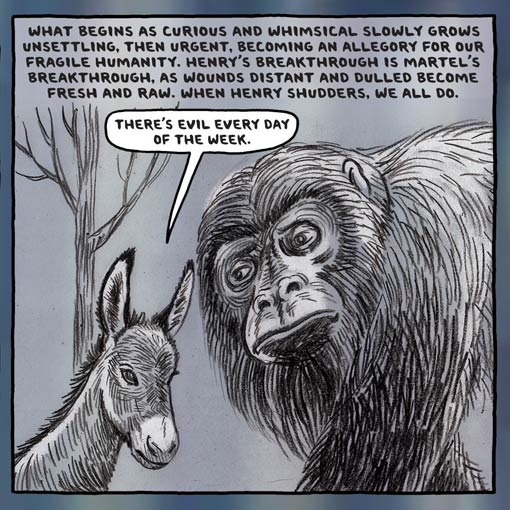

89 comments:
1 Jacobson
Beatrice and Virgil is different than any other art I have experienced. A huge quality that makes it different is the fact that it is constantly referring to the main character (Henry) in a way that makes you think it is actually referring to Yann Martel. It is also different for the fact that it constantly refers back to Life of Pi. No other novel that I have read has referred to another novel as much as this one. In a negative review Edward Champion states that he wants to chop off Martel's hands and prevent him from ever holding a pen or setting foot near a laptop again. I thought this review was pretty brutal...but once I got more into the book, I can see where Edward is coming from. This book so far (to me) is boring, but that doesn't mean that Martel doesn't deserve the right to write anymore.
I understand we are obligated to like each story read in English classes but Beatrice and Virgil grinds every gear I have. The novel is extremely unique because it is not a typical story for at least the first fifty-four pages. I do not know if you can classify Henry as the main character or narrator--Yann Martel is not writing a story about Henry’s struggles to write a flip book but of his own failures after composing Life of Pi. No other book has ever just told an author’s personal failures for the first quarter with a make believe story of a fan ( other Henry). What if other Henry is actually Henry? Plus all the negative reviews of the book are quite humorous. Not a single compliment can be worded, not ever a positive thing about the font type printed. Some comments are unfortunately true, an example would be the sexist comments directed towards the main Henry. Hopefully the novel builds a bit more and turns into something greater than negative comments.
The novel Beatrice and Virgil is unique in the perspective of the story. It is beyond confusing trying to decipher if Yann Martel is referring back to himself in real life or if it is simply a story. Many parts seem to talk about Life of Pi--another novel written by Yann Martel. Though it is confusing, I do not have deep hatred for the novel as many reviewers have. Edward Champion claims the novel to be "the Worst Book of the Decade" in the title of his article criticizing Martel's book. Champion states the book is "the equivalent to being completely submerged into a vat of shit," quite harsh in my perspective. The novel interests me because I enjoy anything related to the holocaust. Perspective is very unique in this novel because it is not--so far--a direct story from a survivor of the horrible time. The creativity is admirable from a reader's standpoint; I praise Yann Martel for going out of the ordinary and writing something many authors are not able to do in a successful manner. If the novel was as horrendous and critics make it seem. Mr. Christensen would not assign the novel to students to read.
Beatrice & Virgil is like no other novel I have read due to its outlandish presentation, a playfully descriptive and insinuative literary approach that appears somewhat like Inception with the way that Martel writes the story’s protagonist to parallel himself. I utterly adore this presentation and feel that I am able to better connect with the author--both Henry and Martel--because of it. Admittedly, I, like many others, once viewed this as a bizarre construct with a drizzle of distaste, however that drizzle has now acquired a rich, savory tang that I greet with refreshed intrigue. As for the feelings of others, they don’t seem quite so forgiving; many an online review express such vulgar disapproval of the work that I find myself on the verge of laughter. I feel that the negative reviews of the novel almost prove its literary championship. The mere fact that it is not responded to with mass exaltation displays that Beatrice & Virgil is not your typical novel, which is precisely Martel’s intent for this piece of artwork. The author did not want to write any typical, woeful Holocaust story; he wanted to write a Holocaust story like no other, one that went against societal standards. The receival of poor review clearly shows that Martel’s vision of present society was correct--we have been confined to this certain mental preconception of what sort of literature is socially acceptable and what sort is not, and by composing Beatrice & Virgil, Martel has poked this despicable societal confinement square in its ugly face with a bold, red, Howler monkey finger. Speaking from personal experience, perhaps people would come to appreciate the mastery shown happen they read the novel a second time. My first go reading it was similar to many others: I could not quite grasp the concept at my fingertips, and grew to resent the downward tumble of tone that took my emotional stability with it. However, looking back and reevaluating with new knowledge, I am able to note how skillful an author must be to pull off such a captivating feat, to play an audience’s emotions as Martel often does. Looking back, I see the beauty in the structure, in the plot build, and even in the downward tumble.
6 Mullet
Beatrice and Virgil is a book I cannot quite pin down yet. There seems to be no plot, and I am already over halfway through the book. The book has little direction and is very transparent. Yann Martel is very eerily similar to Henry the writer. They both are stuck on their sophomore book, unable to think of their next masterpiece. Henry tries for many years, then finally gives up after his publishers shoot down almost every aspect of his book. It is well known that Martel’s sophomore book idea also got shot down by his editor. Then, to go beyond just one transparency, there is the similarities with Henry the writer and Henry the typewriter. They both wish to write a highly fictional Holocaust book, both have editors/publishers that try to change the book, and both become frustrated with whoever tries to change it. So far the book seems to be on a straight path to nowhere. Many others seem to think so as well.
Beatrice & Virgil is like no other art I’ve experienced. A large part of this is because the novel contains no chapters. This was the first book I’ve read written in this way. I like organization and to me, without chapters, the book doesn’t flow as well as it could and makes me feel lost. Along with that, this book is unique because it makes the readers feel as if the author is actually a character in the book. Same with Life of Pi, Yann Martel appeared to place himself within this book. Maybe he does this as a way to show his feelings and his thoughts without telling them to others. A last reason this novel is like nothing else deals with the strange play discussed throughout the book. A play based upon two characters, Beatrice and Virgil, with the purpose of the play to “talk about talk”. It sounds pretty strange to me.
Most of the reviews to the novel are negative. I completely understand why so many people have this opinion on the novel. After writing Life of Pi--a well-known and loved novel--one would think that Yann Martel’s next novel would even surpass the previous. Clearly many believe that Martel did not accomplish that. One reader was angry while reading the novel: “I am shaken with rage as the book is one of the most hateful and ghastly jumble of horrors I have ever finished”. Reading a book, with a hidden relation to the Holocaust is not what many people desire. Martel’s novel is not something that I enjoy reading and I fully understand why others feel the same why.
7 Nelson
Beatrice and Virgil by Yann Martel is a unique art compared to the other novels I have read throughout school. First off, I have no idea how the book will end. I already knew how Life of Pi would end because I saw the movie and had heard of the book from my older sister when she read the book in school. I knew how One Flew Over the Cuckoo’s Nest because the College Bound class had talked about it before Literature 210 read it. This book seems like one that I would read in my free time but would not analyze as deeply as we have in forums so far. I like that aspect of this novel. The reviews of the book online are more negative than not. As of now I do not have an opinion but I am hoping by the end of the book my thoughts will be positive. What I truly enjoy is how different Yann Martel’s novels are yet have small links to each other that the reader picks out like easter eggs. A review by Ron Charles states: “This awkward mixture of realism and fairy-tale abstraction only gets more annoying as the story continues.” I could not have said it better myself. I like this review because it is not overbearingly negative and does not try to force its opinion on you like other reviews I found. The novel is short and has a long introduction that does not move the story line along in any way or even motivate the reader to continue reading out of curiosity. Finally when Henry the author met Henry the taxidermist is when the novel picks up some momentum and mystery. I do not want to judge the book yet because Life of Pi had a long and slightly boring introduction but turned out to be a great read and I hope this book will do the same.
2 Knutson
Beatrice and Virgil is not like any other work of art for a variety of reasons. One reason is the author, Yann Martel, often uses the main character, Henry(the writer), to portray himself. It is often difficult to tell the difference between when Martel wants us to compare Henry to himself and when to look at Henry as just a character in the novel. While referencing himself in the novel, Martel also references his other novel, Life of Pi. I am not a big fan of Martel doing this. I believe, as a writer, you should keep your novels separate from each other and not have to incorporate them into the other novels you write. Another reason is the novel does not contain any chapters. I personally am not a fan of this because I feel as though there is never a good stopping point in the novel(which could be the whole point behind Martel writing the novel this way.) I also, to be quite honest, did not pick up on any of the symbolism or Holocaust references that have been applied up to page 116. I have known all along and before we started reading the book, it was a sort of allegory or least referenced the Holocaust in some way, but did not catch onto certain aspects relating to this. The book also seems to not be going anywhere, plot wise, and I almost yearn for something to happen since I am not enjoying the novel all that much.
I am not the only reader who clearly does not enjoy Beatrice and Virgil, as there are a multitude of negative reviews of the novel. One fellow reader even stated that “I think this book now holds the dubious honor of the worst book I have ever finished. It's derivative, dull and pretentious.” I am not sure that I could classify any book as being the worst I have ever read because I think there is something to learn or take from each novel. Though, I do agree with the writer of this review in saying that this is not a book I take pleasure in reading.
1 Peltier
Beatrice and Virgil is not like any other novel that I have read. It is unique in the way that the narrator is the main character and also the way that the book refers back to previous novels that he has written, such as Life of Pi. After looking at many reviews of this book there are many negative ones. In one that I found Mark stated, “I think this book now holds the dubious honor of the worst book I have ever finished. It’s derivative, dull and pretentious.” At first read this review seems completely rude and brutal. However I see exactly where he is coming from. When we first started the book I thought it started slow and I gave it the benefit of the doubt and thought it would pick up, but it has not. Nothing seems to add excitement to the read it is all just mediocre and at time I find myself falling asleep to it. Although I do not love the book that does not mean that it is the worst book ever. I am still open to it in hopes that it will soon have a plot twist and liven up. However I am still apprehensive of what comes next. Out of curiousity I looked up good review of Beatrice and Virgil, but they were actually so what challenging to find. Some of them started out by being positive but as you read on they increasingly became more negative. To me that is not surprising but to them it was. They all seemed to have high hopes for the book but ended up disappointed in the end. No matter how many negative reviews I read I am still open to the book and am keeping an open mind and not letting all these other reviews affect my own opinion on the book.
Kyle Horner
Beatrice and Virgil is a story like no other. It dives deep into the mind of an unspoken old taxidermist that speaks out in his own way. He speaks out through a play that he has been writing for a long time. This art form is in the appearance of a playwright. It is also a unique perspective that Martel has put himself into the book. He makes this an allegory just as he did to the last book. You get a bird's eye view on what he is truly thinking when he speaks of his fans. Also on the terms of how he will write his next book, Henry and Martel, struggle for the path that they should take. They could take the easy route and write something that will be just as descriptive and meaningful to the readers or they could venture out of their comfort zone. Both of them take the route of displeasure among peers. I see it as a way for them as writers to know what heights and depths they will ever reach.
Beatrice and Virgil was probably one of the most bizarre books I have ever read. It was confusing to read at times due to the multiple stories that were being told at the same time. I have never read a novel about writing a play. The characters are also unique both in the novel and in the play. The novel was also different due to the short exciting ending and the enormous not so exciting build up. I enjoyed the novel due to the exciting ending but I wish the whole novel had more action like that. Many critics loathe this book but I found it at least semi-decent. Many readers were disappointed in the book due to Martel’s success with Life of Pi. Many critics disliked Henry due to his self pitying but abundant success with his first book. I was disappointed in the novel because I really enjoyed Life of Pi. I think people are too harsh on Martel and don’t give him enough credit for this book. Although most parts were slow I believe the surprising ending made up for it.
1 Gloege
The novel Beatrice and Virgil is different than any other novel I’ve read, but it is not necessarily better. It has a very different style of writing, but it gets better as the story progresses. In the beginning, it seems to be all over the place. There is really no evident story line or plot, but it is just setting you up to meet Henry, the taxidermist. In reviews I have read, it seems that most readers either think it is the best book they have ever read, or the worst. For me, it is somewhere in between. When I first started reading, I thought it was quite boring and hard to follow. Now that I am further into the book, it is easier to follow along with what is happening, and the readers can tell it is leading up to something big.
1 Finch
The book Beatrice & Virgil is interesting to say the least. Yann Martel is back at it again with the blend of fiction and nonfiction, similar in part to his popular novel Life of Pi. Assuming the reader has a basic understanding of Martel and his writing history (particularly surrounding Life of Pi), one could assume that the main character, Henry, is a writer who clearly symbolizes Martel himself. It is not difficult to infer that Henry's troubles parallel those of Martel, as well as his achievements. This is a tactic I have rarely seen, and only in one other author: Stephen King, and not even in such a realistic manner as Martel. King wrote a few novels and stories about writers that clearly represented himself, but of course, usually threw in wild circumstances in which that writer often underwent physical or emotional torment from either crazed fans or the elements of nature. It is the King of Horror, after all.
As well as Martel's unique writing style, his story line and plot are something to behold. Consider it either innovative or lackluster, but although I am nearing the end of the novel, there seems to be no sense of resolution approaching at all. Of course, I have yet to finish the book so I cannot make any judgments, but this could prove to be a clever plot technique. That said, it could also prove to be the reason this book will have an uneventful, unsatisfying conclusion, with little to no resolution, explaining nothing to the whole rest of the writing work that came before it, in the same way this comment will.
Oren 2
“Beatrice and Virgil” is one of the most interesting books I have ever read. It is a book about the Holocaust that discusses writing a book about the holocaust. At face value I can see where some people would not like the book. Should someone just read the book without looking into it, it may seem dull and confusing. “Beatrice and Virgil” is certainly no “Life of Pi”. Those with negative views have really negative views. One such view is from literary critic Edward Champion of edrants.com: “When I finished reading this book, I threw it with such force against the wall that a hairline crack formed in the plaster. And even if you have the basest literary taste (no judgment from me, I assure you), that is the kind of thing that this book will do to you.” I guess, according to Ed, I do not have the “basest literary taste” because I believe that I enjoyed it. Allow me to explain, I share the viewpoint of another literary critic, Elizabeth A. White of elizabethawhite.com: “Days after finishing ‘Beatrice and Virgil’ I still can’t decide: do I love it, or hate it?” The book left me with a feeling that I cannot describe because I cannot feel it. All I can say for sure about the novel is that it is interesting and has left me intrigued.
"Beatrice & Virgil" is like no other art I have experienced. This novel is not like any novel I have experienced due to how far down you have to dig to really understand what is going on in the novel figuring out what the characters, and let alone the main character are trying to represent. "Beatrice & Virgil" have many references to another one of Yann Martel’s novel, Life of Pi. Both "Beatrice & Virgil" and "Life of Pi" evolve around each other in many different ways. As the reader, I am able to make connections with the two novels. In "Beatrice & Virgil", the main character, Henry, is resembling the author Yann Martel. One of many negative reviews "Beatrice & Virgil" received was from Edward Champion. Champion bashed Martel stating that Martel had lazy exposition and that Martel kept repeating his words to fill up space. Champion also believed that Martel had poor research obtaining to his novel, "Beatrice & Virgil".
This novel is unlike any other because there is not much action. The entire time the reader is wonder what is going to happen in the novel and I think it receives negative critics because the reader never receives the action they have been waiting for. It is not an enticing story drawing the reader in to continue reading. Edward Champion wrote an article titled, “Why Yann Martel’s Beatrice and Virgil is the Worst Book of the Decade.” Champion lists the reasons why this book is so awful: a terrible prognostic, over writing to expand word count, redundant and imprecise description, lazy exposition, and recycling text to fill up space. I believe that this book is unlike any other because it tells the story of an author of a play and an author of a novel inside the book itself. While searching for an original piece of art to describe I think Yann Martel really just chose a topic that no one cares about. By the topic I mean the two authors trying to write a play, no the holocaust. If he really wanted to write a book about the holocaust then the could have told the entire play in the viewpoints of Beatrice and Virgil. He could have told the world about their struggles of the holocaust. The shirt and all those symbols could be great things that can really make the reader think an analyze the words of Martel. But instead he told the story of two failed authors. That is why it is unlike any other novel. I give him credit for trying to be different but by writing this novel, he himself because Henry, the failed novelist of the book.
After reading Yann Martel’s noteworthy novel Life of Pi, I was quite excited to start his next novel, Beatrice and Virgil. I understand not all novels are going to be good, however, how can one author go from writing something so magnificently clever to something so boring? Beatrice and Virgil is like no other art I have experienced for many different reasons. The first reason is how Martel makes Henry, the main character, seem closely similar to himself. Martel starts the novel by talking about himself but then switches it over to Henry, making the readers confused as to where the actual novel starts. Another interesting aspect of Beatrice and Virgil is that Martel refers to his other novel, Life of Pi, constantly throughout the book.
I fully understand as to why this novel has received so many terrible and negative reviews. One reader commented that “Beatrice and Virgil deserves to be severely reviled because this book, which should not have even been permitted even the fourth-class method of self-publication, earned its bumpkin author a six figure sum through indolence and incompetence.” Even though some of these reviews are far too harsh, I understand where they are coming from.
At first I did not enjoy this book,the plot was dry and it was hard to get through the pages. But in the middle of the book it started to get good and Martel's style of writing is unique than any other author that I have read. It flows nicely and it is a quick read. The amount of detail and research that Martel puts into his novels make it more appealing to read. The reviews are mostly all bad, because I think people are offended that it is an allegory to the Holocaust. I enjoy authors like Stephen King, so the gore and hatred in this book doesn't bother me much. Most of the reactions liked the book until the Holocaust allegory was revealed. The torturing of Virgil was hard to read, the detail was frightening. The book shifts dramatically into the torture scene with Virgil. This book is genius, and I don't know how Martel thought up something like this. It is also confusing why he named the taxidermist and the main character'Henry'. I feel like that means something deeper.
Beatrice and Virgil is unlike any other book I have read. Although it was a quick read, I never quite comprehended what was going on. Because both the taxidermist and the author share the name Henry, it got confusing at times trying to figure out who was talking. Also, Yann Martel wrote himself into the story which is unlike any other art I have ever read. I do not think this book has a plot. I think it is just a narrative about a creepy man, a donkey, and a howler monkey. The ending seems random and totally caught me off guard. Life of Pi was so creatively written, researched, and thought out, so, naturally, I had high hopes for Beatrice and Virgil. It was the exact opposite of Life of Pi--slapdash, random, and boring. I felt like I was being told what was happening. I could not picture the scene in my head. Although it contains some unique quotes, it fails to inspire me. I read a review online that wrote “I think this book now holds the dubious honor of the worst book I have ever finished. It’s derivative, dull and pretentious.” I completely agree with that review. I am shocked that USA Today would call Beatrice and Virgil a masterpiece because it is far from. Martel’s ideas about relating animals to the holocaust could have made this book interesting but he did not execute the story the right way.
In my life, I would say I have read a diverse bunch of novels, short stories, as well as poems. So I find myself fairly familiar with literary works and several notorious authors of those works. A name that has recently made its way into the world of literature is none other than Yann Martel. Life of Pi has become one of the most renown novels of the decade and for good reasons. But some believe Martel should have stopped there. Beatrice and Virgil has mustered up numerous of negative reviews... brutal criticism to say the least. In the beginning it was not easy at all to follow along and even to be remotely interested but getting deeper in the novel has sparked some interest. There has been some seriously good reviews that mention Beatrice and Virgil being the best literary work they have come across. And then there are many that have not an ounce of respect towards the book. The layout and the characters are like none other in this novel and with it being based on the Holocaust really helps the interest and the potential.
Beatrice and Virgil is not the typical type of book I would read. In fact, if we weren’t required to read it for class, I probably would have stopped reading it 10 pages in. However, I believe once I finish the book I will be glad I finished it. I am about 60 pages from the end of the book, but it still does not have a plot or a point. It is just a long run on story about Henry’s life. It is starting to pick up a little bit more so I believe that at the end of the book the entire novel will make more sense as a whole. I see a lot of resemblance between Henry and Yann Martel. I believe Yann Martel is Henry as an author who is stuck on what he should write next. I am shocked at the vast difference between Life of Pi and Beatrice and Virgil. There was so much action in Life of Pi, but barely any in Beatrice and Virgil. The most action I have read is the death of Henry’s pets. Life of Pi is by far the greatest book I have ever read, so I had high expectations for Beatrice and Virgil. I am not very impressed so far, but I think that there is going to be a turn of events and everything will make sense, such as the pear, taxidermy animals, monkey, donkey, etc. As of right now, the book is just random words on a piece of paper that has no purpose. According to a lot of articles online, a lot of people agree with me. There are a lot of negative articles saying how it is the worst book on the planet. Hopefully, there is a huge plot movement and everything ends up making sense on why the novel is the way it is. I hope to be impressed with another Yann Martel novel.
1 Wardlow
After completing Yann Martel’s novel Life of Pi I was beyond excited to jump into another novel by him Beatrice and Virgil. I read a few reviews online before beginning the novel and was shocked to see that most of the reviews were negative. How could the author of the spectacular novel Life of Pi write such a poorly reviewed novel? One of the reviews I read called Beatrice and Virgil the worst novel of the decade. I had high expectations for this novel, and sadly they were not met. The novel is boring, and takes a long time to become interesting. This novel may fall short of my expectations, however the novel itself is full of art. The allusions and symbolism in this novel is astounding. This novel constantly makes references to Life of Pi. The tiger in the taxidermist's shop is from a zoo in India which reminds me of Pi’s family zoo. Also the symbolism of the holocaust is interesting also. This novel reminds me so much of Life of Pi, which is different than any other novel I have ever read. Overall I am disappointed in this novel.
Beatrice and Virgil is a novel like no other. It was distinctly different in the fact that the book was told by the perspective of the author, Henry, who is much like Yann Martel. Beatrice and Virgil gives the reader so much more insight into what the author is thinking by the first chapters that talked about the author’s feelings of fame and success, and how it did not change him. I would not have expected this book to become an allegory for the Holocaust if I did not have the prior knowledge to what the book was about. There were subtle hints at the Holocaust within the first 100 pages, but then after that I was certain that is what it was about. I have never read a book that tells a story about the horrors faced by many during this time period, and it made me truly think about it and reflect more than I ever have. The section in the back, Games for Gustav, was a section I have never seen in the average book. The “games” really made me think of what I would do if put in that situation. The part that cast an extremely somber shadow on me was that these are scenarios that happened during the Holocaust. It is absolutely appalling the things that humans will do to others.
I read some reviews online and I am astonished that there are so many negative reviews about Beatrice and Virgil. Martel’s previous book--Life of Pi--is absolutely canon, and I think it is unfair to place Beatrice and Virgil with Life of Pi and critique them the same. They are separate books with different qualities and messages that they try to convey, which makes them unique. I firmly state that Beatrice and Virgil is one of the best books I have read, and it is a book that should continue to be studied and analyzed.
6 Bose…
In my personal opinion, Beatrice and Virgil has been a book that has been assumed before even read. I too believed that this was an awful book, until I looked deeper into the novel I realized how many symbols and how all of the material in the book connected right to Yann Martel and his writing career. There are many reviews that claim this book is dry, Yann overwrites and uses too many words and also that there is no protagonist in the book. Many other critics, along with myself at first, say that the book is just flat out confusing. There are two Henry’s in the novel and one of the critics from a newspaper article I read stated that, “It almost appears that the Henry character may be the same person, or may be not, it is hard to tell who is talking.” I completely agreed with this, but I don’t think some of these critics pulled Beatrice and Virgil apart enough to discover how extraordinary this novel actually is. I also agreed that this book was awful at first but as I continued to read on, I realized that there were a ton of hidden meanings in the book. If I would have not read Life of Pi before this book I would have been completely lost. Beatrice and Virgil is not suppose to be a sequence necessarily from Life of Pi, but if you had read it, Beatrice and Virgil would make a lot more sense if you did. I really enjoy this book and would have to disagree with some the reviews and that these critics should have an open mind and give Beatrice and Virgil another try.
Beatrice and Virgil is definitely like no other art that I’ve experienced before. It is most definitely the most interesting book I’ve ever read too because of Yann Martel’s use of language. It’s strange how this book is almost relating completely back to Life of Pi. Animals and zoos are incorporated so much into this novel. Also, it is as if Martel is Henry in the novel. A lady named Melinda reviewed the novel Beatrice and Virgil and had a lot to say. She was completely outraged by the end of the novel and said that there was a ton of white space.
After searching review after review, the only criticism I saw was negative. Critic after critic claimed this as the worst book of the decade...The worse book ever written! I for one have yet to fully see the good part in this book, but I also have not gotten to the good part, the ending. I have been told personally by a few peers how this is their all time favorite book; I can not wait to get to the part where I fully comprehend this book and have criticism for myself. I am around page 160 and I have yet to understand the book. Is this book actually written about Yann? It's a very unique form of writing to say the least. All of Martel's books are unique, although I enjoyed our previous novels much better.
Beatrice and Virgil is unique in the way that it does not use chapters to separate the scenes. In a way, it just drags on for the full length of the novel. The reader knows where a chapter should be but Martel intentionally leaves it out. In other ways it is supposed to be an allegory of the holocaust. I still have not made the blatant connections the way that Animal Farm did. Also, a confusing character plot has made me wonder who is who. Most reviews are completely negative of this novel, in which I think are well deserved. Authors with one or many great books are taken as great. Critics assume all of their literature is good, that is not always the case. I do agree with most critics that this novel could be better in many ways, however maybe I do not enjoy this the way I should.
Beatrice and Virgil takes the same old story of the Holocaust through a different story line. In middle school I read every holocaust book in the library. I have never seen the story through the eyes of a Nazi. It’s not that the Nazi told the story about how he was wrong and the event was tragic, it’s through the eyes of the Nazi who still believes that they were right. One review I found online was negative saying that they Henry who is the narrator is a bad guy that has the reader sympathizing with. The critic shows that lack of variety in Yann Martel’s writing. He overuses adjectives, and repeats sentences. Without much anticipation the events just happen and the narrator does not go through the book revealing his symbolism. I agree with this review. The book’s events just happen. There is no anticipation leading up, or follow through after the event. It seems as if Martel was rushed. In the beginning of the book he followed through and drew even over prolonged. He seemed as if he was trying to get a length instead of events. The end of the book leaves many events unanswered. I hate books that are “cliff hangers”. The book became interesting in the end, yet poorly written. I am still confused on what happened to the taxidermist and his viewpoints. I am confused on why he was always so quiet. This book in one of the most interesting books I have read so far.
Beatrice and Virgil is a profoundly unique composition by Yann Martel. After previously reading Life of PI, I had hopes for this book. To my surprise, I feel this novel fell short of what most people expected after reading Life of Pi. Beatrice and Virgil is a whole different style of writing that I have yet to experience until now. Most books I have read have had a relatively easy story-line to follow but this one has been much more confusing thus for. Reading more, it has started to make a little more sense but still hard to follow at times especially consider both main characters share the name Henry. In order to enjoy this book, the Martel intended, you must look at it from a different standpoint not the way you have look at more simple novels.
I, personally, am enjoying reading Beatrice and Virgil much more than any other novel assigned to us this year. Something about it's complexity is intriguing and alluring. Yann Martel writes this in a similar way to Life of Pi, yet it is entirely different. Taking a well known tragedy, Martel rewrites the Holocaust, which never bores, and somehow makes it more understandable. Martel's astounding creativity truly shows through this novel. A particularly interesting occurrence is the addition of Henry, the so-called narrator and author, who is thought to be Yann Martel himself. It is unclear whether it not Martel or it is, but signs point to the latter. Once again, much like in Life of Pi, there are two characters with the same name, but disparate personalities. I believe Martel includes characters like these to show the differences that are present in similarities. Mixed and mostly negative, the reviews for this novel are not stellar, to say the least. I strongly disagree with those reviews, but it is merely opinion, not fact. Of course, readers adored Lord of the Flies, but to me, it did not live up to it's stellar reviews. The message, itself, was great and the symbolism was pure genius; however, the writing fell flat and felt lifeless. But like I previously stated, it is merely my opinion. A writing or work is to be enjoyed by all readers; a few opinions and reviews should never influence anyone else's.
Beatrice and Virgil is a novel like no other I have ever read before. This Holocaust novel is told entirely as an allegory which is a new spin on the almost entirely morbid and factual portrayals of this event. Yann Martel offers a new perspective towards the Holocaust and also challenges the reader to question many of the scenarios that happen to Beatrice and Virgil. However the allusions to the Holocaust are not only found in the play, Henry’s dog is put to sleep in a gas chamber. Many reviews online talk about the book in a negative light with little to nothing good to say about the novel. This novel can not be treated or read the same as other Holocaust novels simply because it is one of a kind in what it does for the event. I do agree that this novel is not all that it could have been, but I believe Martel accomplished his goal of the depiction of the Holocaust once again using animals as his cast instead of humans.
Beatrice and Virgil is like no other are I have ever experienced because I have never read a fiction allegory about the Holocaust. The novel has no chapters present. The novel seems to be all over the place. Without thinking about the holocaust during the novel, The novel would be meaningless and have no direction. The reviews are mostly negative reviews. Most people are disappointed with the work that Yann Martel did after the work he did with Life of Pi. According to erdants.com, Beatrice and Virgil has a terrible protagonist, overwriting to expand word count and etc. My reaction to the novel is that it has a good idea to the book but it could have been written better when writing a play and making an allegory for the Holocaust.
Beatrice & Virgil is a very unique novel. One way in which it is unique is when and who it was written by. A few years before this book, Yann Martel created an enormously successful fictional novel entitled Life of Pi. Life of Pi received such overwhelmingly positive reviews that a movie was made out of it. To have that kind of success followed by a book that has been called “the worst book of the decade,” and “a risky fable about genocide” must have been quite a hit on Yann Martel’s reputation. However there are other reasons that this book is unlike any other I have read. It is different because there is simply so many complicated details that are sometimes difficult to understand; details that are referenced later on in the book such as the boy and his two friends, who ended up being the harbingers of death for Beatrice and Virgil. Also, never in any book that I have ever read, does a book end so abruptly through the killing of the main character by the second main character. Also, the true name of the second main character (the taxidermist) is never revealed to the reader, leaving the reader in shock and wonder when the pages run out.
The reactions to this mysterious novella could not be more one-sided if it were written by the authoritarian militaristic dictator of a small power-hungry nation who enjoys to control the press, similarly to North Korea. Almost every single review of Beatrice & Virgil is extremely negative, but I think that that is exactly what Yann Martel wanted. I think that Yann Martel wanted the readers to be disgusted by his book, especially the ending, so that we as human beings may stop and take a moment to realize what we are doing, whether it is to animals or other humans. We are convinced to take this moment of silence by the sudden and violent injuries inflicted on Henry and the taxidermist’s intense, hellish suicide. Perhaps the negative reviews are written by the people who refused to stop and take that moment of reflection on what they were doing. They were in too much shock by the ending that they immediately refused to look into it any further.
According to Edward Champion, “reading [Beatrice and Virgil] is akin to walking the Bataan Death March.” I suppose he would know from experience. Of course, everybody is entitled to their own opinion, and Champion is merely voicing his own. But a line must be drawn in the sand. While it is fine to dislike a book--in fact, disliking a book makes a person wrestle all the more with it--I do not think it is fine to rail on an author without first contacting him face to face. If someone’s opinion of a book is so overwhelmingly negative their review becomes a personal attack on the author, that person ought to bring his complaints to the author, not the public. Doubtless I am being too harsh on Champion. Yet Martel invested a season of his life to writing Beatrice and Virgil--so at the very least, the book deserves a respectful opinion, whatever opinion that may be. For myself, I have never read a book quite like Beatrice and Virgil. Just as Henry’s flip book presents the Holocaust in a revolutionary light, so does Martel’s work as a whole. Martel mixes elements of parable with the broader plot, and being a tanner myself, I found a special connection to the story through the presence of taxidermy, which is a major plot device. This connection was overall rather unnerving: Henry the taxidermist is a symbol for the Nazi perpetrators of the Holocaust, and the objects of his craft represent the Jews. This does not bode well for me! On a serious note, Martel has done a masterful job converting one of the darkest periods of recent history into something near fiction. Near fiction, I say, because it does not quite belong there--the book does not trivialize the Holocaust in any way, and while the superficial plot is a figment of Martel’s imagination, it nonetheless contains truth.
6 Bender
I just finished the book second ago. I have mixed feels about the end of the book. While I have truly enjoyed both of Yann Martel’s last books that we have read, I have been finding myself conflicted at the end. With this book, I am frustrated with the end of the book because that is where every single action/plot point happens. The play’s plot is just like the books plot. I did predict that the taxidermist was going to do something at the end but I was hoping--being a glass half full kind of person--that the taxidermist would indeed be a good guy in the end. Wishful thinking. I do not like how the whole book is so boring. If I were to just pick up any book in a book story, I would like something to happen in the first half of the book in order for me to continue reading it. While the end was dramatic and full of excitement, the rest of the book is quite boring. It is like no other modern novel because of how I just described the book; I, like many other readers my age, need the author to get to the point of the book quicker. Yann Martel writes fantastically and shows that it will not be a teen classic like that of the Divergent series or the Hunger Games series. His books, I believe, will stand the test of time.
I read “Why Yann Martel’s Beatrice and Virgil is the Worst Book of the Decade” by Edward Champion on the internet and I agree with some of his points--but not with his use of profanity. He talks about how Henry the author is a weak protagonist. In reality we know little about hims, kind of like how we know little about the antagonist, Henry the taxidermist. While we cheer for him in the end after the violent attack, I am not fully behind Henry and do not fully feel as if I could put my myself in his place or relate to him as I do with some of my other favorite characters. Also, Edward Champion points out the question of why does Martel have the taxidermist write the play so repetitive. I feel stupider reading the play after I read Beatrice and Virgil fight over what day it is for almost half a page.
Beatrice and Virgil is a very unique book and there are many qualities that make it different. First of all (and what kind of bothers me) is that there are no chapter numbers or titles that separates the book; it seems to be one long run-on novel. Also the fact that this book is written as a fiction of the holocaust is never before heard of. Some people may even think that is absurd. Who could do such a thing? Make up a story about the holocaust? Well, Yann Martel is your guy and he does it brilliantly. It is also very unique how it seems as though Martel is constantly referencing back to his book, Life of Pi. Unfortunately though, Beatrice and Virgil has a slightly confusing character plot which kind of makes it difficult to follow at some points. As I research this novel, it seems as though every review that I find is negative. Harsh words after harsh words causes a reader to not even believe for the slightest second that anyone would want to read the book. However, to some extent, I would agree with some of the criticism. Martel seems to overuse adjectives and also repeat himself frequently. But maybe why the critics are so harsh are because they had high standards. It is set in some people’s minds that if an author had one huge success, the rest of their literature must be great as well, right? Well it is not always true, even though some people still believe it must always be true. Whatever the critics say, however, does not matter to me, I still enjoy the book no matter what they say.
When I first started reading Beatrice and Virgil I have high expectations for this novel. Life of Pi was a extremely well written novel that captured the eye of readers and many different ages. But, sadly, once I started reading the novel started started to agree with the nasty reviews from other people about how it was not a very good book. But that was just from the beginning of the novel and what I had first read. Some people stated that it was the worse book they have ever read. I do not fully agree with that. There are a large amount of exhausting, boring readings. But, towards the end of the novel I am starting to get more into it. Henry reminds me much of Yann Martel. Just from the simplicity of the way he writes. I am looking forward to the end of the novel and hope that my review of Beatrice and virgil will not be identical the the repulsive remarks that are made on the internet. Without being in Mr. C’s Literature class there was a large percentage that I would have never read this book or Life of Pi. Im thankful that I got the chance to read the writings of Martel.
Beatrice and Virgil is by far one of the more unique novel I have ever read. After reading reviews saying that this novel is the worst book of the decade I was concerned about reading this book. The beginning of the book lived up to the expectations. I thought it was kind of confusing trying understand the meaning in the novel, if there was any. It did not seem like anything was going to happen and it was irritating having things like the setting be so vague. After the first forum, I started appreciate the novel more. I learned basically everything in Beatrice and Virgil could be related to the Holocaust. The switch between the various literary styles (novel to story to play) was intriguing; it made me want to connect the literary dots between the stories. After finishing the novel, I understand that majority of the novel, confusing as it maybe, was needed to accomplish the ending that occurred. Yann Martel did a good job making the reader feel invested in the play. I like to see things start to finish. Having the play get burned, kind of upsetted me. I wanted to know how it ended. This was an interesting opportunity to learn even though I did not necessarily enjoy the medium of learning.
Beatrice and Virgil is like no book I have ever read before. As I have read on, it gets more interesting. At first, the book did not interest me one bit and I figured that it would be a difficult book to read. After the first couple of forums in class, the discussions made it well worth it. Classmates of mine explained parts of the book that I did not understand and made it so that I completely understood. Knowing that Yann Martel wrote this book as well, I had hoped that it would be as well written as Life of Pi. Beatrice and Virgil has gotten to be a hard to follow novel, but it also intrigues me as I continued to read towards the end of the book. After looking online at what the critics wrote about Beatrice and Virgil, every single one is negative. One specific reader wrote “I am shaken with rage as the book is one of the most hateful and ghastly jumbles of horror I have ever finished”. With that being said, many people find that the book is a horrible book, but as for me, I find it like no other book I have read before and that is what I like about it.
After reading Life of Pi I was excited to read another novel by Yann Martel. But when you first introduced the novel to us you told us to read reviews about Beatrice and Virgil. The first review that popped up was, Why Yann Martel's Beatrice and Virgil is the Worst Book of the Decade. I was honestly shocked because Life of Pi was an awesome book, I just couldn't get my mind to wrap around that a novel that Yann Martel could be an awful book. A comment made my Edward Champion shocked me, "when you read a book with such dreadful syntax, without even a fiber of merit, so libertine in the manner it insults the audience, and so producing the literary equivalent to being completely submerged into a vat of shit, that the reader, having embarked on the fetid journey, begins to pine for a brutal throng of vigilantes to chop off the author’s hands and prevent the hopeless hack from ever holding a pen or setting foot near a laptop again." I was excited to read a book about the holocaust, something I have been interested in for awhile. But, I was thinking this is going to be hard to read. Sure enough the beginning of the book did not interest me and I was let down because I thought it was just going to be about how his Holocaust book failed, I was definitely let down. Something that I have never experienced in a novel is the way that he is basically talking about himself and his success in earlier highly succeeding novel. I am not sure why he does that. Is it to assure the readers that he is a great author and remind them of the great novel he wrote before this one? Throughout the novel there was also references that I caught; Henry's interest in the tiger from India, talking about zoos, living in Canada, and so on. Beatrice and Virgil ended up becoming more interesting in the end but was not what I was expecting.
1 Peterson
After reading Life of Pi I was excited to read another novel by Yann Martel. But when you first introduced the novel to us you told us to read reviews about Beatrice and Virgil. The first review that popped up was, Why Yann Martel's Beatrice and Virgil is the Worst Book of the Decade. I was honestly shocked because Life of Pi was an awesome book, I just couldn't get my mind to wrap around that a novel that Yann Martel could be an awful book. A comment made my Edward Champion shocked me, "when you read a book with such dreadful syntax, without even a fiber of merit, so libertine in the manner it insults the audience, and so producing the literary equivalent to being completely submerged into a vat of shit, that the reader, having embarked on the fetid journey, begins to pine for a brutal throng of vigilantes to chop off the author’s hands and prevent the hopeless hack from ever holding a pen or setting foot near a laptop again." I was excited to read a book about the holocaust, something I have been interested in for awhile. But, I was thinking this is going to be hard to read. Sure enough the beginning of the book did not interest me and I was let down because I thought it was just going to be about how his Holocaust book failed, I was definitely let down. Something that I have never experienced in a novel is the way that he is basically talking about himself and his success in earlier highly succeeding novel. I am not sure why he does that. Is it to assure the readers that he is a great author and remind them of the great novel he wrote before this one? Throughout the novel there was also references that I caught; Henry's interest in the tiger from India, talking about zoos, living in Canada, and so on. Beatrice and Virgil ended up becoming more interesting in the end but was not what I was expecting.
Beatrice and Virgil is like no other art I’ve experienced because it has a dullness to it, but yet it begs to be viewed and interpreted. Martel’s writing style keeps the reader interested, although there is little to no plot. This book is extremely fascinating because Martel forces the reader to feel the same emotions as Henry as he reads the taxidermist’s play: confusion, intrigue, boredom, and deception. For both the reader and Henry, what they are reading seem to be about nothing and yet have something about them that begs to be discovered. At the end of the play that Henry reads, the only action happens when Beatrice recalls for Virgil what happened to her during the Horrors, which is very shocking for Henry. Then very, very shortly after, Henry is suddenly stabbed by the taxidermist out of nowhere; the only real action to happen in the novel.
Another extremely enticing aspect of this novel is that Henry the author is almost undoubtedly Yann Martel himself. Henry discusses how his famous book which sounds just like Life of Pi, living in the city, and having a wife and one son; just like Martel. His blurring of fiction and reality is extremely difficult to decipher and causes the to ponder if Martel knew an ex-Nazi like Henry the taxidermist.
One of the reviews that I came upon began with discussing how Henry, the narrator, was extremely unlikable and was baffled on how any reader could sympathize him at all. I do not agree with this viewpoint at all and see Henry as a regular man who just happened to have a gift for turning words into something beautiful. He was just adjusting back to a normal life in the beginning of the novel and happened to meet an ex-Nazi who obviously had not gotten over the Nazi era and being obsessed with death.
As I began to read Beatrice and Virgil it was starting to become apparent to me that it would not be an easy read seeming the first maybe 100 pages of the book I could not seem to get myself to enjoy it or get into it. This book takes much longer than it should to grasp the attention of the reader. But to make it worse, when the book starts to become a little bit more interesting, the problem with saying “this is where the book will start getting better” is that it does not. I say this because at the end, the main events that happen included many things about death. I am not a person who is so strongly about animal cruelty that even when it happens in books I think of the entire book as bad and would stop reading it (although I still do not believe in such a thing), but when the only action parts of a book are just death, death, and more death, it makes the book highly unfavored. From about page 150-200, you can account for about nine deaths, four of which are human. I did not like the ending of the book at all. After looking at reviews of the book I can see that there are many other people who did not enjoy the book as well. Many of which brought up some of the same points: the book being too cruel to animals, no real plot to the book, or the book was too short to be considered a novel. The last two I could argue against but the last one I would agree, did seem to be a bit harsh on the animals. But in my opinion, I feel as though Yann Martel used animals for the same purpose that he used animals in Life of Pi. If the play that the taxidermist wrote had animals as the main characters, the book would be mortifying. But in reality, the things that happened in the book did in fact happen during the holocaust.
What makes Beatrice & Virgil like no other book we have read in class is the fact that it has dark tones to it. It is a very gory book that has death, murder, and makes the reader look behind their back as they are reading. As life of Pi had creepy details (such as finding the human tooth in the plant on the floating island), nothing to this extreme did the other book have. What makes this book different is the fact that it is between two characters. One Henry after the other. I am not one for reading books that are gruesome and murderous. I enjoy books that are upbeat and have a happy ending, something gets accomplished. Why would I want to read something with a bad ending? Edward Champion had plenty to say about Martel’s story plot line and ending. Martel uses repeated nouns and verbs in the same few pages, which can make a reader annoyed and lose focus. I would have to agree with this. Redundant and slow plot make this book hard to stay true to the main idea and figure out what Martel is trying to explain. Next, never have a read a book where the protagonist and antagonist have the same name, making it hard to keep them separate. For the longest time I figured good Henry was talking to himself in the future. It is complicating for the reader to concentrate on both characters without feeling that there is a specific connection in between the two. Champion also states that Martel recycled text just to fill space. The book could have been much shorter and less cluttered with the use of taken out useless information as well as make the text shorter and smaller. Martel hit a bump in the road when comparing this to LIfe of Pi.
Schwint 1
Beatrice and Virgil approaches the Holocaust in a different way that had rarely been done before. Martel chose to have animals suffering through the Holocaust instead of following the normal stories about humans in concentration camps. In fact, this book does not focus mainly on the concentration camps and only has subtle references to history instead of being all about historical accuracy. This different approach to the Holocaust and the story having little action in it until the end has caused a lot of bad criticism from many different people. Once such criticism from Edward Champion claimed that reading this book made him. “pine for a brutal throng of vigilantes to chop off the author’s hands and prevent the hopeless hack from ever holding a pen or setting foot near a laptop again.” Now while I did not particularly like this book myself I did not hate it to the point where i wished anything bad against this author. I also do not believe you should judge an author by just one of their books but instead you should look at all their writings and then make your judgement about the author.
Beatrice and Virgil is certainly an interesting read to say the least. Never before have I read a book about a play about a donkey and a howler monkey talking without much action and still be interested. Yann Martel has definitely peaked my interest with his other novel Life of Pi, so I came into this one expecting great things. I was slightly let down, however, this novel still stands as a good book. My problem was that I was going into it expecting another beautiful story like Life of Pi. I think that is what most of the reviews that I read problems were. I think they went into the book expecting Life of Pi esque Martel and what they got surprised them and they were caught off guard. In almost every review I read it said that it was not up to their Pi standards which blows my mind that they can write off a fairly good novel entirely based on the fact that it was not as good as his other book. I also did this, I did go in expecting a classic. What Martel delivered though, is a very good book with some well thought out meanings behind the novel. Even though it is not up to many people's standards, it is definitely still a well-written story with a twist ending that caught me off guard. The ending, I thought, was interesting and it gave me food for thought for a couple nights. Martel certainly did not disappoint if you take Beatrice and Virgil as its own standalone book. I would surely refer others to this book if they want a not-so-stereotypical holocaust book that really makes you think in a different mindset. I might even have to read it again in order to catch all of the minute details pertaining to the overall story.
Beatrice and Virgil is unlike any other novel I have ever read before. It is like no other art I have experienced. The book does not contain chapters. This threw me off a lot and I felt as though I never had a resting point in the book. It felt as though it was one long sentence that went on for 200 pages. This made me not want to stop reading because there was never a feeling of getting a break. I would not say this is a bad thing, just a confusing thing. I did enjoy the uniqueness displayed throughout the entire novel. The author makes the readers feel as if the author is actually a character in a book. The same goes with Life of Pi, Yann Martel places himself within the novels. I enjoyed how Martel incorporates his novels together. It was like a small inside-joke between the reader and author. I enjoyed understanding the resemblance between his novels. The small and subtle, yet incredibly important references to the Holocaust made this novel even more unique. No author has done was Martel has. He incorporates the Holocaust sometimes without the readers even noticing it. Readers can interpret the novel in many different ways, which also contributes to its uniqueness. I was slightly annoyed at the amount of time it took for the novel to begin its plot. At times it was hard to continue reading, but I am glad I did.
I do not agree with the negative criticism about this novel. I agree with the argument that the book is boring and sometimes hard to read. However, I do not agree with the novel being the worst novel ever written. I believe there is always something you can learn or take from a novel, and there is a lot one can take from Yann Martel’s Beatrice and Virgil.
Beatrice and Virgil is a novel in which it challenges a reader to enhance their thinking and learning skills. Many literary devices are used in the novel including allegory and irony. This book differs from others due to its uncommon characters and format. Despite its major differences from other novels, and long but necessary beginning, I did enjoy the unexpected novel. Martel engages the reader with many uses of symbolism and suspension. Although it was horrid to read the passages through Beatrice's experiences, it was used to better understand the capacity and importance of suffering and animal cruelty used in comparison of that to the true horror's of the holocaust.
After reading Beatrice and Virgil made me have different feelings: confusion and shock to name some. The entire book leading up to the the cafe scene with Virgil reading the paper had been extremely slow and not very interesting. However, after the cafe scene, it was the first instance where I got a little bit of plot of the play. From that point on I paid a little closer attention. And oh was I in for more. The next major part of the story that had me at the edge of my seat was the arrest of Beatrice and the following torture that he endures. The words that Martel chose to describe the scene was gruesome. At many points I could vividly picture what was happening and cringe when the nail went through the hoof. However, the one part of the story that was very sudden and felt as it needed more of an introduction was the death of Beatrice and Virgil. One minute the Taxidermist was reading to Henry about how they had seen a very mean boy in town the day prior and now ran into him in the forest, and the next the mean boy was bashing in Virgil’s head with his rifle and shooting Beatrice in the head. I was completely shocked at what had just happened, but the next scene left me with more shock than the death of Beatrice and Virgil. It was when the Taxidermist had stabbed Henry. It all happened so suddenly, not to mention out of the blue. I definitely did not see it coming. At the end of the novel, I felt like I had a false sense of closure. What I mean by this, is that even though Henry had written the book retelling his encounter with the Taxidermist, I feel that his (Taxidermist) story was never told. Therefore, I have no knowledge and understanding as to why the Taxidermist would do such an act. Not to mention that before he burned down the shop, he gave a big smile to henry. This too is never explained why he went crazy. One can make many assumptions, but Martel did a great job at making many more loose ends to this story than he did in Life of Pi. This book was unlike any other book that I have read before because the book has no ramp in ramp out method. Instead it flat lines until the last half of the book, spikes when Henry was stabbed, and has a rather short decline as Henry is talking about how life is for him after the stabbing.
Beatrice and Virgil is different than any other art that I have read because of the way it refers to the main character as almost two different people, but yet refers to him with the same name. The way it builds up the plot is also a way that makes it very different to any other art I have ever read. You do not exactly understand the plot of the story until the end where it all starts to make sense. It is also different how it refers to a different book written by the same author as building up the plot of the own book. I do like how most of the book refers to the Holocaust and explaining it using everyday people and animals
Beck 1
Beatrice and Virgil is a novel like no other, it makes you think about what you are reading sentence by sentence. Many times Yann Martel in his books puts bits and pieces of himself in the main character. The only way you could really figure this out is by reading other books of his. Being forced to read a story is normally not something that usually intrigues me, yet in Beatrice and Virgil it’s a different story. Most stories I struggle to read and to flip the pages on, and to finish. Something in this story that really intrigues me is that you at points in the story do not know whether or not Yann Martel is referring to himself or yet another fictional character in one of his stories. Reading all of the negative comments written about this book before reading it will change your thoughts on it and can immediately change your thoughts on it and make you want to just not read it at all. The Holocaust has always intrigued me to read about, yet in this story it is played out in a different way. You have to think in a different mind in order to completely understand it. Henry plays out his experiences through a play that features a monkey and a donkey. No other book I have read that is about the Holocaust has talked about it in this way Yann Martel portrays it as. This makes you think about the story, yet makes you want to keep flipping the pages to see what is happening next. I believe that this is a good story to read about. By the end of this book I was happy that I was able to read it, some schools are not as privileged as ours is. Choosing this book for our 210 Literature class was an excellent selection made. It makes you think of the holocaust in a different perspective and I enjoyed being able to think about it in a different way.
Beatrice and Virgil turned out to be extremely different from other books I have read due to the fact of the enormous and unseen plot twist at the end of the novel. I have read many novels with a plot twist but none like Martel is able to create. He is one of the most genius authors that I have come across in my lifetime. The way he can captivate the mind with his descriptive words and make the reader want to continue to see what point he is trying to make at the end is unlike any book I have read before. He told a story within a story while explaining through another story (I am not sure if that makes sense to you but I cannot figure out how else to word it) and his novel is purely magnificent. I feel as if the ones who negatively review this novel do not understand how incredibly it has been written, all while appealing to the readers five senses with his descriptions. Beatrice and Virgil blew me away at the end and I am forever grateful to have read such an intriguing novel created by such an amazing author.
Beatrice and Virgil is a book that although I have finished, I am not quite sure I am able to fully understand. Yann Martel wrote this book in a way I do not believe I have ever experienced before. I think that the confusion with the style of this book however makes me more intrigued to get to the bottom of what Martel is trying so hard to convey. I think it is different how he is talking about detrimental history, but he does so in sort of a discrete way. There is really no plot to this book and even after finishing this is something that brings great confusion to me. After reading, when trying to help find guidance on what to emphasis in my forum notes, I could hardly find anything to help me. This is because instead of people sharing their deeper analysis to the understand the book, several negative thoughts are given instead. Review after review of negative feedback for Martel is found on the internet. One article I had given time to, written by The New York Times, states it is a “disappointing and often perverse novel.” I believe these negative reviews are actually playing to Martel’s benefit however because to me it seems to prove his point on the ignorance of society. In the book it is mentioned “to talk about so that we might live with...” “To know and yet to be happy” (137). With this quote I believe it is important to keep talking about what happened with the holocaust, but not to just simply “live with the facts” it is important to educate so that society is not tricked into yet another form of the Holocaust. The unfavorable reviews about the book I believe show that many people in society, especially those writing the reviews, don’t want to accept the facts. They are sick of people talking about it and they don’t agree with the way Martel is portraying it.
Beatrice and Virgil was one of the most bizarre books I have ever read. It was confusing to read at times due to the multiple stories that were being told at the same time. I have never read a novel about writing a play. The characters are also unique both in the novel and in the play. The novel was also different due to the short exciting ending and the enormous not so exciting build up. I enjoyed the novel due to the exciting ending but I wish the whole novel had more action like that. Many critics absolutely hate this book but I found it to be average at best.. Many readers were disappointed in the book due to Martel’s success with Life of Pi. Many critics disliked Henry due to his self pitying but abundant success with his first book. I was disappointed in the novel because I really enjoyed Life of Pi. I think people are too harsh on Martel and don’t give him enough credit for this book. Although most parts were slow I believe the surprising ending made up for it.
Beatrice and Virgil is a book unlike any other art I have seen. It talks about the Holocaust with such elegance that traditional books about similar topics do not have. The book creates a non-fiction within fiction within non-fiction and is fairly easy to read. Several people enjoy this book because of the way it goes about the topic and its easily read text. I, however, did not enjoy this book. I agree with the critics online who say that it hardly has a plot. It would be different if the book was only the play, and not with the Henrys, however, with those two characters and a whole other world outside of the play, there is no plot. The most interesting part of the book happens between pages 159 and 193, only about 40 pages of this 200 page book. That means that 4/5 of the book is utter boringness, which doesn’t make those 40 pages worth it. I, along with other critics, are surprised that this book even made it to 200 pages because of the lack of “meat”. Though, we do know how it managed to get that far. Martel seems to like to be redundant when describing things. For example, when he describes the flip book, it takes him a whole paragraph just to explain that half is an essay, half is a novel, and it meets in the middle because there should be no end to the Holocaust, meaning that you need to flip each side to read it properly. Also, he seems to be inconsistent between what the animals Beatrice and Virgil are going through, and things that happened in the actual Holocaust. For example, how do Beatrice and Virgil just come up with the exact street address for the records of the Holocaust without ever being a part of the real world? How do they know that that’s the place things need to go? How does the sewing kit get passed on to other people to tell their story if the only two people who know about it are dead? I realize that this can all be put onto the taxidermist, for he is the “true” author, but Martel is the author of the taxidermist, therefore shouldn’t he have done a better job at making the play not a complete piece of work? This transfers over into the “Games for Gustav”; I just cannot imagine Beatrice and Virgil asking these questions to one another without knowing about the Holocaust. However, my biggest pet peeve about this book is the lack of plot. Even the play within has very little plot, but it still has more plot than the book itself.
Schroeder pd. 6
After reading Yann Martel’s Life of pi, Beatrice and Virgil was very different. Starting the book, as a reader I did not know whether Yann was talking about himself through the character Henry. Throughout the book, I was a confused at times, because of multiple stories going on at once. I have not read a book like this one, because Yann writes in a way that is mysterious. I thought that Henry the taxidermist was a questionable individual when Henry the author went to meet him. I loved that Martel made us think about the Holocaust in a different way. While reading an interview that involved Martel, he had said that his point was to have the readers think about the holocaust in a different way. Whenever I see, or eat a pear I now think about Beatrice and Virgil. This was Martel’s intention. The book was very good, it was not like any other book I have read before because it just had many ideas going on at one time. The ending was the best part, and the stabbing of Henry caught me by surprise. What was Henry’s intent? I understood that he was a nazi but was he under so much stress that he couldn’t help it? I loved that it was open for interpretation and we discussed today that Gustav was Henry the taxidermist and Beatrice and Virgil were indeed the first animals that he had tortured/killed. These animals were supposed to represent the jews. Many of the reviews written were negative but every book will have negative feedback. I really enjoyed this book, and students will always complain that the book sucks. But just tell them that life sucks.
Beatrice and Virgil is like no book I have ever read. Never have I read a book with the main characters being animals. Never have I read a book with the main topic being a play. Never have I read a book so gruesome and weird as Beatrice and Virgil. Although the Novel is definitely different than anything else I have read, it is not a bad book. I actually enjoyed the plot and characters that Yann Martel portrayed. I like how he says in his question and answers at the end of the book the reason behind why he uses animals in not only Beatrice and Virgil but Life of Pi. He says "I find it easier to suspend my reader's disbelief if I use animals as characters"(220). I like how he does that, and the reasoning behind it. I do not think this was as great as Life of Pi, but I did enjoy the book. It confuses me as to why there is so much hatred behind it. " I am shaken with rage as the book is one of the most hateful and ghastly jumble of horrors I have ever finished." This is one of the many reviews of hatred of the book. I believe people hate it because of how gruesome it is, but wasn't the holocaust "hateful and ghastly"? I believe people have so much hatred behind the book because they don't want to acknowledge the real topic of how gruesome the holocaust was. I enjoyed the book, and I would like to read it again to see all of the small symbols Yann Martel hid in the book.
Beatrice and Virgil is a one of a kind book. It tries to describe the holocaust through a play written by a former Nazi torturer. The play is complete fiction about an absolutely real event. Unlike Life of Pi where the probability of what Pi had to go through was almost impossible. Beatrice and Virgil may fall into historical fiction but it also couldn’t. It couldn’t because you could interpret it as about being nothing the holocaust just some crazy man who loves his job and play way too much. Also Henry, the narrator, could just be misunderstanding the whole thing and seeing holocaust where there is none. Another thing that makes Beatrice and Virgil so different is the fact that it seems so jumbled and has little plot to it at all. The parts of the play come out in short segments. They are rarely following each other in chronological order. It has no flow and little action to intrigue the reader. But maybe that is not the point. However, I did read a review online that claimed this was the worst book of the century which I wholly disagree with. This book may not be entertaining or make you want to keep seeing what is next. But it does have quality lessons being taught. Both the Taxidermist and the author are named Henry which symbolize that everyone could be possible the horrors described in the play. Just like Life of Pi with Richard Parker and Pi being the same person different sides of them.
When we looked up reviews for Beatrice and Virgil, I was honestly shocked because I have never read a review so malicious and negative for anything in my life. Who ever wrote it slander the book profusely and took shots at Yann Martel by calling him a “bumpkin” which I thought was hilarious and ridiculous. The slander was misplaced in my opinion. That being said I did not like the book. I really do not like how Yann Martel structures this book and Life of Pi. He makes the begining so long and uneventful then he slowly adds plot in increasingly less pages. I lose interest then Martel throws something in that makes me want to read more and the cycle continues. In the end he drops a hammer on you and everything unfolds in the last ten percent of the book. It irritates me so much because I am so uninterested during most of the book then the cool stuff happens and there is no time to absorb it. There is no time absorb the plot because the book ends. Beatrice and Virgil has a unique layout in that it is a story about a play and two authors. I do not think that I have ever read a fiction holocaust book either. The idea of Holocaust fiction does not really appeal to me at all because it seems unnecessary. Beatrice and Virgil is not set during the holocaust so it makes the whole idea feel less demeaning to the Holocaust. I can respect the gothic aspects of the book. The horrifying descriptions and the intimidating second Henry give a very peculiar feel the the novel. The ending is also unlike anything I have ever seen. Never in a book that I have read has there such a unbelievable twist at the end.
7 Hammond
Beatrice and Virgil was like no other book that I have other read. While Martel's style was familiar after Life of Pi, the book was also unique in its own way. Both had his great use of literary techniques, especially ambiguity and imagery. Vivid descriptions made me go into the book, made me smell the taxidermist’s shop, just like I had been on the salty seas with Pi. Reading it with the knowledge that it was about the Holocaust had me waiting for the allegories to appear and when they finally started to reveal themselves I was not disappointed. The depth and subtly was amazing. I liked how Henry’s discovery almost parallels the readers. During one of the forums, the discussion had mainly focused on the taxidermist and how he was yes, involved in the Holocaust, but we had discussed how he was a victim. Even after asking Mr. C, I still thought he might have been a Jew, which made the actual reveal of him being a Nazi surprising. In that aspect also the book made you think. His attempt at redemption was the preservation of life through taxidermy. It was a book about an author and a play, so in a way, Martel had to write two stories. I personally loved the book, it was interesting and strange throughout the entire book and it was utterly fascinating to me. Half of what made this book good, was also the reviews. My favorite will forever be Edward Champion's review. His vulgar language and utterly immature disdain was hilarious. I don't think this book deserved the negative reviews it's gotten.
Yann Martel's book "Beatrice and Virgil" was for me, a very satisfying reading experience. However many critiques, and people who think their opinion matters, have very strong negative opinions on the book. Before our class began reading we researched reviews on the internet over the novel. One critique went as far to say that it was "the worst book of the decade". I would take that comment into consideration if I knew for a fact they have read every book written in the 2010's. Some may agree that "Beatrice and Virgil" is a greater work than Yann Martel's "Life of Pi". I disagree because where "Life of Pi" included brave adventures and epic tragedies, "Beatrice and Virgil" lacked. I would rate this book a four out of five stars. It might have been "a long road to a small house" but the weird originality engaged me and it will always stay with me. The darkness was revitalizing.
“Beatrice and Virgil” can be classified as an art in three ways: By how it is written, how it is read, and how it impacts the reader. It is written as a play within a story within a narrative, all wrapped up in a quesadilla-esque novel. It is written from the author’s character’s perspective, and then shows the writer’s same-named friend, a taxidermist (who may also represent an author, like the main character)’s perspective, and also shows the taxidermist’s guise through a play, all the while telling a tale of the Holocaust. It is read very quickly, and though short, has a large story and message to tell, of the Holocaust, but also of the evils inside of all of us. It can be read through various lenses, and through these different lenses, the reader can choose to read it as they please. This story impacts the reader in many ways. For some, it may show the reader’s desensitivity towards violence, as if the reader feels nothing towards all the violent acts shown it may show themselves how desensitized they have become. It may show the reader’s caringness and willingness to become attached to character’s in a novel, showing their benevolent and perhaps wistful heart. Or, perhaps, it may be used as a checkpoint in their individual knowledges, showing them if they have gone far enough in their education to truly pick apart and understand all the symbols and nuances the author has left for the reader.
There are many forms of art: music, poetry, dancing, singing, writing. They all have much to offer, but to be truly classified as an art, it must be a lasting effect that it offers. “Beatrice and Virgil” is an art because of how it is written, how it is read, and how it is impactful to the reader. Though it impacted a few people (perhaps more than a few) in a negative way, I personally still consider it a fine example of ART.
Going into Beatrice and Virgil I had no clue what to expect. Some people that had read the book absolutely loved it while other people absolutely hated it. Some people believe that the novel is: “Strange--and often strangely beguiling” (Newsweek). I would agree with the Newsweek critic. This is one of the strangest novels I have ever read. However, it has that intriguing quality where I never wanted to put the book down. I had gone into the book knowing that it would be about the holocaust so I was always trying to figure out the symbolism in this book in relation to the holocaust. However, other people made barbarous comments (in run-on sentences may I add) like: “There comes a rare time… when you read a book with such dreadful syntax, without even a fiber of merit… that the reader, having embarked on the fetid journey, begins to pine for a brutal throng of vigilantes to chop of the author’s hands and prevent the hopeless hack from ever holding a pen or setting foot near a laptop again” (edrants.com). I personally believe this is an extreme over exaggeration as to how bad this book was. If you read the book and do not think about what you are reading, then yes this book is going to be miserable to read. However after having some forum discussions over the book I have come to the conclusion that the book is actually pretty good and I am glad that I had the opportunity to read it.
Beatrice and Virgil is contrary to any piece of work I have ever read. Most books have a plot that's easy to follow and makes sense. With Beatrice and Virgil, it would be so hard to describe to someone what exactly this book is about. In my opinion, that is what I think makes a book better than others. The more you can strive from the norm, the more fame you should receive because in turn you are forcing the reader to think in an altered state of mind. This book is highly devoted to taking an event, object, or person and symbolizing it through a different thing or event. For example, all of the taxidermist animals are meant to be the Jews. You can sympathize the animals the way you would to the Jews that had to suffer through the holocaust. Throughout this book you constantly fluctuate between fiction and reality, sometimes it's hard to keep them separated. I read in a review about this book that Martel tries to interpret the holocaust through fiction instead of facts. I think this is what gives the book the distinction it withholds. To many, history taught through fiction isn't the right way to go about teaching it. Although, to Martel, I believe that his message is that history ought to be taught through fiction as well. Most negative reviews over this book say that it did not live up to the potential of Martel's first novel, Life of Pi. I would say they are both similar in many ways although Life of Pi is more appealing since there is more action throughout the whole novel. In Beatrice and Virgil the climax does not happen until the very end and really doesn't contain much plot at all. I enjoyed this book in the way that it forced me to ponder and then lead me to ask myself so many questions.
Beatrice and Virgil is entirely unlike any book I have ever read. At the start of this novel I was absolutely indifferent to what was happening in the story. As it progressed though I found a desire to read more and more and put the pieces of this puzzle together. Others though such as Edward Champion have a vastly different opinion they find the descriptions used in the book to be “overwritten to expand word count … and to push the novel into a ‘novel-length’ size”, personally I believe the descriptions set this novel apart. These descriptions give greater depth to the story and is a great literary technique. During one of the two forums we had over Beatrice and Virgil others at the table did not like how many holes left in the story. I enjoyed having to guess what could possibly fill these holes which made up part of the fun in reading this. Often books give us the entire story and guides us along and at the end all is made clear. Here we never really know if the book he writes is like the play wrote, we don’t know if the novel in the book is successful, or even what happens to Theo. Of some of the reviews I read on goodreads.com they did not like the use of animals to tell the story of the holocaust and they believed that the violence towards the animals was pointless and believed that the torture scene was too thought out. I liked the use of the animals to talk about the holocaust in Martel’s book because they tell the story well without being offensive because it is a fiction about a serious topic. Of the low reviews I read on goodreads the readers of the book couldn’t really describe their dislike for the book and I feel that if just because they feel the book is slow or in their opinion boring they should search for a more concrete reason.
2 Nick Rise
Beatrice and Virgil is a completely different piece of art. The novel first off has no real action until the last 40 pages or so. It follows an author and his struggles and his assistance to a taxidermist. Already this is a strange idea for a story. Another oddity is just the general idea that a Nazi collaborator is the main character of the story (sort of). Henry, the author, takes forever to realize it, and with his realization the reader realizes, but it still means we just read 200 pages of a play written by a member of one of the most foul groups of people in the last century. I believe that this is one reason the novel gets negative reviews. I, in my entire life, have never been so physically affected by something. The book took such a drastic turn from a happy sometimes mysterious book about the writing struggle to the cynical, sadistic mind of a Nazi. The amount of detail used to describe the heinous torture scenes and other moments of cruelty literally left a pit within my stomach. I felt gross after reading them, I feel as though some other people also felt this way and didn’t like it. Also the absolute surprise of it would mess with people, it is extremely abrupt and completely catches the reader off guard. The book is completely surprising and most people don’t like this.
This novel is very hard to understand if you dont pay close attention. The way Martel organizes the book makes for a very interesting read. I read online multiple reviews that were almost entirely negative. I would have to agree with them on what they have to say. Personally I don't like how dark this book became. I missed the atmosphere that Life of Pi had. I do plan to read more of Martel's novels because i enjoy what he does and how he does it.
2 Klumpp
Beatrice and Virgil is unlike any other novel for multiple reasons. The story seems to have no plot not only overall but the play within the book. Throughout the entire novel I was trying to figure out if Yann Martel was referring to himself in the novel as Henry, at the beginning it seemed extremely obvious. Especially, when he talks about Henry's first book was a huge success but struggled with his second book, exactly like Yann Martel. I think the story within a story was very interesting and unique, it was confusing at times but I enjoyed the variety. The symbolism was a little less obvious than in Life Of Pi but if someone would read over and study the pages the symbolism would become very obvious to the reader. Also like Life of Pi, Beatrice and Virgil was a dark novel but Beatrice and Virgil had a even more gloomy tone. I think this was because even though a fictional story the Holocaust hits most humans pretty deep unlike Life of Pi which was more disturbing at the end and not as sad. I love the way Yann Martel writes and story tells,his books have so much hidden details and symbols that make you think in a way no author has never done. His books are almost like a challenge that reader has to take on to figure out the real meaning behind the book.
Beatrice and Virgil is perhaps the most unique work that I have ever read. First, the book not only gives the author Henry several traits that Yann has, but the two Henrys also share striking similarities. Both of the Henrys are fascinated by taxidermy, the art of preserving the past,and the Holocaust; both have been successful in their past and are trying to develop new skills; and most obviously, they are both named Henry. Secondly, this book is odd in the fact that it refers to multiple different literary works that technically make sense, especially since the writer is well, a writer, but the typical reader would not get these allusions to the works. Third, simply the background of this novel is unique in and of itself. A book about a famous author that has a rejected idea for a flip book of the Holocaust that discovers a Nazi taxidermist who is writing a play about the struggles of a donkey and a howler monkey is truly bizarre.
Because of its unorthodox design, this novel, like lutefisk (fish cured with lye), it is either loved or hated by the people that digested its message; there was no middle ground. According to reviews on Amazon, the book has a rating of 3.1 out of 5. Of 30 ratings on the first page of comments, only three out of thirty gave three stars to the book. For having such a mediocre score, the book has ratings all across the board. Oddly enough, I like lutefisk, and I also like this book, so whether the a reader liked the book or not is simply a matter of perspective.
Beatrice and Virgil is an outstanding literary achievement as is any book that is able to get published. That fact in itself should give the book some credit, but perhaps not in this case. Yann Martel had already published Life of Pi, and with that being a great success there was not much doubt that he would publish a new book. However, Beatrice and Virgil was not received with open arms by the critics. But in all honesty, I do not think they know what they are talking about. It is a wonderful book, by far my favorite of the books we have read in this class so far. The critics have a right to talk badly about a book because they are critics, but most of the comments are complete bull. It is one thing to critique, but another to ramble like a 4-year-old about all the things you did not like. These people are adults and critiquing is their job and I would have appreciated if they had taken it more seriously.
The book was able to sustain my attention and it felt like the pages were flying by while I was reading. I would say that Beatrice and Virgil is much better than Life of Pi. I appreciate detail, but it just did not pull me in like this one. I would definitely recommend this book to anyone and read it again.
2 Laycock
Beatrice & Virgil by Yann Martel is a book for the ages. Not because I am particularly fond of it, which I am not, but because the layout of the novel is unlike any I have ever seen. I have never experienced a book that basically its entirety is an author’s note. It makes it a slow read, which is probably one reason why I, along with many others, am not a big fan of the book. As you look deeper into the novel, you can tell the common connections between the book and the holocaust; although most readers do not find them, which is another theory why most reviews online are poor. This book is different from any other art because how it is presented is unlike any other piece of art. It is written as a story from the past, but as you read it, you think it is someone telling a story. It's a work of art that few can appreciate, and few have ever seen.
Beatrice and Virgil is an interesting novel. The author writes himself into the novel, but it is not an autobiography, nor is his name used. He creates a character with an extremely similar background, having both written books about animals that sold well.
I have not read a novel that has the Holocaust as a focal point of the novel. This novel has both parts of a play that is in the process of being written and the authors reading it. The novel reads like it has a built-in discussion. The reader can notice and react to things differently than they would without the input from the characters in the book. It is quite different than the traditional format of novels.
I have enjoyed the novel to this point. I can understand the criticism that Yann Martel goes into too much detail about Henry’s background. It takes up almost a quarter of the novel, but I enjoyed the exposition. I was fascinated by the realism and detail in Henry’s character. Narratives are a type of writing that I struggle with, so I am in awe of the creativity and skill it takes to write such a compelling and captivating novel. I only noticed the immense amount of detail in a negative way once during the novel. It was when Henry entered the taxidermy shop for the first time, and listed all of the positions and animals that were in the shop. It did not have the attractive feel of Martel’s writing, and it seemed to drone on for pages.
I am excited for the novel to begin having Holocaust themes. There has been a lot of plot points that will tie into the Holocaust, and I think these will come together well.
2 litt
Beatrice and Virgil is a peculiar novel. From the fact that it is chapterless to how the author seems to have wrote himself into it. The novel itself has no chapters which is an interesting way to write a novel. It seems to signify in my mind that Yann Martel wrote the novel more for himself because he wanted to. One of the characters in the novel is quite seemingly like Martel himself. This is an interesting and unique aspect of the novel because it is not often that authors include themselves to this extent in their novels. In the first about half of the book almost nothing happens to further the plot line. This is one of the biggest drawbacks to the book to me. I cannot stand reading material that has no purpose. Some of the reviews of this book are awful and I understand what they are talking about. This novel is completely different from Martel’s other Life of Pi. It is not for everyone but is extremely unique in almost every aspect.
2 Brett Hoffman
Beatrice and Virgil I thought was quite an interesting book to read and study. The start of the book nearly seemed to drag on and when I looked and the ratings of the book, a lot said the same. Yann Martel did a lot of excessive repeating throughout the book, e.i. "it was the bookseller, an American bookseller in London..." (12) or "Many letters contained questions. A reader had a question, or two, or three." (28). Just a lot of nonsense dissonant repetition was added throughout the book in some spots which seemed to be just added for lengthening the book. With a lot of the reviews though, a lot of the pages listed were the first 100 pages which I do believe wasn't the greatest portion of the book but after the first 100 pages, the book really picked up and was pieced together well. Also, I think Yann Martel could've done a better job with lengthening the ending of the book because it seemed to happen so quick, within 3 pages even with the taxidermist stabbing Henry and then killing himself and setting the house of fire. Overall though, I do believe that people who reviewed the book never really looked deeply into the book, it was an odd book by far but it also was a brilliant piece of work.
“I threw it with such force against the wall that a hairline crack formed in the plaster. And even if you have the basest literary taste (no judgment from me, I assure you), that is the kind of thing that this book will do to you. This book will fill you with such vileness that you will find yourself instantly ruminating about what an AK-47 might be able to do when fired in the right direction” said Edward Champion. This book is nothing like any of the books I have read throughout high school. One of the aspects that confused me the most was having both the author and main character named Henry. Martel also used this in a different way in Life of Pi with the two Mr.Kumars. Many times during the book I find myself confused as to which Henry is talking or which one it is referring to. I believe that is book was meant to cause anger in the reader. The Holocaust was a horrible event that caused many deaths of innocent adults and children. However overall I enjoyed the book.
7 Ullom
To be honest, “Beatrice and Virgil” is not on my list of favorite novels. It’s different and unique. This novel does relate to “Life of Pi” in certain aspects. The book doesn’t fully get the reader's attention right away. I feel if he would have gotten our attention right of the bat more people would enjoy the book. I have read through multiple reviews and most were negative. Personally, I did not prefer the novel but I didn’t think it was horrible. “I am shaken with rage as the book is one of the most hateful and ghastly jumble of horrors I have ever finished.” This was one of the reviews I have found on the book. Though this review is harsh, I would like to point out that every novel is going to have at least one bad review and one good. Everyone that reads this novel or any other novel will learn and take something of value from it.
7 Nador
Beatrice and Virgil in my opinion is a great book. Not because of all the mind-blowing action that is not present, or the excitement, or the happy and uplifting events that are also absent. I liked it because it is different from anything I've ever read, and even though the Holocaust is a gruesome subject, the book reads extremely easily and fast. Surprisingly, the story is not boring, even though I can count its significant events on one hand. When I read reviews of the novel, I found an abundance of negativity and rage among the readers. Had I found something negative about Life of Pi, I would have been upset and started defending everything about the book. The one-star reviews about Beatrice and Virgil, however, are understandable in a way. The Holocaust is a sensitive topic, and fictionalizing it to this extent may not please many. Also, animals die in the book, and the end is a bloody mess with a howling inferno in the background; not the typical happy ending Hollywood story. Despite all of the "weak points" and criticisms of the book, I was pleased to be presented something different, because it is fun to discuss and learn more about reading between the lines this way.
Yann Martel is a wonderful writer no doubt, but I have to agree with many of the reviews over this book-it is not his best work. I was pretty bored while reading Beatrice and Virgil. I definitely prefered Life of Pi. I think the book legged. It didn’t leave me wanting to read more. Whereas Life of Pi was much more exciting. A lot of online reviews said the same thing. According to goodreads.com it is, “...the worst book I have ever finished. It's derivative, dull & pretentious.” Dull is the word that comes to mind for me too. I flipped past most of the pages where the taxidermist went into depth about his trade because they were plain and monotonous. Maybe it is over my head though! Maybe there is more to the taxidermists’ ramblings than I could understand. I think that since Martel wanted to do a book about a play about the holocaust, he should have added more depth and more emotion to it. I feel, along with others according to reviews, it lacked feeling on the author’s part. The holocaust is raught with raw emotion that the donkey and monkey simply did not portray. However, I think the skeleton of the book is a great idea-I see where he was going with it and I like it. By skeleton I am referring to the outline of an author as a narrator and the play within the book. I am no famous author or literary critic myself though so this is all just my opinion.
6 Kribell
Beatrice and Virgil is like not other art I've experienced because of the way it brings about the main point. It's in first person, but in such a twisted and unique way that it can be confusing. And it uses animals as a way to convey a tragedy and horror rather than a happy and silly story like animals are typically used. It also is unique in the way that it is so horrendously abused by critics but still manages to outshine many books and make its way through the ranks. I honestly believe that it is the hatred around this book that makes it like no other for me.
Beatrice and Virgil is one of the most confusing books I have ever read. In the beginning it lacks a plot that keeps the reader wanting to read. But by the end one is completely surprised by it. I thought the ending of this book was in some ways clever and very interesting. I just wish that I had thought that way about the entire book. The beginning did not entice me to keep reading (although I had to because of class). It is not shocking that this book got very poor reviews especially after such a successful book like Life of Pi. I think this story lacks a complete story line and becomes very mangled to the reader. I am not sure if I like how he used animals to act as people. While looking on reviews it's easier to find more negative than positive. I think some of the reviews to his book are a little harsh and a bit inconsiderate. I think there was more of a point Martel was trying to make that can go unnoticed by a regular reader. Overall I think his story lacked plot but the ending made up for the beginning.
Beatrice and Virgil is like no other I have read before because it is wrote as if the writer is thinking and he himself is trying to write a book. It adds an extra element to the story. It also puts the writer, Yann Martel, in to the book and his struggle at the beginning. Many reviews I read were bad about Beatrice and Virgil because Martel starts the book out very slow and explains in too much depth. Personally when I was only half way through the book I completely agreed with what the critics were saying. After more and more reading though I found the book intriguing and wanting to read more. It may have taken a long time to get into but it ended up being a very good book that I would recommend to others. It is a book you either really like or do not like it at all.
Beatrice and Virgil is unlike any other novel I have studied because of how strange it is. It is a story that bends reality, and merges fiction with nonfiction. Yann Martel places himself into a novel, but quickly takes it into a fictional story, where the title of the story is about a play in the story. The whole book is convoluted in the way it’s story goes and it tells a strange story. The story however is supposed to be an allegory of the Holocaust which can be seen when digged into to through things like the horror’s hand gesture and Henry the taxidermist. A lot of people dislike this book and frankly I am kind of one of them. It is a strange book that wasn’t a great read, but it has cool symbolism behind it which is a plus. The symbolism is the main reason this book should be studied, because it is not common for the Holocaust to appear in fictional literature. It is quite impressive though how he blended fiction and the Holocaust together, even if the way he did it was not the most entertaining. Overall, I feel as though it is an important book to study, but frankly it is not my favorite book in the world. It is a good story to teach in schools, but I wouldn’t read it in my free time.
Beatrice and Virgil is like no other art I have experienced for multiple reasons. The way in which Martel wrote the novel is one reason. He crafted the novel by blurring the lines between reality and fiction again, like in Life of Pi, but in this novel he uses himself as the main character and writes about events that happened to him in real life. Some of these events are true and some are not, though. The reader is left wondering how much of the novel is real and actually happened to Martel and how much is fiction, fabricated by him to enhance the story. Another reason Martel’s novel is like no other I have experienced is by the means in which he represents the Holocaust. No other author has attempted such a feat of representing the Holocaust allegorically like Martel has done in this novel, using animals to tell a story that symbolizes several Holocaust ideas. Along with symbolic animals, Martel chooses to tell the story of these animals by creating a play for them. The story of Beatrice and Virgil is written in play form to make the events and ideas more realistic for the readers. If Beatrice and Virgil are made out to be like real people then readers sympathize with them and the book significantly more. The emotional connection is considerably greater. Lastly, the novel is like no other art I have experienced because of the ending. The shock, disturbance, and abruptness of the ending makes the novel unforgettable for readers.
My reaction to the negative reviews found online was appalled. I was appalled at how profoundly negative some of the reviews were, saying abhorred comments about Yann Martel. I think this novel was an appreciable achievement for him. The research, effort, and overall time that was put into crafting this novel must have been substantial. One knows this because of the unique and noteworthy way Martel wrote his book.
Beatrice and Virgil was an incredibly interesting and thought provoking book. There were certainly times during the book where I was just hoping it would end already so I could finish with the absurdity which was this novel. However, I did find it intriguing at parts and an overall interesting book. Most art is supposed to be pleasing to the senses. If not, at least it is supposed to be stimulating for the viewers. Beatrice and Virgil is not at all pleasing to the senses. It does not make me as the reader feel good. It instead makes me feel confused and generally bad. It was not pleasing to read and the random things that happened which were terrible for Henry just added to the atmosphere of awfulness. Beatrice and Virgil was overall just not a nice book. This whole book is designed to not make sense and make the reader feel bad. It makes sense though when looked at knowing it is a book about the Holocaust. The entire experience is designed to help the reader connect with the tragedy which is the Holocaust.
Polasky 6
Beatrice and Virgil is a book I did not hate. It was a different read. The hardest part about reading was how there were no chapters. However with that said, it was a fairly quick read. I did not have a problem reading this quickly. The way Yann Martel decided to use Henry for both of the main characters names was a bit puzzling to me. The beginning was easy to understand but as the book progressed along it became a bit confusing. The way the Beatrice and Virgil play was thrown amongst the text was puzzling. I felt like each word they spoke had a deeper meaning I could not fully understand. I knew the play related to Henry the taxidermist but it was a matter of how. I loved how the ending ended. It was the best possible way the book could turn out although it was a bit gruesome. I feel like the negative reviews are from people who did not understand the novel. Rereading this book again may pull out all the symbolism from the beginning to the end. Over all this novel was not one of my ultimate favorite but it was a book I enjoyed to read.
Klumpp 1
Beatrice and Virgil was a novel that I did not love nor hate. I simply thought the novel was mediocre. I did become frustrated at times when the book seemed to ramble on about pointless things. I enjoyed how Beatrice and Virgil wrote about the Holocaust from a totally different prospective and approach. This novel made me think and truly wonder and always left room for imagination. I also found it interesting how the book was both fiction and nonfiction, and I liked how the two connected. I found it confusing how both characters were named Henry and i felt like it provided no literary gain. At times I found it hard to understand the plot but as i kept reading i slowly found out the answers to my questions. One review I read was a critic said that "A human vegetable could right a better novel than Beatrice and Virgil." I do not agree with this review, but I do agree that the novel was hard to understand and slow at times. But overall the book was not painful to read and enjoyable during some points. I enjoyed Life of Pi a lot more than Beatrice and Virgil because I thought it was more fast paced with a better plot.
7 Waldner
Beatrice and Virgil is like no other art I have ever experienced because it goes around the obvious. The play that the taxidermist reads is obviously about the Holocaust, but the taxidermist never straight out says that it is, and Henry never directly asks him. Another thing that I find interesting is that the taxidermist’s play takes place on a shirt. The idea of that is really weird to me and it doesn’t make sense.
While reading reviews online, I found one by a user named Melinda that said, “I am shaken with rage as the book is one of the most hateful and ghastly jumble of horrors I have ever finished. At least it is mercifully short. In fact, it is so short, it can hardly be called more than just a long short story. The main story clocks in under 200 pages, there is tons of white space and the last 8 pages are "games" that feel lifted from works about the Holocaust ranging from Roman Polanski's The Pianist to Sophie's Choice.” This reader is obviously displeased, and I agree with her when she mentions that she is annoyed about all of the white space in the book. I like it when books have smaller font, and more words on a page. Books with large font and a bunch of white space annoy me because I feel like I am reading through pages so fast that I don’t even know what is going on. Melinda also says that she thinks, “Mr. Martel had terrible writer's block after Pi,” and that “he overreaches” in trying to write about the Holocaust in a different way. Partially I agree with this, because the book does seem to be dragging on and on, while I’m still not quite sure of the point of it.
Another user, Trish, praises the book. He says that “‘Trivial’ is not a word I would use to describe this book. ‘Anguished’ is more the word I would choose.” He chooses this word, because the book is about a popular topic, but it is also very different than every other book before it. He also says “Dare you take on the challenge of making art, not war? Show us your colors,” in his comment--a powerful statement. Trish sees the book as a true work of art and a great accomplishment. I partially agree. There are some parts of the book that I find
Post a Comment