 |
| guardian.uk |
Select two lenses (Feminist, Marxist, Psychoanalytic, Archetypal, Deconstructionist--or more elaborate lenses if you can understand them). Research and write about what these two lenses try to accomplish, giving credit to your source(s). To which single lens do you gravitate most often? Name one famous theorist who shares the lens you gravitate toward. Write 300+ words.
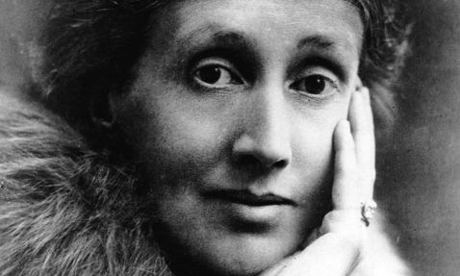
(Pictured is Virginia Woolf, famous feminist literary critic/theorist.)

96 comments:
January 28th
6 Bose said…
One of the lenses I chose was Feminist. I chose this not because I am a women but because I believe in what it stands for and how it affects our society. According to Wikipedia, Feminist are people that share a common goal of achieving, defining, reforming, and establishing rights for women. I believe over the centuries and decades that have passed that women’s rights have come a very very long way. We are treated more equally, can vote, have a high level of education, and have the opportunity to have certain jobs. There are still some stereotypes that do remain in society today, but you will find stereotypes with every race, gender, heritage, even every type of sports, or groups of kids. I am all for women's rights but I am not an extreme feminist. I believe that feminists are just trying to open the lense of how women can do just as much anyone and that they are not inferior to jobs or genders. The other lense I chose was Deconstructionist. According to Merriam-Webster, Deconstructionist are people that use a theory that was used in the study of literature or philosophy which says that a piece of writing does not have just one meaning and that the meaning depends on the reader. I would consider myself a deconstructionist. When I read a book or read anything really, I interpret it in my own way. I build an environment and create the characters in my head. It is like I have movie going on in my head. William Golding, the author of Lord of the Flies, has this amazing setting in the book. When I read this book I created the island in my head and I created all of the characters in my head. What they looked like, how they acted, I even let the words come out of their mouths as if I was there and they were talking to me. I really connect to William Golding’s style of writing because when he gives such detailed settings it makes me easier to see the setting and all of the events that are happening.
I first chose to research the feminist lens. The feminist lens views society in a patriarchal way and this hinders women from understanding their true potential (http://comosr.spps.org/lit_theory). With that, the feminist lense is viewed as the helpless roles that female have throughout society. An example of this from the Lion King is how the female lions provide food and care for the baby, while the males have all the power. Another example is the transfer of power when Mufasa dies. Mufasa’s wife is never considered to be the next one on the throne; she’s not even considered even though she would clearly be a better choice than Simba. According to Wikipedia, the feminist lense shares a common goal of defining, establishing, and achieving equal political, economic, cultural, personal, and social rights for women.
The other lens I chose was the psychoanalytic lens. This lens focuses as works of literature in their fictional form. This includes the personality, state of mind, feelings, and desires of the author. Work generated through this lens often correlates with the the mental traits of the author (http://www.mpsaz.org/rmhs/staff/rkcupryk/aa_jr/files/microsoft_word_-_literary_theories.pdf). It is not always easy to find the meaning of the text with this lens; you must often look into the psychology of a character or an author. An example of this from the Lion King is how jealous Scar is of his older brother. Another example is overcoming feelings of guilt, which Simba had to do after his father died. According to Wikipedia, the goal of the Psychoanalytic lens can be simply the psychoanalysis of the author or another character in a piece of literature.
I think that I tend to gravitate towards the feminist lens most often because it’s the lens that I understand the most. With that, it is easier for me to find the use of this lens in literary work compared to the other types of lenses. A famous feminist theorist is Cathy Young.
7 Hammond
One of the lenses I chose was psychoanalytic. I chose this because I enjoy psychology and the deeper aspects and thinking about people and how they work. Researching this lens, the website public.wus.edu, says that it "adopts the methods of 'reading' employed by Freud and later theorists to interpret texts. It argues that literary texts, like dreams, express the secret unconscious desires and anxieties of the author, that a literary work is a manifestation of the author's own neuroses." which I think is a good definition of it. A good demonstration of this is in the book "The Lord of the Flies". While there is more symbolism, the symbolism is that each character represents a part of the human psychology. The story tells a deeper tale about how these characters, this pieces of human nature, interact and how we humans deal with things and how society affects our behavior. While Freud (obviously) is a famous psychoanalytical theorist, a few other examples of psychoanalytic theorists would be, Harold Bloom, Peter Brooks, and Jacque Lacan.
The second lens I looked at was the feminist lens. I went to ow.english.purdue.edu this time to find my information. It had lots of very good and useful information. This lens, as the title would imply, deals with feminist issues such as how society is mainly male dominated, how women are oppressed politically and socially, and the differences between defined sexuality and gender. As a female, I find I tend to naturally gravitate towards this lens. It is always fascinating to use this lens in reading and seeing how the author portrays women. Using "The Lord of the Flies" as an example again, looking at the book through a feminist lens, one can notice that there are no women on the island, only boys. There is one graphic depiction of one of the few females on the island; the sow. In this graphic scene, the boys brutally kill a mother sow, and, amidst the rage and the blood-lust, stick her with a spear. In later reading and analysis, it would seem a sexual reference, and looking at it through a feminist lens provides for very interesting discussion. Some examples of famous feminist theorists are Mary Wollstonecraft, Simone de Beauvoir, and Julia Kristeva.
Peltier 1
One of the lenses that I chose to look more deeply into is the feminist lens. I did not choose this lens because I am a woman myself, but rather I chose it because feminism was a major problem in our history. According to Purdue OWL, feminism is the way in which literature reinforce or undermine the economic, political, social, and psychological oppression of women. the feminist lens is a degrading language system created by male-dominated power. Common forms of the feminist lens occur by using negative connotation in order to make males look superior to females. In reading the books in class, like Lord of the Flies, and also books that I have read outside of school feminism appears in many other different ways. these ways include gender exploitation and gender roles. Gender roles could include references to women being the ones to clean the house and provide food for the family. All of these techniques are used to make women look like they have less authority and are not capable of doing the same things men are capable of doing. The other lens I chose is the marxist. According to Wikipedia, the marxist lens is based on socialist and dialectic theories. Marxist literary works as reflects of the social institutes of which they originated. This literary works does not aim to mention the working class, but rather it aims to explain the literary work more fully. The goal of Marxist is can be to analyze the the class constructs displayed in the literature context. I feel like this is a lens that we should truly care about because literature is directly connects us to real life, by relating rich to poor, owners to workers, and even cats to dogs. Marxist is a lens that helps us see the difference of all the social classes in reality. I believe I gravitate towards the marxist lens because I have a firm understanding on it and I get what the point of it is. In Lord of the Flies William Golding uses it often. He displays it by comparing people that have authority to those who do not. He does this by displaying how a group of people can overthrow another person and bring somebody else to power. I find the way he displays marxist intriguing and he does it in a cool subtle way.
6 Mullet
The feminist lens takes a look at the world through a “battle of the sexes” in a sense. Purdue OWL, an accredited English resource, states that the feminist lens “reinforces or undermines the economic, political, social and psychological oppression of women.” The lens questions the traits characters possess, and whether they are feminine or masculine. The lens then applies that to their power status, the author’s views on patriarchy, and the events that unfold on these characters. The feminist lens is aimed to promote gender equality and gender difference awareness.
The psychoanalytic lens takes a deep look into the subconscious mind and is rooted from birth. Purdue OWL provides a background knowledge to Freud’s theories, such as the unconscious mind and desires, Id Superego and Ego (desires, morality, and the balance between them), and the Oedipus Complex (children vie for their parents full attention and envy their same-sex parent). As one reads a piece of literature, they can ponder why the author chose these specific problems, why some people interpret the story the way they do, and why the characters have the fascinations, or obsessions, they possess. The psychoanalytic lens aims to try to identify why the characters take the actions they do and why the author chooses all details.
I tend to gravitate towards the psychoanalytic lens due to the fact that I enjoy psychology. I love pondering at what makes the mind work and what we are composed of. This lens is perfect for me due to this fascination. I like discussing possible motives and reasoning the actions of the characters. Since I find psychology the most interesting, I spend most of my reading time reading through a psychoanalytic lens. Sigmund Freud is the big, famous theorist that introduced this lens, so it is fitting to say he is the theorist I share the same lens with.
One of the lenses that I find most interesting is the Marxist lens. Purdue Owl says the Marxist lens looks into our social rankings and interprets literature from which class it was derived from. What had gotten me interested in the Marxist theory is when we read Animal Farm in Honors English 10. I became fascinated with the communistic ideas and the class rankings because it is something uncommon and unknown and I simply wanted to know more of the psychology behind the dictator’s minds and the Marxist lens is just one opening. Karl Marx (the creator of this lens) believes that the struggle between different classes will lead to uprisings and revolutions. Therefore, when using this lens in literature, we look at how the more poor or the less fortune group is in relation to the higher class group. People interested in the Marxist lens are commonly interested in who Marxism truly benefits because it is unclear. They are also amused with how the lower-class is oppressed. The feminist lense, according to Purdue Owl, is the perception of women in literature. A feminist lens may portray women to be the power figure, or simply hard working and not just a “house-wife”. This lense will also bring up the point that women are commonly oppressed and do not have the freedoms they should. People in support of the feminist lens are people who want and believe women should have rights and that they should be equal, if not greater then men themselves. I am more interested in the Marxist lens than the feminist lens mostly because, as previously stated, I am not exposed to the Marxist lens as much as the feminist lens, therefore, it is more interesting. Leon Trotsky (related to Animal Farm as well) is another well-known Marxist. He was a soviet politician, the leader of the Red Army, and an enthusiastic Marxist. He wrote, “Literature and Revolution” in which he analyzed society and how it shaped the common person’s mind. There are many different lenses and many points of view to be considered and discovered, these are just two. Any way you can analyze a story is just a whole new world to discover so it is amazing to get to look through all lenses.
I love looking at literature I read through different lenses. Getting a new perspective in books provides new insights, and new revelations of deeper meanings to the readings that I appreciate. Two lenses I gravitate towards are structuralism and feminist. Structuralism is “reading between the lines” and finding a pattern of deeper meanings than what is obviously presented to the reader. Purdue OWL gives a great example of it: “...the picture of the reclining blond beauty in the skin-tight, black velvet dress on the billboard...'tells' us that those who drink this whiskey (presumably male) will be attractive to...beautiful women like the one displayed here’ (Tyson 205)”. They do not blatantly say that that is the meaning on the billboard, but it is implied and anyone who sees it, consciously or not, will receive that message. Two important theorists in structuralism are Charles Sanders Peirce and Ferdinand de Saussure. One important idea Peirce contributed to is the theory of “signs” that represent things to us universally. An example of this are the stick figures on bathroom doors that show one side is for women, one is for men. The website, Schmoop informs us that Saussure added to the major idea in structuralism that everything can be analyzed and found to have “deep structure” in it. Feminist critics look at how literature portrays women within novels and how they use egregious sexist language. Purdue OWL defines it as, “ ‘...the ways in which literature (and other cultural productions) reinforce or undermine the economic, political, social, and psychological oppression of women’ (Tyson).” The oppression of women is something that has existed in our society for, well, forever. So a feminist lense can be used in every novel. Novel’s are made using history. Even in books like Lord of the Flies, where every character is male, you can find the feminine characteristics in some of them and how the other people in the novel treat them because of it. I tend to use the Feminist lense the most because I believe in the equality of not only men and women, but everyone. (Not economically wise, I am a capitalist.) But socially, racially, and sex wise. Kate Millet and her book, Sexual Politics, is an example of a literary feminist critic.
When given this topic, the one particular lens that stood out to me was the deconstruction theory. Needless to say, this was slightly difficult to understand. Let us start with an example. The statements given, "I am lying. Am I telling the truth?", irked my inquisitive mind, and I delved further into my own thoughts on this particular sentence. If the person says that they are lying, can they be telling truth? The two sentences keep on looping back onto itself over and over. This is what, so I learned, Deconstruction is based upon. Instead, Deconstructionists say that every piece of literature is always contradicting itself. One particular video, made by Knowledge Channels on YouTube, gave me several great examples of how this can be applied. He stated a poem, and went line by line of how they each can mean something completely different than what was literally implied by the reader. The other lens that intrigued me was the psychoanalytic theory. According to an article written by Michael Delahoyde, “It argues that literary texts, like dreams, express the secret unconscious desires and anxieties of the author...that a literary work is a manifestation of the author's own neuroses.” I find this lens to be the one that I will gravitate more towards due to the fact that the human mind is one of the most spectacular to see what makes it tick. Coincidentally enough, Jacques Derrida used parts of what Freud said in the psychoanalytic theory, and used it to fabricate and create his own theory: Deconstruction. He even found contradictions and tensions in what Freud said. I find studying the reasons behind why people do what they do is very fascinating, and this information can be used in many situations, with emphasis in describing and analyzing pieces of literature. When reading stories, the reader can have a completely different outlook on a particular character once they apply the psychoanalytic lens. After applying the lens, the reader can view the story at certain parts to better understand why that character does what he does, and what inflections of the author's mind are shown through this.
I tend to lean towards looking through a more feminist lense, as it seems everyone tends to do, because I identify myself as a feminist in certain aspects of my life. The Purdue Owl describes a feminist critic as so, “Feminist criticism is also concerned with less obvious forms of marginalization such as the exclusion of women writers from the traditional literary canon: "...unless the critical or historical point of view is feminist, there is a tendency to under-represent the contribution of women writers”. Luce Irigaray, a Belgian-born French philosopher and feminist, is one critic whom I admire for her famous works: Speculum of the Other Woman (1974) and This Sex Which Is Not One (1977). Irigaray is not an extreme feminist, in contrast to Portlandia’s fan-favorite extreme feminists, Toni and Candace. She takes a more gentle approach to the controversial and highly arguable topic. I do tend to gravitate towards feminism, but not quite as much as I identify more with the idea of Postmodern, or postmodernism, literary criticism. It is generally less debated. According to Wikipedia, “ Postmodernism promotes the notion of radical pluralism; that there are many ways of knowing, and many truths to a fact. From a postmodern perspective knowledge is articulated from perspectives, with all its uncertainties, complexity and paradox”. This type of criticism is not only applicable on literature, but also on the arts and film, which makes it much more interesting in the categories of literary criticisms. Pierre Bourdieu, born in Denguin, France, is a well-known anthropologist and philosopher who specializes in postmodernism. He generally works with the concern of power dynamics in society and that is outlined in his famous book, Distinction: A Social Critique of the Judgment of Taste (1979). Both of these lenses, as well as the rest I did not mention, are incredibly helpful in better understanding and comprehending literature.
Nelson 7
One lens that I researched was the marxist lens. Karl Marx extensively studied social organization and concluded that all of human history balanced between classes of the oppressed and the oppressing. Marx taught many to believe that materialism is the driving force of conflict. According to Marxists criticism, literature reflects class struggle and materialism as well as reflecting the own author's financial situation or personal opinion of the classes. Michael Delahoyde from Washington State University has an article that helps readers keeps in mind issues of power and money by answering questions such as: What role does class play in the work; what is the author's analysis of class relations; How do characters overcome oppression; Are social conflicts ignored or blamed elsewhere; Does the work propose some form of utopian vision as a solution to the problems encountered in the work? With these questions in mind it was easy to understand how to use a marxist lens.
The other lens I desired to learn more about was the deconstructionist lens. One of the more controversial and radical lenses, deconstructionism has a goal to show how texts contradict themselves. Instead of showing how everything ties in together, deconstruction tries to show how texts unravel themselves. This is the best lens to use when looking deeply at at text's beliefs or assumptions. In my studies I found that this lens is not fully developed or accepted. Another article by Michael Delahoyde says “The text has intertwined and contradictory discourses, gaps, and incoherencies, since language itself is unstable and arbitrary. The critic doesn't undermine the text; the text already dismantles itself. Its rhetoric subverts or undermines its ostensible meaning.” I believe that looking through the deconstruction lens is easier said than done.
The one lens I know the most about is the feminist lens which is also why I gravitate towards it. The list of feminist writers as well and novels goes on and on. Most commonly when one thinks of a feminist writer, they think of the middle ages woman in a black and white photo fighting for women’s rights in general. In the modern day there are just as many feminist writers although the messages are starting to change. One theorist who I share the feminist lens with is Louisa May Alcott, the author the Little Women.
Post-colonial criticism offers a unique perspective on the literature produced by colonial powers (and those who were colonized). Authors in the classic age of imperialism were directly influenced by the political circumstances of their day; there existed an interesting dynamic between Western colonizers and the peoples they controlled. According to the Purdue OWL, post-colonial theory examines how this dynamic of hegemony impacts the issues of power, economics, religion, and culture in colonial literature. The post-colonial critic asks a variety of questions: How does the text depict colonial oppression? Are there groups of people designated as outsiders? How are they treated? Do colonial politics affect character self-perception? Post-colonial criticism was founded by Edward Said, a Palestinian literary theorist who spoke out against culturally inaccurate representations of Oriental nations in Western literature.
Many of the books I read were written by English authors living in the age of imperialism; I think my mind unconsciously gravitates toward post-colonial criticism (although I have never recognized this lens, nor even known it existed). Some books are more easily analyzed than others, but King Solomon’s Mines by H. Rider Haggard is an obvious choice. Haggard was born in England in 1856, later moving to South Africa (a British colony at the time) to farm and work in the Civil Service. The book portrays the native Zulus and Kukuanas as savages possessing little sense of civility; doubtless this was the perspective Haggard picked up living as a Westerner in colonial South Africa--his work is partly a product of his political surroundings. To what degree should he be excused for material modern readers recognize as racist? An interesting question indeed.
According to M. H. Abrams, literature is a product of the economic and ideological factors specific to its era. Such is the foundation of Marxist criticism, which examines the interaction of social classes and the material realities of society within literature. Sometimes an author uses a work to represent a particular social class, while other times a work merely documents the struggle between social classes. As the name implies, this literary lens is based on the socioeconomic theories of Karl Marx.
Polasky 6
The feminist lens has always seemed interesting to me so I thought I would look farther into it. Feminist lens is a way to look at a piece of literature in a new way. This includes looking at a novel to see how women/men are portrayed, the limits or privileges women/men are given, and how each character acts. Looking through the feminist lens does not have to be looking for any girly character but looking at how each character, male or female, is portrayed (http://bookbuilder.cast.org/view_print.php?book=53482).
Another lens I wanted to look farther into is the marxist lens. Looking through this lens you can see how an author may write about how a character or setting experiences a class system, class struggle, or materialism. When looking into the way someone acts or what they believe in is using the marxist lens. This lens is not just looking for socialist or communistic views but any economical status (http://public.wsu.edu/~delahoyd/marxist.crit.html).
My favorite lens that I associate with often is the feminist lens. It is not just because I am a women. This lens deals with how men and women act and are perceived as. In The Lord Of The Flies we looked at characters such as Piggy or Ralph and said that they had more nurturing qualities which stereotypically speaking women have. Without looking through this lens we may not have seen this characteristic and we might have just seen them as thoughtful or sensible which they were. Another reason I like this lens is because it can give everyone a view on how society is sometimes sexist and did not always treat women or even men the way they should be treated. Sometimes men are viewed lesser than women but that is not right either. Everyone should be seen as equals. One famous feminist theorist is a Cathy Young.
The lense I first chose to research and explore was that of the Feministic view. I chose this because although I do not have a broad understanding yet, I would say this is the lense I have most often heard of. According to Purdue Owl, Feminist criticism is concerned with/focuses on the ways of which literature weakens women. Criticism through a feminist lense has dated back to the 1960s and is still a crucial lense in present day.
Another lense I chose to heighten my understanding of was the psychoanalytic lense. As briefly discussed in class, the psychoanalytic lense stems from that of Sigmund Freud’s freudian theories of psychology. Diving into the research in hopes to find more about this type of lense, I discovered that this approach validates the importance of literature. According to wsu.edu, this criticism is not concerned with what the author intended but instead what the author never intended. This method will allow the viewer to find the author’s own background within the characters and factors of his book.
Out of all the lenses I gravitate towards most I would have to go with the feminist lense. Many say that they fit along with this method “not because they are a woman” but I would honestly have to say that I fit along with this because I am a woman. The fact that I am a woman allows me to better relate and comprehend this standard of criticism. Having the outlook on life as a woman allows me to easily connect with the feminist side without having to think too hard about it. Lord of the Flies for example, I was able to quickly take notice to the lack of women in the novel and the strong use of men simply because I am a woman and take defense to the feminine side. Although I am not an accredited feminist, Mary Wollstonecraft was a famous theorist that shares the same lense as I. Wollstonecraft has been often called “first feminist” or “mother of feminism” due to her book-length essay “A Vindication of the Rights of Women” that gives an understanding to the history of feminism.
1 Gloege
When an author begins to write a novel, they can use many different lenses to appeal to their readers, and get their point across. Feminist, Psychoanalytic, Deconstructionist, and Marxist are all examples of different lenses that an author could use when they are writing. Personally, I think I am most like a Feminist. I believe that being a female has a lot to do with this. It allows the female reader to relate easier to the female characters in the novel than a male would relate to them. The Purdue Online Writing Lab says that Feminist lenses are “...the ways in which literature (and other cultural productions) reinforce or undermine the economic, political, social, and psychological oppression of women.” A famous feminist I could relate to is Maya Angelou. She wrote many books, and was also a Civil rights activist. Another lense is Marxist. Marxist is a lense that criticizes the social class issues in novels, and was created because of Philosopher Karl Marx. It also recognizes the development of capitalism, and class struggles during economic changes. Authors use this lense to relate to readers who may be struggling in their lives due to lack of money or work. It also can relate to the wealthy and fortunate, it all just depends on what class is being written about in the book. Psychoanalytic lenses are also used very often. It is based off of the methods created by Freud and many other theorists. Authors who use this lense argue that literary works express everyone’s secret desires and anxieties, similar to dreams we have. This is seen to be a subconscious response to how we are feeling.
I chose the psychoanalytic theory as my first lens. I chose psychoanalytic because I enjoy seeing how people think on a deeper basis. Which is a part of what psychology does. According to simplypsychology.org, psychoanalysis was founded by Sigmund Freud. Freud believed that people could be cured by making conscious their unconscious thoughts and motivations, thus gaining “insight”. The aim of psychoanalysis therapy is to release repressed emotions and experiences, i.e. make the unconscious conscious. One of the characteristics of a psychoanalytic lens is seeing all problems as rooted in the unconscious mind. This type of writing usually has a deeper meaning that what is at the surface.
Feminist lens is the other one i picked to write about because of all the advancements woman have made. I believe they should be looked at as equal in jobs and anything else they would like to do. According to womenshistory.about.com, Feminist literary criticism is literary analysis that arises from the viewpoint of feminism, feminist theory and/or feminist politics. Some of the beliefs of this lens are feminist literary critic resists traditional assumptions while reading. In addition to challenging assumptions which were thought to be universal, feminist literary criticism actively supports including women's knowledge in literature and valuing women's experiences. Feminists are influenced usually by the second wave of feminist. Its history has been broad and varied, from classic works of nineteenth-century women authors such as George Eliot and Margaret Fuller to cutting-edge theoretical work in women's studies and gender studies by "third-wave" authors. In general, feminist literary criticism before the 1970s—in the first and second waves of feminism—was concerned with women's authorship and the representation of women's condition within literature; including the depiction of fictional female characters. In addition, feminist criticism was concerned with the exclusion of women from the literary canon.
The Psychoanalytic and Marxist lenses have always intrigued me. These two lenses set out to view the world as Freud saw it and as related to socialist ideas respectively. The Psychoanalytic lens tries to view the world as a psychologist would. They breakdown texts and literature and apply it to psychology, by comparing ideas to things such as the ego, superego, and id, or to things like the Oedipus complex. This lens applies these things and usually ties them in with our the human brain thinks and how humans act. The Marxist lens on the other hand compares literature and texts to socialist principles and the socialist way of life and thinking. They are quite similar in the sense that they both look at the way humans think and act, but Psychoanalytic is more about the individual, and Marxist is more about groups.
Personally I gravitate more towards to the Psychoanalytic way of thinking when applying a lens to literature. For example, in Lord of the Flies, my mind went to the Psychoanalytic way of thinking many times, such as the idea that Ralph represents the ego, Piggy represents the superego, and Jack represents the id. This is an example of looking at text through the Psychoanalytic lens, and this happened a lot reading through Lord of the Flies. I find the Psychoanalytic lens is one of the more relateable lenses out of them all because this lens is how humans think. Applying literature to how humans think is an easy and effective task to do, because we all think in similar ways (at least in most cases). One famous theorist behind the Psychoanalytic lens is obviously Sigmund Freud. The Psychoanalytical lens is based on Freud’s work on human psychology, and if it wasn’t for his ideas and findings, we wouldn’t have the Psychoanalytical lens.
The two lenses I naturally am inclined to research more are the psychoanalytic and the marxist lens. I find the study of the human mind very interesting and think writers make their characters so much more deep by giving them thoughts that deal with this concept. If the characters thoughts and actions have a psychoanalytic meaning then the reader can dig deeper into the novel causing more connection. Sigmund Freud is the main force behind this lens, in fact he was the first to use the term psychoanalytic. According to theories of learning in educational psychology, Freud is the basis for todays psychology. He was more interested in the dream aspect of psychology, it transferred over to literature when authors started making their characters and stories have deeper psychological meaning. The second lens I am attracted to the most is the marxist lens. This is very interesting to me because it deals with human nature. In the common day world everyone is looking to gain power, monetary value. This is what the marxist lens focuses on. Not only the money and not only communism, but the transfer of money and power. Of course, almost every book has some sort of money or power in it, but writers use symbols and smaller aspects to represent power and a lot of the time represent the culture of the time period. Lord of the Flies, Golding used the boys being rescued as a sign they were not going to anything better, they were going off to fight in a new war. This just transfers the power from Jack and Ralph to the soldiers. The marxist lens can help readers find symbols and a deeper meaning in smaller events throughout the story. All lenses are great to use, some are more fitted to stories than other. If you want to be a good reader and take the real meaning out of the novels, you will naturally learn the lenses and become your own critics.
The first lense I was eager to learn more about was the feminist lense. Feminist is avoiding social, political, legal, and the economic rights for women to be equal to those of men (www.dictionary.reference.com). I did not choose feminism just because I am a female, I chose feminism because it was a problem in our history and still somewhat is to this day. Gender roles was a big problem back in the day. Women were to stay at home to cook and clean, while the men were out working and earning money for their family. This showed how women have less authority and the men are the rock in the family. Susan B. Anthony was a famous feminist theorist against women's suffrage. Anthony lectured on women’s rights and started a petition for women having the right to vote and to own property. Women wanted to have the same rights as men and Susan B. Anthony acted to make it happen. Anthony along with fifteen other women voted in the presidential election (www.univer.omsk.su). Another lense I was eager to learn more about was the marxist lense. Marxist is the belief that the struggle between social classes was a major force in history and that there should be a society in which there are no classes (www.merriam-webster.com). Marxist is based on approach to theories and socialists. Marxist is still used to this day by relating the rich to the poor, business owners to employees, and there are many more scenarios. People are then ranked by others by what they have and put them into the category as a high, middle, or low class individual or family. In the Lord Of The Flies, William Golding uses marxist fairly often. Golding used marxist to show what authorities different characters have within his book making the reader think about where that character stands from the others.
The first lens I chose to look at is the Psychoanalytic lens. I chose to research this lens because I remember learning a little bit about the Psychoanalytic lens last year in my english class and also my psychology class. However, I wish to become someone of an expert on this lens to further better my reading/understanding. The Psychoanalytic lens comes from the ideas of a famous psychologist named, Sigmund Freud. Freud worked with patients that have behavioral issues in mental hospitals and listened to their stories. He believed that their unconscious has lead them to act a certain way in their lives. Many critics believe that this is translated over into the literary world. Psychoanalytic critics used Freud’s theories and found that there is an underlying meaning behind some author’s work. According to Washington State University, this hidden meaning “expresses the unconscious desires and anxieties of the author”. I gravitate mostly toward the Psychoanalytic lens because I find it very intriguing. There is always apart of the author’s unconscious in the novel. It is interesting to find out more about the author within his books. Sigmund Freud obviously shares the same passion as me towards the psychoanalytic lens.
The second lens I chose to research is the Feminist lens. This lens is also very intriguing because feminism has played a lot in our society’s past and present. It will most likely be a problem in the future as well. I agree that women should be treated equally as men. We are able to do everything they can. One reason why I chose to research the Feminist lens is because I want to learn more about it. I fully agree with feminism theories and I hope to learn more so I can also better my reading with this lens. According to Purdue OWL, the feminist lens focuses on how society undermines women. This includes politically, economically, and socially. It also focuses on how women are portrayed in novels and whether or not they are being stereotyped.
Many times I find myself gravitating towards the feminist lens. Is this because I am a woman, or because of the way society and literature portray it? Dictonary.com defines feminisum as the doctrine advocating social, political, and all other rights of women equal to those of men. In books/ movies like the Lord of the Flies, and the Lion King; viewing them with a feminist lens changes how you portray them. When watching Lion King as a child I never really put too much thought into it; simply because I was uneducated on different types of lenses, and symbols. Going back now with the feminist lens, the Lion King seems like a whole new movie. Why is it that when Mufasa dies Scar takes over the kingdom, when the best choice would be his wife? Women are usually not viewed as leaders. However if Mufasa's wife would have taken over then the kingdom never would have done as downhill as it did.
I also tend to find myself gravitating toward the psychoanalytic lens. I have always been very intrigued with the deeper thoughts/motives behind people, and just the overall idea how and why people act they way they do. According to dictonary.com psychoanalytic is a systematic structure of theories concerning the relation of conscious and unconscious psychological processes. When reading a book you must not only think about the symbols and thoughts of the fictional characters, but also the author! Reading into information about the author many times may help open your eyes to where they are coming from or why they wrote what they wrote. For instance William Golding fought in World War 2. Golding said he felt compelled to write about man’s evil. But beyond this, he wanted to make it clear in his book that such behavior could occur anywhere, even in a seemingly advanced nation such as England (Bloom’s guides page 11).
The first lens I chose to analyze is the Marxist theory. The Free Dictionary summarized the Marxist theory in these words: The political and economic philosophy of Karl Marx and Friedrich Engels in which the concept of class struggle plays a central role in understanding society's allegedly inevitable development from bourgeois oppression under capitalism to a socialist and ultimately classless society. http://www.thefreedictionary.com/Marxist+Theory Marxist theory focuses mainly on money, but also how money drives us to power. In society today it is nearly impossible to feel in power without grand amounts of money. The Marxist theory reminds me greatly of Lord of the Flies. In Lord of the Flies Jack and Ralph competed for power. I especially liked the part of the definition that said this theory would lead to a classless society. Which is exactly what occurred in Lord of the Flies; Jack sought after power so deeply that he resorted to killing as a solution to become the leader. In the real world people will do unworthy things just to possess money and feel powerful.
The next lens I chose to view is the feminist theory. The feminists work towards a common goal of making society equal despite gender. It’s easy to pick out many anti-feminist characters, plots, and symbols in classical works. It is this way mostly due to the fact that classical works were chosen in the time period around the mid-1900’s; therefore, a majority of people did not see women as powerful as men. Feminism, I feel, has come a long stretch through history but is still high topic of discussion today and people remain fighting for total equality of women.
I would have to conclude that I side more with the feminist lens, although, as I regret to admit that I also tend to gravitate towards the Marxist lens. I would say I am a moderate feminist. It never really came to my full attention until this year. I always understood it and its purpose but I wouldn’t say I became a knowledgeable feminist until just recently. It just seems like common sense in my mind that women should be equal to men on all aspects,but I guess differing circumstances and lack of knowledge led people back in history to accept an alternate view.
The two lenses I chose were Feminist and Marxist. The feminist lens are really seeing how women are shown through books and whether or not women are placed in a stereotype. The main focus is to see how women are portrayed, how they function, and behave as women. It is fascinating to see authors use this lens and see how they portray women. As a woman myself I tend to gravitate to the feminist lens over any other lens. The feminist lens can be hard to pick up but sometimes easy as well. For example, in the Lion King, there is helpless female lions but they only provide food for their young and care yet the males get all the power (http://www.slideshare.net/kerryhayes/marxist-and-feminist-lenses-2014). Nala is the stronger lion out of the group and is stronger than simba, but she does not inherit the crown.
According to Wikipedia, Lisa Tuttle has defined feminist theory as asking "new questions of old texts." Her goals for feminist criticism is to develop and uncover a female tradition of writing, to interpret symbolism of women's writing so that it will not be lost or ignored by the male point of view, to analyze women writers and their writings from a female perspective, to resist sexism in literature.
Marxist lens helps examine how the socioeconomic factors influence the book as a whole. Through the theories of class struggle, politics and economics that Marxist literary criticism emerged. The Marxist lens comes up through the ideas of social class and class conflict. According to http://public.wsu.edu/~delahoyd/marxist.crit.html, literature reflects class struggle and materialism. Literature reflects an author's own class or analysis of class relations, however piercing or shallow that analysis may be. Literature also reflects social institutions which emerge throughout the novel. Marxist lens look to mention the social and economic views not the communist views like Hitler and other communist leaders.
The two types of lens I am focusing on are feminist and marxist. The marxist lens was created by Karl Marx. This lens focuses mainly on how socioeconomic factors can influence the plot and characters. It also highlights the idea of working people and how they can be oppressed within society according to Purdue Owl. This lens focuses more on society than law. Karl Marx holds the idea that uprisings will come from the working class themselves. Once overthrown all classes will be more equal which in today’s world is called socialism. What class is the author from is a common question asked by scholars. This lens intrigues me because many books have the idea of a social class divide. In many ways it can correlate with society in today’s world too. The other lens I explored is the feminist lens. Purdue Owl stated that the feminist lens is ways in which literature reinforces the economic, political, and social oppression of women. It looks specifically how our culture is male dominated. Many times women can be under-represented in literature and throughout history. It can also can help examine how gender is a factor overall. I find feminism to be one of the most interesting lens we study because it has evolved over so many years. The first wave of feminism began in the 1700’s and is still ongoing today. That is something very spectacular and interesting about the feminist lens. Feminist lens also goes into the idea of gender roles and the limits these ideas place on gender in itself. I find the idea of gender roles and dominance to be very interesting. It also is a very studied lens and can be found it many books. It makes me wonder how these ideas were formed and from who. Evelyn Reed was a feminist who wrote about it and fought for it.
An important lens to look through and that relates most to what is happening in today’s society is the Feminist theory. The Feminist theory looks at the culture and how it is dominated patriarchal, by men. It deals with the oppression that women are facing. Women face oppression economically, politically, socially, and psychologically. In the man run world a woman is only defined by her difference from the male norms and values. Yet, feminist lenses do not just include women. Men who are represented as feminine instead of masculine are viewed negatively or as victims. For example, Piggy is ostracized and he is portrayed femininely and similar follows with Ralph, and Simon who are also feminine characters. It is meant to exploit and show readers that our culture had advances for men and no chances for women. Another minor concern from the theorists, that I did not know until reading this article, is the lack of representation of women writers. Women are not represented in writing unless from a historical or critical standpoint (https://owl.english.purdue.edu/owl/resource/722/11/). The next lens I chose was the Marxist Lens. I chose this lens simply because I had no knowledge about it. The Marxist Lens is a lens that criticizes class differences along with the problems found in the capitalist system. It attempts to show the ways that one’s socioeconomic system is the source for their own experience. The lens makes the reader question which class receives the most benefits. The elite or the middle class? Similar to the feminist lens and that reveals the oppression women face; the Marxist lens reveals the oppression of the working class in everyday life and in literature. This lens is also valuable with the ability to correspond with what is happening in today’s society (https://owl.english.purdue.edu/owl/resource/722/05/). I gravitate more towards the feministic lens. This is simply because I can relate to women not being able to be equal to men. It can be seen in everyday life how men are treated differently than women. A feminist theorist who agrees with me is George Eliot. She was a Victorian woman who devoted her days to writing with feminist themes (https://www.nytimes.com/books/97/07/27/reviews/970727.27peterst.html). Feminism has come far but will not rest until women and men can be equal; not women are more superior than men.
To start off, I have always been one to pick up a book in my free time. I have always enjoyed reading any type of book of my preference--obviously. For years I have been forced to read books. It started off learning letters, learning words, learning to read, having to set goals to meet, testing off of books just to make sure we actually read them...but what is the use of that? Reading is literature. Literature is reading. Literature is being able to read the book, and enjoying it enough so you can analyze it. Authors may just throw sentences together to write a sloppy book, but that is rare. Authors purposely use different types of lenses to make the book stand out. To not directly infer what they want you to know, but you have a big enough knowledge to understand. My favorite type of lenses to help me understand would be psychoanalytic and feminist.
A psychoanalytic lens, best said by Michael Delahoyde, adopts the methods of "reading" employed by Freud and later theorists to interpret texts. It uses the author's feelings all over a book without giving any direct indication that the author feels that way specifically. This type of lens usually give us unresolved problems or scenarios that we are allowed to interpret all for ourselves. That is the joy of literature of reading, it allows our mind to think/interpret without the slightest realization of so.
My second and last lens I chose was a feminist theory. I chose this because I am a woman? Wrong. I chose this because it is an effective use of literature in certain given circumstances. As stated by Kerry Hayes, this lens helps us examine how gender is a factor in any given piece. Feminism is not specifically on the portrayal of women, but of men as well. In class we discussed a movie--one of my favorite childhood movies--that uses more literary lenses than we could count, The Lion King. An example of this feminist theory is the crowning of Simba and not Nala. Simba(and Nala’s) father passes away. It is obvious that Nala is much stronger than Simba, but for the mere fact that Simba is a boy, the crown is passed along to him. Another example is from the book The Lord of the Flies. Piggy is a young boy who has been secluded from the group from the beginning. Piggy has always been the most wise and sensible, almost mother like to all the other boys. For this reason, all other boys seemed to look down upon him as a weak link. Feminism is more than just a degrading thing towards women and men, but an actual way to critique and analyze stories.
Beck 1
The First lense I chose to look at was the Feminist lense, I did not just choose this lens because I am a female, but because looking at society men and women are treated differently, and it is not for the good of women. Women are treated on the lesser side of everything, at one point in life women were treated as property and some still probably are. Looking at the definition of feminism on wikipedia it says that feminism is a range of movements and ideologies that share a common goal. Which is to define, establish, and achieve equal political economic, cultural, personal, and social rights for women. Some people may say that men and women are treated equally, yet others may think differently. There can be many stereotypes hidden in parts of the world in different things. Such as getting a job there is a highly sophisticated man and woman both applying for a job, they both have equal qualification, yet the man is going to get the job over the woman. The little things show.
The second lense I decided to further explore was the Marxist lense. Looking at wikipedia to see the definition I came up with this: Marxist Literary Criticism deals with literary works that are reflections of the social institutions from which they originate. Literature itself is a social institution and it has a specific ideological function. This lense directly deals everyday social items, literature is something that can really connect us with past social lives. It can truly explain the social statues and how things originated.
The lense I would have to say I gravitate towards the most is the one of feminist lense, I look at this and see things in everyday life that deals with feminism and how women are treated as compared to men. For example in the book The Lord of the Flies, it does not have a very clear feminist lense, you have to look deep inside to find it. For starters on the island it is all male characters, and no female characters. Yet feminist is used a little bit in the book, but you have to dig deep down in order to find it and understand what it really means. Piggy is the main feminist in the book, it is discussed that people sometimes consider him the grandmotherly type, with his large glasses and large body. When people think of their grandparents some may think of a larger woman with glasses and this could be seen with him. Another thing is his sense of order, most women like to have things in order and how they want it and you can see here and there this feature in Piggy. Looking for a famous theorist that shares the same lense that I gravitate towards I wanted to find someone that was recently an activist in this, some one in the last century or so. The theorist I found was Margery Corbett Ashby and she lived from 1882-1981, and she was a suffragette. This lady fought for what she believed in and she believed for women's rights.
It is interesting to find so many different lenses to analyze literature with, yet they weave together to possibly further explain the literature that is being looked onto. The first lens I chose to research was the Marxist lens. According to Wikipedia, the Marxist literary theory is based on socialist and dialectic theories. Marxist critics view literary works as reflections of social institutions from which they originate. Marxism was first introduced by Friedrich Engels and Karl Marx, a German philosopher, economist, journalist, and revolutionary socialist. The purpose of the Marxist literary theory is to look at literary works and how they reflect the struggles of socioeconomic classes and materialism. For example, a person reading with a Marxist lens on would look for the issues of power, the role of characters and how they relate to the classes, how characters may overcome oppression, or how social conflicts are ignored or blamed on someone else.
The second literary lens is the psychoanalytic. According to Wikipedia, the psychoanalytic lens is the psychoanalysis of a certain character, or even of the author in a literary work. Psychoanalytic lens directly relates to Sigmund Freud, an Austrian neurologist, who developed the psychoanalysis technique in his studies The critics using this lens will analyze the characters or author as psychological case studies, looking for concepts popularized by Sigmund Freud. The concepts include theories such as the id, ego, and superego, or even the Oedipus complex. These Freudian concepts influence the thoughts and behaviors of the character(s) being studied.
I tend to find myself reviewing books with a psychoanalytic approach because I look for the character’s reason behind doing a certain thing. It is one of the easier approaches for me to understand, which would make sense as to why I criticize literary works with it. Sigmund Freud, the obvious champion of Psychoanalysis, is arguably the most famous theorist who uses this lens.
Schroeder Pd. 6
One of the two lenses that I chose between the Marxist lense, Feminist lense, Psychoanalytic lense, and the Deconstructionist lense, were the Psychoanalytic lense and the Feminist lense. First, the Psychoanalytic lense I did not have a clue what it entailed so I looked on Wikipedia and in the Oxford English Dictionary. Personally, I did not like psychology but this theory caught my attention back in Mrs. Ebright’s class. This lense was created by Austrian Sigmund Freud, this therapeutic method was used for treating mental disorders by investigating the interaction of conscious and unconscious elements in the patient’s mind and bringing repressed fears and conflicts into the conscious mind. Freud used techniques such as dream interpretation and free association. Psychoanalytic theorists believe that human behavior is deterministic. They say that it involves three things: irrational forces, the unconscious, and instinctual and biological drives. Due to the deterministic nature, psychoanalytic theorists do not believe in free will. Freud said that it is the unconscious that exposes the true feelings, emotions, and thoughts of the individual. The other lens that I found interest in was the Feminist lens. Feminism has been going on even before the 1800’s, the movement has not stopped gaining momentum since. When researching Purdue Owl, I had read that the Feminist lens is a way in which literature reinforces the economic, political, and social oppression of women. Another way is it studies the way that our society and culture are male dominated. I feel like nowadays, males and females have equal rights other than a few exceptions, but very equal in my eyes. Feminist lens also goes into the idea of gender roles and the limits these ideas place on gender in itself. There is a wide range of books out there containing not only the Feminist lense but the Psychoanalytic lense. Some famous authors that demonstrate the Feminist lense within their books are: Gloria Steinem, Germaine Greer, Jo Freeman, and Bell Hooks.
The feminist lens views the way that “women characters are portrayed, exposing the patriarchal idealogy implicit in the so called classics” (Murfin) Viewing literature through a feminist lens can help analyze sexism in the time period that the literature was written. “The Yellow Wallpaper” by Charlotte Perkins Gilman is a classic example of feminist writing. The short story, written in the late 1800s, is story told through secret journal entries of a woman suffering from postpartum depression. Her husband buys a mansion and forces the woman to forgo her work as an author and recover from her illness by taking time off from daily activities. When this novel is viewed through a feminist lens, it is easy to see that she is being held back from life by patriarchy. Throughout the novel, the woman says that it helps to write, even though she is forbidden to write by her husband. The woman is tormented by the awful design on the yellow wallpaper in the nursery. The wallpaper symbolized the patriarchy; she eventually is smothered by the patriarchy and goes irreversibly mad. A feminist lens helps to ascertain the harsh sexism in which women lived through during the time period, and helps to understand certain aspects of sexism in modern society.
The Marxist literary criticism lens describes literary criticism based on social classes. Marxist criticism views literature based on the classes of the social institution that the literature originates from. When viewing literature through a Marxist lens, you would see the class struggle and materialism. Marxists often ask “how often does the quest for wealth define the character?” when viewing literature. The literature is seen as a reflection of the author’s class and an analysis of the class struggle of the time period of origin. The literature can be seen as either propaganda for the status quo, or even a rebellion against the status quo. One Flew Over the Cuckoo’s Nest by Ken Kesey when viewed through the Marxist lens, shows the struggle between the lower class (the patients) against the oppression of the wealthy (Nurse Ratched). McMurphy comes in the psych ward and aims to disrupt this class system.
Murfin, Ross, and Supriya M. Ray. “Critical Approaches: Definition of Feminist Criticism.”
virtuaLit: Interactive Poetry Tutorial. N.p., n.d. Web. 15 Mar. 2014.
<http://bcs.bedfordstmartins.com/virtualit/poetry/critical_define/crit_femin.html>.
Delahoyde, Michael. "Marxist Criticism." Marxist Criticism. N.p., n.d. Web. 27 Jan. 2016.
One of the lenses I have chosen is the feminist lens. According to fiministandgenderlense.com, he feminist lens helps view how women characters are portrayed in so called classics. The feminist lens is trying to see how women are really shown through out books and whether or not the women in these books are portrayed as stereotypes or not. The feminist lens is looking to accomplish equal rights for women in all aspects: economic, cultural, personal, financial, carriers, and other social rights. There are still some inequalities that women face each day and the feminist lens is looking at these barriers through books. For example, how come in The Lord of the Flies all the characters are male. Would the story change if there were females on the island? I am often drawn to this lens but maybe that is just because I am female. I am not an extreme feminist but I do believe we deserve equal rights as men. Judith Sargent Murray is a famous feminist lens author and wrote The Gleaner. Another lens is the Marxist lens. According to Wikipedia, the simplest goals of the Marxist literary lens is to assess any political ‘tendency’ of a literary work, determining whether its social content or its literary for are ‘progressive’. Marxist critics often try to see what role a class plays in a certain novel and what is the stereotypes the author is giving that class. They also look to see if the work shows any propaganda for any social rankings. In the novel A Tale of Two cities, the higher class is made to look like the villains of the novel. The novel is propaganda for the lower class. (However that is my all time favorite book). It is interesting to read a book keeping in mind of the different lenses and I will try to keep this in mind as a keep on reading this semester.
The lens that I first chose to research and explore more in depth about was the feminist lens. I chose this lens because although I do not have a deep understanding about it, it is probably the one that I have heard of the most out of the ones listed. According to Purdue Owl, feminist criticism is concerned with the ways in which literature undermines or reinforces the oppression of women. Obviously, criticism through a feminist lens has dated back a few centuries, but is still continuously happening today.
Another lens that I chose to heighten my understanding of was the marxist lens. I am quite unfamiliar with that of the marxist lens. According to Purdue Owl, marxism attempts to reveal the ways in which our socioeconomic system is the ultimate source of our experience. The one question that tends to arise with this topic, would be whom does this benefit? The elite? Middle class? Marxist critics are also interested in how the lower or working classes are oppressed--in everyday life.
Out of all the lenses listed, I gravitate towards feminism the most. I would have to say that I can relate to this the most because I am a woman. The fact that I am a woman makes it a lot easier for me to comprehend and relate to this topic. I just find it so interesting that over many centuries it is still going on today. For example, in The Lord of the Flies, all of the characters are boys. There is a significant lack of female figures in the novel; therefore I took defense to the feminist real quickly. Although I am not an accredited feminist, Evelyn Reed was one of many women who wrote about feminism and fought plenty for it.
1 Wardlow
The two literary lenses that I find myself noticing the most are feminist and Marxist. Feminist lens, also called feminist criticism, deals with the way society treats women. Purdue describes the feminist lens as examining the economic, social, political and psychological oppression of women. Michael Delahoyde says that the Marxist lens examines the quest for wealth. The Marxist lens is concerned with the issues of power and money. I notice feminist lenses the most often, not because I am a female but because I find that the feminist lens is used most often, or at least most obviously. I enjoy looking through this lens because I think this lens really portrays society the best. This lens portrays society the best because women make up such a big part of society and are essential to the survival of the society. I also like to scope out marxist ideas in my reading. The ideas and issues with power and money can be found in any literature. Society needs money to function therefore it is a concept that all readers can find themselves relating to in some shape or form. When looking for a famous writer who used the feminist lens often I found Mary Wollstonecraft to be interesting. The first peculiarity that struck me about Wollstonecraft was that she had an abusive father. She was abused by a male. I wonder if the abuse inflicted on her by her father is what drove her to become a feminist and write literature with a feminist lens. Another peculiarity about Wollstonecraft was that I found on biography.com was that she had not one, but two children outside of wedlock. Having children without being married was extremely uncommon and severely frowned upon in her days. I believe that she had those children almost as protest to the oppression of women. One of Wollstonecraft’s most popular books was A Vindication of the Rights of Woman, in which Wollstonecraft presses for reforms in education.
An author has many options of lenses they are able to use to appeal to the specific type of readers who read their novels. Feminist, Marxist, Psychoanalytic, and Deconstructionist are a few examples of lenses. I believe I relate the best with the feminist lense. Since I am a woman, this does play a big part in my life. I’m not a super big feminist, but I believe everyone deserves to have equal rights, regardless of age, gender, race, etc. Women’s rights have changed drastically over the course of a century or two. Women are now able to vote, go to school, obtain professional jobs, and speak their minds. According to Purdue Owl, “Feminist criticism is also concerned with less obvious forms of marginalization such as the exclusion of women writers from the traditional literary canon: ‘...unless the critical or historical point of view is feminist, there is a tendency to under-represent the contribution of women writers’ (Tyson 82-83).” Female writers are not treated equal as male writers. This does not shock me because men are usually favored more than women. Gloria Steinem is a huge feminist leader and spokeswoman. She is an American feminist, journalist, and a social and political activists who is nationally recognized. The other lense that I relate to is Deconstructionist. According to Merriam-Webster, a theory used in the study of literature or philosophy which says that a piece of writing does not have just one meaning and that the meaning depends on the reader. I believe in this because every single person has a different view point/conspiracies on the books we have been reading in class. For example, during the Lord of the Flies forum, every single person at my table had a different conspiracy for why a specific thing happened in the book. Both of these lenses fascinate me because of how relevant they currently are in my life.
A lens I have researched (the ones listed I already vaguely have an understanding of, thus provoking me to do further research) is named the ‘Moral Criticism’ lens, and has a few criteria/aspects to it. The first aspect is of moral ‘rightness’, and another one is ethics. These people try and judge pieces of literature based on their own (or perhaps more so, their churches’) ideas of moral straightness and categorize them depending on their degrees of moralness. Plato argued that the literature we read can change our moral compasses. In that way, literature can both instruct and corrupt, which was to be taken as a warning by Plato towards the readers of literature. Some things to take into account when trying to use this lens are:
-Maturity, sincerity, honesty, sensitivity, and/or courage
-Is the text being shown in such ways?
-Is the text trying to corrupt the reader? How so?
-Is there a moral lesson/teaching?
-Do certain character, settings, or plots act/exist in an
immoral way, or symbolize society or social norms/ways in
negative ways?
(note: information derived from http://aplitsota.blogspot.com/)
The second lens I studied was the gender and/or queer lens, a more recent lens, used to explore sexuality and power. It is similar to the feminist lens, but focuses more on discussing sexuality as described in a work. Some critics propose that this lens is used to discuss how male and females are portrayed in novels, and what position each character and each gender holds. This lens also tries to show how masculinity plays a factor, in being strong or aggressive, compared to the stereotypically passive, weaker feminine qualities, and what this may mean from the reader’s and author’s viewpoints. Users of this lens also try and see what aspects of stories have both masculine and feminine qualities: that of a bisexual nature. They also try to pick out aspects of the state of being gay, lesbian, or queer, as they occur (or are symbolized) in text. In this way, they decipher if it was meant for a gay, lesbian, or queer audience, or whether or not it was meant to be homophobic or not. I found this lens to be very interesting, and I may try to even use it sometime.
(note: information gathered from https://owl.english.purdue.edu)
6 Bender
When reading, one should always look at things from a perspective not always of their own. I like to look at things from different characters stand points in books and movies and see how foreign the book/movie would be. This is one thing that different literary can do when reading. The lens that sounded intriguing is Deconstructionist lens because I have never heard of it. I always hear about the feminine and marxist lens so those are old news. This deconstructionist lens is defined by webster's dictionary as a “piece of writing does not have just one meaning and that the meaning depends on the reader” which is used in every book. This lens is actually extremely easy to use because every reader has a different life and life experiences. For example, in the last book we read, Lord of the Flies, possibly someone who hates shells and the ocean gets a negative connotation with the conch; while I on the other hand love the conch. My grandmother, whose health is declining rapidly, has a massive shell collection. She shows them off with pride and joy each time we visit her in Texas. I love shells do to her love.
The Psychoanalytic lens is another more complex lens. This lens was developed from Sigmund Freud when he was studying his mental patients according to Purdue Owl’s article on Psychoanalytic Criticism. This lens says that dream interpretation and other various techniques can bring out unconscious impulses and anxieties. This could be used when reading a book to analysis the characters actions and what they could subconsciously be inferring to the reader. This lens could also help interpret internal conflicts and what their true feelings are. The author seems to use this lens with underlying hints in text. While this is a hard lens to understand, it is an extremely crucial one.
Merriam-Webster. Merriam-Webster, n.d. Web. 27 Jan. 2016. .
"Welcome to the Purdue OWL." Purdue OWL: Literary Theory and Schools of Criticism. N.p., n.d. Web. 27 Jan. 2016. .
2 Oren
The two lenses that I seem to understand the most are the feminist lens and the Marxist lens. The Purdue OWL describes the feminist lens as any way in which literature reinforces the oppression of women in society, politics, or economics. It also reinforces the psychological oppression of women. A feminist theorist is likely to look at a piece of literature and ponder the relationship between men and women in that selected work. The Marxist lens, as according to the Purdue OWL, focuses on class system, the economy, and capitalism as a whole. A Marxist theorist is likely to examine works and ask themselves how different classes are represented and how they interact with each other. As a feminist, that is the lens which I see out of the easiest. I enjoy noting the inequalities and discussing the unjust system that is society. The Marxist theory is also one that I pick up on, but not a easily as the feminist one. My absolute favorite feminist theorist is Mary Wollstonecraft. We learned about her last year in history, and she is one name that has stuck with me. Wollstonecraft was asked to write "A Vindication for the Rights of Men". She did this and then a couple years later, in retaliation of her own book, she wrote "A Vindication for the Rights of Women". She was trying to stick it to the man; on paper it looks like she is sticking it to herself. I found the situation to be both hilarious and powerful. Thus, Mary Wollstonecraft became my favorite feminist theorist. As for Marxists, the big kahuna is Karl Marx. Marx was one of the authors of the Communist Manifesto, the other one being Friedrich Engles. The Communist Manifesto discusses the struggles between classes and the problems with capitalism.
The lense i chose to write about was the feminist lens. I think this is an interesting topic to research to see how much has changed from how women used to be treated and portrayed as. After researching on the topic I found a few different things. According to Wikipedia, Feminist are people that share a common goal of achieving, defining, and establishing rights for women. Over the many years of learning, women's rights keep climbing and society keeps coming towards more of an equal state between genders. Sexists still exist and steryotypes still exist today, but stereotypes will always be. Women’s rights and their movements have changed dramatically throughout the years and still will for many years to come. It is a debated topic still today if women receive the same rights as men and in my opinion they do not.
Another one I researched was the Marxist lenses. According to Marxists criticism, literature reflects class struggle and materialism as well as reflecting the own author's financial situation or personal opinion of the classes. According to wikipedia “Marxist literary criticism is based on socialist and dialectic theories. Marxist criticism views literary works as reflections of the social institutions from which they originate. According to Marxists, even literature itself is a social institution and has a specific ideological function, based on the background and ideology of the author.”
The last lenses i researched was the psychoanalytic lens. The psychoanalytic lens comes from the great ideas of a famous psychologist named Sigmund Freud. I find this very interesting to research about because I’ve never been educated on these lenses. Freud said that he believed that people could be cured by making conscious their unconscious thoughts and motivations. One of many characteristics of psychoanalytic lens is seeing all problems as rooted in the unconscious mind. I find this one of the most interesting to research about because I enjoy to learn how people think and process their thoughts.
Marxist readers usually try to focus on how power and money tie into a characters actions and attributes. A simple example of this would be in Lord of The Flies and the conflict that arises between Jack and Ralph. At the beginning of the novel, Ralph is elected chief. Subconsciously, Jack feels as though he is placed at a lower social class than Ralph. We see throughout the novel that Jack attempts to climb his way to the top of the class by questioning Ralph’s decisions and authority, ultimately culminating in Jack leaving the tribe to start his own. This proves successful as most of the boys from Ralph’s tribe leave for Jack’s. Michael Delahoyde, a professor out of Washington State University, said about Marxist Criticism “Literature reflects class struggle and materialism: think how often the quest for wealth traditionally defines characters.” This further supports Jacks behavior in this book.
Another very popular literary criticism is the Feminist Criticism. Feminist criticisms “critiques patriarchal language and literature by exposing how these reflect masculine ideology” (Delahoyde). In summary, it is a sexist view on literature and utilizes the stereotypes of men and women to classify characters in novels. This lense can be applied to Lord of The Flies as well. After Ralph is elected chief, he decides to appease Jack by allowing him and his boys to be hunters. We see that throughout the novel, Jack possesses more masculine traits than Ralph does. Such as killing the pigs to supply the boys with food and doing most of the manual labor. Whereas Ralph and Piggy are mostly there to just make decisions for the group. A feminist critic would say that Ralph and Piggy represent the mother figure in the book due to their behavior and actions while Jack represents the father figure in the sense that he supplies everyone with food and does the work.
The first lense that I am looking forward to learning about is the feminist lense. As a female I enjoy looking at how writing has changed over the decades with the roles of women changing as well. I consider myself a feminist and this lense interests me greatly. This lense views how “women characters are portrayed, exposing the patriarchal ideology implicit in the so called classics” (feministandgenderlens.wordpress.com). That last sentence is many big, confusing words but simplified as viewing women in writing as stereotypical or not. Roles of women are looked at in the writing. Where the females a leader? Did the women suppress to the men's demands? Also the masculinity of each character in a story is observed--is the main character more of a male or female in their actions (not just physical appearance)? Gender roles have changed through the genders but sexist actions still take place today. Women are able to work outside the home and pursue careers of their own but some men believe certain careers can only be pursued by males.
Marxist literary criticism is another interesting lense which sparks some interest. In the most simple form, according to Shmoop.com, this lense is “you don’t pick your class--your class picks you.” Marxist makes the reader think about destiny over choice. Many may think all our choices choose where we go (they do) but destiny may have be assigned earlier in life and those choice were going to happen inevitably. The lense connects directly to the reader’s life; thoughts created about a book if it were happening right now.The main objective of this lense is to focus of the power struggle. Rich versus poor, owners versus workers, cats versus dogs are common examples of power struggle. Some power struggles are less obvious since they are hidden within characters.
1 Jacobson
One of the lenses I chose was feminist. Feminism interests me not only because I am a woman, but also because it affects society day by day. I do have to say I have a little bit of feminist in me...doesn't every woman? According to owl.english.purdue.edu the feminist criticism lens is concerned with the ways literature and other cultural productions reinforce and undermine the economic, political, social, and psychological oppression of women. Feminist criticism is also concerned with less obvious forms of exclusion of women writers from the traditional literary canon. Feminists have brought up a number of changes within american society. Women now have the right to vote, can receive a higher education, and have more opportunity to jobs. However, with the many changes, their is still a debate whether women are treated totally equal or not. There are still many stereotypes out there, and always will be.
The second lens I chose to write about was the Marxist. According to wikipedia.com Marxist literary criticism is a loose term describing literary criticism based on socialist and dialectic theories. Marxist criticism views literary works as reflections of the social institutions from which they originate. I think the Marxist lens is a very unique way to critique novels. Marxists see and interpret stories in a whole new perspective, always keeping in mind issues of power and money.
I would say I gravitate towards the feminist lens most often simply because I find it genuinely interesting. A famous theorist that shares the same interest in the feminist lens is Olympe de Gouge, a french playwright at the time of the Revolution. Olympe spoke not only for herself but for many of the women of France when she wrote and published the Declaration of the Rights of Woman and of the Citizen in 1791. In this document she extended many rights to women and helped impact the feminist culture.
One of the lenses that I chose was Feminism. According to Wikipedia, Feminism is described as the advocacy of women's rights on the grounds of political, social, and economic equality to men. Feminism has come quite a ways in the previous years. Women nearly have all the same rights as men at this point in time. There are only a few things that are standing in their way. For instance there is still talk of the situation of them being on the front lines of the military. As well, statistically, women do get paid at a lower wage than men when it comes to doing the exact same job. This is something that must be fixed in the near future or there will be serious repercussions in my opinion. Other than that though, women are basically equal to men. They have the right to vote, and can do any job that a man can do. Although, when a man turns eighteen, he is legally required to sign up for the military draft. He can be randomly selected at any time of crisis and be called upon to serve his country. Women, however, are not required to do so. I believe if women want to be serving in the special services and be serving in the top ranks of the military, then they must be willing to sign up for the draft.
Another lense would be Deconstruction. According to the dictionary, deconstruction is A philosophical movement and theory of literary criticism that questions traditional assumptions about certainty,identity, and truth; asserts that words can only refer to other words; and attempts to demonstrate how statements about any text subvert their own meanings. This is not a very easy topic to understand and I still do not fully understand it after reading and researching about it. Gil Anidjar is a professor in southern asia and has written the introduction to many books, including acts of religion.
Laycock 2
Every lens is intriguing in its own way; however, I personally gravitate to the Marxist lens and the Psychoanalytic lens. These lenses are important not only to me, but to the evolving state our society has gone through over the past century. I gravitate more towards the psychoanalytic state, a set of psychological theories that the mind creates (according to Wikipedia), because the mind and how it functions is incredibly fascinating. The way each person examines a situation that is presented, whether in the book or in real life, and how they deal with that situation is neat. Psychoanalysis is categorized into three groups: id, ego, and super ego. Id is the set of uncoordinated trends used based off of your instincts. Superego is all about critical thinking and planning ahead. Ego is the organized, realistic category that lies in between the two. This is all based off of a model produced by Sigmund Freud. It helps us, as readers, analyze and differentiate different characters and how they react to one another.
I also gravitate towards the Marxist lens. Marxist criticism resembles the socialist theories and views literary works as reflections of the social institutions from which they come from (Wikipedia). I find this lens fascinating because it often asks, "are the characters every concerned about wealth or power?" Asking this is truly a question we ask ourselves. Everyone goes to college in order to get a hot spouse and a big house. Getting these things requires money, and running up the rankings of a big business is one way to require more wealth and more power in today's society. We, as the reader, can analyze books this way too. In the Lord of the Flies, Jack wants to be the leader of the group, craving power. He shows the many depths that people will go to reach the top and be the leader.
Murfin, Ross, and Supriya M. Ray. “Critical Approaches: Definition of Feminist Criticism.”
virtuaLit: Interactive Poetry Tutorial. N.p., n.d. Web. 15 Mar. 2014.
.
Delahoyde, Michael. "Marxist Criticism." Marxist Criticism. N.p., n.d. Web. 28 Jan. 2016.
Pd.6 Brown
The psychoanalytic lense interests me the most, because psychology and how people think really interests me. Whenever I read books I always analyze the characters deeply and essentially connect with them. When I read Life of Pi, I really connected with Pi, and even got nervous and anxious at the dire times of the novel. According to public.edu, psychoanalytic criticism “argues that literary texts, like dreams, express the secret unconscious desires and anxieties of the author.” I completely agree with this statement. Usually the most gruesome, disturbing books written are written by authors with a disturbing past. An example would be Lord of the Flies. The author, William Golding, served time in war and saw the horror of mankind and killings. That was his inspiration behind Lord of the Flies. I read on Wikipedia, that Karl Abraham, is a famous German psychoanalyst. I tend to read through this lense the most, because I love reading and really connect with every book I read. I read further into the book, behind the words and characters, getting real insight. The author wrote the book for a reason, and I like to dig deep as to why.
Another lense I tend to gravitate towards to is, of course, the feminist lense. And yes, it is because I am a female, and believe females can be portrayed the same way men can in books. I also believe men have feminine qualities in them. An example would be Lord of the Flies. Ralph possesses many female traits, as he is like a mother to the younger boys on the island. There are also many books that put girls as the lead role, or dominant. Such as Hunger Games, whereas Katniss Everdeen was more masculine and tough. Being a woman, I relate to many women in books I read and analyze how they are portrayed in that particular book. One of my favorites, Their Eyes Were Watching God, about a young African American woman and her life, is feminist. Janie is treated poorly by men in the beginning of the book, but soon finds her voice and power as a woman.
There are many lenses that could be researched and opinionated on such as feminist, Marxist, psychoanalytic, deconstructionist and many more. The two lenses that I will chose to research on and elaborate on are feminist and Marxist. These are the two I gravitate towards more often than the others. I did not choose feminist because I am a female. I had chosen it because it really is an interesting topic to elaborate on and to research into further detail on. Feminism has come a long way over the last many decades. We went from not having the right to vote, to having a woman run for president in the upcoming presidential election. There is still thought to be feminism in this life however. Women still feel as if they are not completely equal to men. Such an example would be money wages. Men are often paid more than what a woman is paid. We see feminism in our everyday life. Although, it has become less of a problem the further we venture into the future. Rachel Speght was the first woman known to have published a women’s rights pamphlet under her own name. She was a poet and polemicist; a critic of gender ideology. She is best known for her piece “A Mouzell for Melastomus”. It was a well written essay going against those who do not respect women, her 19 year old self wrote this piece.
Marxism is an interesting topic to look into considering that it is dealt with communism. Communism is not likely to be performed in religious acts around where we live. However, North Korea is a communist country which sparks interest of many. Marxism critiques capitalism. It was originally supposed to steer society away from the abusive forms of capitalism and reaffirm more liberal laws.
http://womenshistory.about.com/od/rachelspeght/tp/rachel_speght.htm
https://www.wwnorton.com/college/english/nael/17century/topic_2/speght.htm
http://www.investopedia.com/terms/m/marxism.asp
2 Knutson
The psychoanalytic lens is based off of Freud’s theories of psychology. Freud was a psychologist who believed that all people have both a conscious and unconscious. Freud believed that we are controlled by our unconscious which houses our deepest and darkest desires. To keep these desires under control, we have certain defenses such as, selective perception, selective memory, denial, displacement, projection, rejection, etc. Freud also believed these desires and defenses were hidden layers known as the id, ego, and superego. It is in the id that the drives are located;the ego houses the defenses and the superego hold our unconscious desires. Using the psychoanalytic lens we look at characters and what their actions and/or behaviors tell us about them. The psychoanalytic lens can also be used to tell us more about the authors state psychological being (https://owl.english.purdue.edu/owl/resource/722/04/).
The feminist lens focuses on how literature either reinforces or undermines the oppression of women in society. The theory looks at how our society and culture is inherently male dominated. The oppression of women can be found in many realms including the economy, in politics, in social atmospheres, and also how men can belittle women psychologically. The goal of the feminist lens is to generate and create gender equality. Using the feminist lens, you ask yourself questions such as: how is the relationship between men and women portrayed, how are the men's roles defined versus how the woman's role is defined, etc (https://owl.english.purdue.edu/owl/resource/722/11/).
I feel as though the lens I gravitate more towards would be the psychoanalytic lens. I gravitate more towards this lens because I’m intrigued behind the deeper meaning as to why a person does a certain action or behaves a certain way. I find Freudian psychology and Freud’s theories to be quite interesting, especially in regards to his opinions on drives and desires. A famous theorist who shares the same lens as I do would be Charles Mauron.
I have never really given any thought to the different types of lenses. I found the Marxist and feminist lens the most interesting and adds a lot to reading. A Marxist theory is a political and economic philosophy of Karl Marx in which the concept of class struggle plays a central role in understanding society's allegedly inevitable development from bourgeois oppression under capitalism to a socialist and ultimately classless society, found on wsu.edu. The one big thing that intrigued me the most was that in the early 1930 the Soviet Union had a type of the Marxist theory that played a role in their day to day lives. In the beginning of the Marxist theory some people did not care for it so instead of getting rid out it they modified it to fit. I also found the feminist theory interesting. I was not quite sure what feminist theory was so I googled it and Wikipedia gave me great insight to what it is. I learned feminist theory is the extension of feminism into theoretical or philosophical discourse. It aims to understand the nature of gender inequality. It examines women's social roles, experience, interests, chores, and feminist politics in a variety of fields, such as anthropology and sociology, communication, psychoanalysis, home economics, literature, education, and philosophy. Feminist theory focuses on analyzing gender inequality. Themes explored in feminism include discrimination, objectification, oppression, patriarchy, stereotyping, art history and contemporary art, and aesthetics. Feminist theory gives women a way to make them self-equal to men and also can show them how to do it. I think more people need to look through different types of lenses to get different prospective on issues and everyday lives. By changing the way you think when reading a book it could change your whole outlook on life.
The feminist lens is used in literature as a way to view how authors (as a reflection of society) view women and what they can or should contribute to the world. Purdue OWL aided me in finding further information on this lens; which discusses the different feminist movements in history and how they shaped literature (and vise versa). This lens examines how relationships between different genders are portrayed and how the genders are valued in the writings.
Purdue OWL also enlightened me more on the psychoanalytic or Freudian criticism. This lens analyzes character’s motives and morals in the work. One of its main focuses is the id, ego, and superego. The id is the instinct to do wrong, the superego is the instinct to do right, and the ego is consciousness to decide which side to choose in order to benefit the most.
Personally, I gravitate to the Freudian criticism because in everyday life I try to figure out why people do the right and the wrong they do and see if there is a justifiable answer. Literature usually has the answers that I look for in my own life so it can be much more satisfying to get an answer in a few days of reading a work rather than a lifetime to sometimes find out why people behave the way that they do.
A theorist that share my taste in lenses, other than Freud himself, is one of his students, Carl Jung. Jung mainly studied archetypes and collective unconsciousness. He believed that there were only so many unique characteristics that people can posses, like a hero or villain for example. His take on the collective unconsciousness summarily is that society has opinions that are unspoken and that have a very hard time changing (like racism). He knows that novelists have the task of changing the collective unconsciousness with their works.
The feminist lens is used in writing to create equality between men and women because too often only men are used in text or masculine words are used to define men and women instead of using nonsexist terms to describe the group. Sometimes, when taken to extremes this lens puts women above men as a more superior being or only having women in the literary work to make a point that they are more important or the subject of the topic at hand. For example, using a feminist lens you would say humankind instead of mankind because you would be talking about both men and women and therefore would not want to use the word man. You want to maintain an equal use of words describing both sexes are not leaning more to one side, especially the masculine side. According to alleydog.com, the psychoanalytic lens deals with the unconscious thoughts and not with the conscious. It is dictated by behavior of your past experiences that people are unaware of. It is used by people who believe that early experiences are very influential on current behavior. I found it somewhat odd that being a female, I do not gravitate toward feminist language at all. When I greet my friends I say, “Hey, what’s up guys?” and use many other non-feminist uses of words where I easily could make them more equivalent between the two sexes. In more formal writing I use words like mankind instead of humankind because I am more used to hearing mankind, I assume. Or possibly it could be because my audience, is in fact male being that my English instructor is a man, so I could possibly be making the story easier for him to relate. I think that I use psychoanalysis the more often in my writing. Sigmund Freud shares the gravitation of psychoanalysis with me because he is the one that started it.
7 Waldner
The Psychoanalytic Lense builds on the Freudian theories of psychology. This particular lense serves to point out the unconscious characteristics of people. Freud believed that people do things based off of unconscious feelings that we are not aware of ourselves. It is believed that these unconscious things that control us are developed at a very young age. There are three areas that our unconscious builds up within us. The first, id, is our instinctual desires. The id is what causes us to act without thinking. The second, superego, is the part that makes us think before we act. We often play it safe when we follow our superego, and act very carefully. Third, the ego, is a mix of the previous two. It causes us to think, then act rationally based off of the desires of our id and in accordance with the restraints of the superego. The id is completely subconscious, with the ego and superego are mainly subconscious but partly conscious. By using this lense and observing an author and their work, we can read inbetween the lines and examine the true motives of the author and the characters. For example an author may choose to write a novel in which black people are seen as inferior if they have grown up in a time of extreme racism. This may not even be apparent to the author, he may have produced it unknowingly due to a latent form of racism within him because of his upbringing. The characters can also be analyzed by the audience/readers with this lense to gain a deeper understanding of their true motives. I gravitate towards this lense more often, because it is the most interesting to me, and not as overused as Feminist and Marxist lenses. Mikhail Bakhtin is a literary theorist who gravitates toward the psychoanalytic lense. He is known as a theorist of communication. His work approaches rituals and social norms in different ways, giving readers better insight on a variety of topics. The other lense I researched is the Feminist lense. This lense serves to see if women are discriminated against within the book, and identify what the author is trying to communicate through the way he had women treated in his book. One thing that may be subconscious, but also revealing, is when an author uses “him” or “he” when talking about someone whose gender is unknown. The feminist lense also challenges representations of women within a book, and will analyze how often male characters are talking in comparison to women characters.
McManus, Barbara F. "Psychoanalytic Approaches." Psychoanalytic Approaches. N.p., Oct. 1998. Web. 27 Jan. 2016.
http://bookbuilder.cast.org/view_print.php?book=53482
"The Academy." Bakhtin. N.p., n.d. Web. 28 Jan. 2016. .
The feminist perspective is one that deals with gender equality in literature. This view most directly relates to how we women are viewed in novels. Since the beginning of time, man has and almost always will be the stronger individual. You rarely ever see a woman hero or the woman the leader in the novel. This stems from the ways and rules man wants women to behave. As we see in the works of One Flew Over the Cuckoo’s Nest, Nurse Ratched is the head of the nurses and sometimes tries to be show up the doctors. Even though she thinks and wants to be respected, all the men of the ward do is talk about all the things wrong with her. Don’t get me wrong she does make the worst choices and doesn’t treat others how they should be treated, but she is still a woman in charge. She gets under appreciated and the men judge her off her cup size and the way she styles her hair, even the way she fits into her white uniform. When will we start appreciating what we women have in our brains and not what is on our style or how we are suppose to act. I believe this is the perspective I most relate to and strongly believe. I am a very independent individual and do not like to take orders from almost anyone. I hope some day we can achieve and solve this issue which us women deal with on a every day basis. When it comes to my second favorite perspective, it would have to be the Freud lens. Every book to each individual is broken down differently. As you read a book, one might believe the author meant to talk about this and that, but others that relate on a deeper level to the book can mean something completely different. This simply helps readers have a variety of different likes and dislikes on their list of books read. What a boring place this world would be if we all enjoyed and disliked the same books. Peoples past experience help them interpret a book. From our Friday forums you can see how each student understand the novel. It helps all readers see different views and make us try to think in a new way. Novels like One Flew Over the Cuckoo’s Nest describes greatly the way others view the world in their minds and from the truth, which no one truly knows.
Before this class, I did not know these lenses even existed. Now that we have discussed them in class, I have become more interested in lenses and look for them in the books I read. One lens I am elaborating on is the Feminist lens. Feminist lenses are concerned with the way literature reinforce the oppression of women. (https://owl.english.purdue.edu/owl/resource/722/11/) When applying the Feminist lens, we look at the portrayal of characters, their attitudes towards other characters, and the language of the text. Because I am female, I have witnessed first-hand the prejudice that comes from sexism. I have a lot of respect for authors who try to bring attention to the negative way females are treated. In books like The Lord of the Flies, Piggy, who represented the feminine character, was treated like an inferior--being excluded from the circle and ignored when he spoke. Hopefully, individuals who read books like this one will connect to Piggy’s character and have more sympathy for the females who have to deal with oppression. In books like The Hunger Games and Divergent the main character is a female portrayed as a strong warrior, fighting for justice. Different authors portray women in a different manner--weak and oppressed, or strong and courageous.
The second lens I find interesting is the Psychoanalytic lens. Psychoanalytic lenses builds on Freudian theories psychology. Freud believed that people’s actions and behavior were affected by their unconscious, and their unconscious was influenced by childhood events. I tend to gravitate toward the Psychoanalytic lens most often because psychology intrigues me. I like to find deeper meanings to characters and plots. Freud discovered the three areas of the mind that fight for power: id, ego, and superego. The Psychoanalytic lens can help us decipher a deeper meaning to a work of literature, psychoanalytically.
Litt 2
Looking at literature through lenses is something every single person should do. When you look at literature through a lens you are becoming more that a reader, you are becoming a literary critic. You can look at literature and see the inner workings of the text. There are many lenses but I will touch on two of them today. The first that of a Marxist lens. According to wsu.edu Karl Marx was primarily a theorist and a historian. He was fascinated by how so many of the events of human history were driven by class struggles. This is one of my favorite lenses to look at literature through. It is interesting to analytically look at the characters in the book whether it be the protagonist or the antagonist and see how the quest for wealth defines the characters in a novel. Generally if you apply this lens to a book you can see that wealth does usually play into the epic struggle in most novels. The next lens that I will touch on is the archetypal lens. The archetypal lens is one that deals heavily with symbolism. According to Washington State University an archetypal lens says that a certain text is formed by cultural and psychological myths. It says that when reading literature you have to look at the symbols within the text and also look at the time period and what was happening when the book was written. It says that without these symbols and recurring themes books would be boring if viewed at face value. An archetypal lens challenges you to look deeper into the novel you are reading and chances are you will find not just one but many different symbols, themes, and similar types of characters throughout literature. Lenses are a critical part of reading any novel and when we use them we become better readers.
1 Peterson
The first lens that I chose was feminist. Feminism is something that is bettering our society. Women’s rights have been gained throughout time including, being able to vote, being paid the same as a male who has the same position, have a higher level of education, exedra… According to Wikipedia, feminist is a school of thought seeking to describe and analyze the ways in which literature portrays the narrative of male domination in regard to female bodies by exploring the economic, social, political, and psychological forces embedded within literature. Often books make men superior to women. An example would be Piggy in Lord of the Flies, even though he is a male is contains many feminist characteristics to him. He cares for the litteluns and he often uses his words to fix problems instead of using his actions. Piggy is thrown to the side and made fun of because of his feminist qualities he has. This book was written a long time ago and think now women are starting to be portrayed more as the hero—strong, bold, independent—but is this because it is women authors writing these books? For example The Hunger Games is written by Suzanne Collins, another example is Divergent written by Veronica Roth.
The second lens I looked into was Deconstructionist. According to Wikipedia, Deconstruction is a critical outlook concerned with the relationship between text and meaning. When I reading a book I putting the words and details together that are given to me and making a picture in my head as how I see them. Often when reading a book first and then watch a movie I am usually upset with the way they portrayed the characters or the way the setting looks, because that is not the way I imagined it to look. It just proves that each reader gets different pictures in their mind and can put different meanings into everything that is read.
Ellie Klumpp Pd. 2
One of the lenses I chose to write about is the feminist lens. Of course, I have a slight likely towards feminist because I am female but also because I believe feminists are trying to reach an equality in our society which has not been reached yet. According Merriman webster.com, feminism is “the belief that men and women should have equal rights and opportunities.’ To this day women are usually looked at as the weaker and less capable sex. They say women are too fragile, emotional and not strong enough. Women have come a substantial way to where we are today but most women still are paid less than men for doing the same job and also are not able to fight on the front lines in our own armed forces. I believe not just women and men should be equal but all races should be equal in our society.
The second lens I chose was psychoanalytic because I enjoy learning how the mind works and relates to our everyday life. The definition of psychoanalytic on wikipedia.com is: “ a set of psychological and psychotherapeutic theories and associated techniques, created by Austrian physicianSigmund Freud and stemming partly from the clinical work of Josef Breuer and others.’ This theory is based on some basic principles such as, a person's development is often rooted in forgotten events from early childhood than inherited traits alone and things such as mannerisms and personality comes from our unconscious. The psychoanalytic lens is use in The Lord of the Flies, in this book we have to look deeper to find the real meaning of the story not just what we are reading. This causes us to think more in depth and figure out symbols and hints that may not be so obvious.
Emma Roach 6
One of the lenses I first chose to observe and talk about was feminism. I chose this because I strongly believe in this lense and what it stands for. I strongly stands for equality and feminism is exactly that. Feminism is all about social, political, and cultural equality between men and women. I strongly believe in every person having an equal opportunity in everything they attempt in life. I am actually confused and disturbed that equality between men and women was and still is not as it should be. We have come a long way from how things use to be but I also believe that we are not at the goal we want to be at. Equality should be the main goal every one shoots for in life whether man or female. As i was researching feminist I came across feminist and author Mary Wollstonecraft. She wrote about her personal struggle and experiences with women's rights. Writing it in the time of 1780-90’s is very brave considering how different things were back then and how strong the separation of males and females back then. That is a main reason why I gravitated more towards this lense. I strongly believe in this lense and the power it holds and how much life would change in a good way if equality was apparent in the life between males and females. The other lense i researched was marxist. This analyzes class relations and social conflict using a materialistic interpretation of historic development. It really looks deep into class struggle and the economic climb. I find this interesting because it is very apparent in today's society. It is very obvious in today's society that people are treated differently by the amount of money they have. People with more money get better opportunities than people with less money. It is a long term struggle that i'm not sure will every go away. It is a sad truth whether we like it or not.
We read many different stories, short stories, and poems. All of these are written by many different people and people of different genders. Which is why there are many different lenses such as a feminist lense. This lense pretty much gives the reader a look into the eyes of a woman. We see their point of view on a topic! Women have been fighting for equal rights as men forever. Feminist writers allow people to view today's issues from a female standpoint. “My hope is that feminist, racial justice, reproductive rights and LGBT movements build a coalition that centers on the lives of women who lead intersectional lives and too often fall in between the cracks of these narrow mission statements.” This quote is from Janet Mock who is a feminist writer and activist. What she is saying in this statement is what she wants to see change in the lives of women. Janet wants to have a group centered on the lives and equality of women. Which I believe is the goal of most feminists.
Psychoanalytic is another type of lens that we see a lot when reading these novels. Psychoanalytic is more fiction than any other lens. Psychoanalytic is a systematic structure of theories concerning the relation of conscious and unconscious psychological processes. I believe this is trying to say that psychoanalytic has us looking into our moral standpoint. In the law force, when someone gets a punishment, many times it is asked if the punishment is cruel and unusual. When determining this they ask themselves, does it shock the conscious of the civilized world. I believe this lens also does this. It has us thinking about things harder and more in depth.
I would have to believe I gravitate towards the feminist lense. Women have been fighting for equal rights for a very long time and I believe they have very strong points over topics about feminism.
When given the options to research different literature lenses, I was naturally pulled towards the feminist lens. I am a female so I may be biased, but I feel it is an important key in literature. Currently we are reading One Flew Over the Cuckoo's Nest in Literature. In this novel, I have noticed an overbearing amount of negative references to women. In multiple instances the men in the novel refer to women as evil, overpowering beings. The characters speak of women as sexual objects and one of the men--McMurphy--feels superior to women. While researching for the definition of Feminism, I discovered it is the theory of the political, economic, and social equality of men and women. This definition was found on http://www.merriam-webster.com/dictionary/feminism. The feminist view in literature deals with gender equality and does not portray just one sex as evil versus the other. A renowned feminist theorist is Hilda Sachs. Hilda Sachs is a Swedish woman who was a writer and one of the founders of the Country Association for Women's Suffrage.
The Psychoanalytic view is defined as "the theory of personality developed by Freud that focuses on repression and unconscious forces and includes the concepts of infantile sexuality, resistance, transference, and division of the psyche into the id, ego, and superego." (http://www.thefreedictionary.com/Psychoanalytic+perspective) This view can also easily be related to the novel being read in class at the moment. In One Flew Over the Cuckoo's Nest, the setting is in a psychiatric ward. Some of the patients have sexuality issues. McMurphy is the newest patient in the ward and begins to resist and cause trouble immediately in the novel. He dislikes how a woman is in charge of the ward and begins to rebel against certain rules deliberately.
Sabrina Simons pd7
Lens #1:
Psychoanalytic
The Psychoanalytic lens of literature focuses mostly on how the book relates to the author. It follows under the belief that books express the subconscious of the author. This includes things that the author has experienced, his past, his views on modern issues, and more. It can include, “...evidence of unresolved emotions, psychological conflicts, guilts, ambivalences, and so forth within what may well be a disunified literary work...” according to public.wsu.edu. “The author's own childhood traumas, family life, sexual conflicts, fixations, and such will be traceable within the behavior of the characters in the literary work.”
Lens #2:
Feminist Lens
The feminist criticism lens views how “women characters are portrayed, exposing the patriarchal ideology implicit in the so called classics” (Murfin). Mostly this means to look at female characters in books (especially classics) to see how they act and if they fit female stereotypes. Feminist criticism is concerned with "...the ways in which literature (and other cultural productions) reinforce or undermine the economic, political, social, and psychological oppression of women" (Tyson). Usually some different subjects are found which fall under the title of Feminist Criticism. One includes where the women are suppressed by the patriarchy in every way: economically, socially, psychologically, and even politically.
I tend to lean more towards the psychoanalytic side of these two. However, I did not know the part about connecting what happens in the book to what the author has experienced. I used to think that the Psychoanalytic lens was only connecting symbols and reading more into the book than perhaps the author had intended. I had never even thought about it before, but I will soon be using that part of the lens, just as Sigmund Freud had probably done so long ago. He is the most famous for using this type of lens.
https://feministandgenderlens.wordpress.com/definition-of-the-feminist-lens-and-gender-lens/
http://public.wsu.edu/~delahoyd/psycho.crit.html
https://owl.english.purdue.edu/owl/resource/722/11/
When having to pick out two lenses to write about, I thought that the feminist lense, and the marxist lense would be the best choice for me. Looking at the other three options, psychoanalytic, archetypal, and deconstructionist, I have less knowledge on those as I do the other two. I am familiar with what a feminist is but I do not know it well enough to teach it to others. The website where I searched to find out more information on these two lenses are on the wonderful and helpful www.owl.english.purdue.edu. Purdue states that feminist criticism is concerned with “...the ways in which literature reinforce or undermine the economic, political, social, and psychological oppression of women” (Tyson). From what I know already, I know that a feminist is a person who supports feminism. There are multiple movements out there that have campaigned for women’s rights to this day. It is an awesome thing knowing that there are people out there who have so much potential and thought put into beliefs like this to prove a point. The other marxist lense I am not familiar with at all. Purdue says that marxism is a method of analysis by the works of German philosophers Karl Marx and Friedrich Engles. They use many ideas to view the social class and its behaviors. The single lens that I gravitate to the most would definitely be a feminist lense. I agree with feminism not only because I am a female but also because their ideas and beliefs in everything is completely true. I have full support towards feminism. Concluding this, the one famous author who shares the lens I gravitate towards would be Doris Lessing. I hope to learn more and gain knowledge and understanding of the other three lenses stated above so that I can grow what I know in any sort of lense.
I never knew until now how many different ways (lenses) there were to analyze literature with.The first lens I picked to study more about was the marxist lens which seems to be the lens I most often view from. The Marxist literary theory is based on dialectic and socialistic theories, according to Wikipedia. It describes literary criticisms based on social classes. You are able to see the class struggle and materialism as well as the author reflecting their own financial situation or personal opinion of the classes. Karl Marx, a German philosopher, economist, journalist, and revolutionary socialist first introduced Marxism. It was through the theories of class struggle, politics and economics that Marxist literary criticism was formed. Viewing through this lens requires you to ask yourself, “Does the quest for wealth or power truly define the character?”
Another lens I found quite interesting was the feminist lens. Considering I am not a female, viewing from this lens is something not as common for me but something I find intriguing. The feminist lens is used in literature to view how authors, as a reflection of society, view women and their role in the world. Purdue Owl offered a lot of insight about the feminist lens.The lens examines how relationships between different genders are portrayed and how the genders are valued in writings. Through Charlotte Perkins Gilman's,“The Yellow Wallpaper” you are able to analyze this feminist writing through the feminist lens clearly. Written in the late 1800’s, this short story tells of a woman who is suffering from postpartum depression through her journal entries. Because of this depression, her husband buys and mansion and forces her to leave her work as an author and focus on becoming better. Throughout the novel, the women says that it helps to write, even though she is forbidden to by her husband. Viewing this short story through the feminist lens helps you as a reader understand the way women were treated in this time period. The sexism portrayed also helps you to understand certain aspects of the way women are treated in today's society.
One lens I chose to learn more about was the Feminist lens. I chose to look more into this because I am a woman, and I believe in the feminist movement. I feel that society needs feminism in order to be looked at as equals to men. Woman have always been seen as less powerful and dominant to men. It is interesting to me to be able to see a different and opposite outlook on this. According to Merriam-Webster, feminism is defined as “the theory of the political, economic, and social equality of the sexes”. Sexism is still placed in today’s society and many people still think men are superior beings to women. I am not an extreme feminist, I simply believe in equal rights and treatments. Feminism appears throughout the book “Lord of Flies” quite often. Women are only ever mentioned about two or three times throughout the entire book. All of the characters were boys. The female figure mentioned in the book was a female pig, who was slaughtered brutally by the boys. Looking at the scene through a Feminist lens provided more insight and deeper thoughts. Another lens I chose to learn more about was the Marxist lens. According to Wikipedia, Marxist criticism views literary works as reflections of the social institutions from which they originate. Marxist literary criticism is a loose term describing literary criticism based on socialist and dialectic theories. I tend to gravitate towards the Feminist lens. I find the feminist lens interesting. I think of things I had not thought of before when using this lens. When I had read “Lord of the Flies” the feminist in me really came out. I enjoyed learning new thought processes and ways to think about certain situations through these lenses. Betty Friedan is a famous novelist who shares the same lens I gravitate towards.
Annie Klumpp pd.1
Lens 1: Feminist
Feminist criticism is concerned with "the ways in which literature (and other cultural productions) reinforce or undermine the economic, political, social, and psychological oppression of women" (Tyson). It can be understood as using feminist principles and ideological discourses to critique the language of literature, its structure and being. This school of thought seeks to describe and analyze the ways in which literature portrays the narrative of male domination in regard to female bodies by exploring the economic, social, political, and psychological forces embedded within literature. First wave feminism speaks about the inequalities between men and women in the late 1700s to early 1900s. These literary works that were written during this time using a feminist lens helped women to achieve suffrage in 1920. This lens is the one I gravitate most toward and an author I admire and who uses this lens is Toni Morrison. Her writing is extremely raw, yet real and truly speaks to the inequalities America has experienced.
Lens 2: Marxist
Marxist Criticism literature reflects those social institutions out of which it emerges and is itself a social institution with a particular ideological function. This type of literature reflects a social class and the struggle for money and materialism. “Marxist criticism is not merely a 'sociology of literature', concerned with how novels get published and whether they mention the working class. Its aim is to explain the literary work more fully; and this means a sensitive attention to its forms, styles and, meanings. But it also means grasping those forms, styles and meanings as the product of a particular history.”(T Eagleton, Marxism and Literary Criticism). The Marxist lens talks about the never-ending climb we have to make more money and have more things. The Marxist lens also talks about how people who have more money tend to have more opportunities than those who do not have money.
The first lens I have researched is the feminist lens. Through a feminist lens, one views how the society treats women, whether in real life or in a book. The lens is described by Purdue OWL as, “’the ways in which literature reinforce or undermine the economic, political, social, and psychological oppression of women’ (Tyson).” There are many questions that can be asked in order to view a book or society through a feminist lens. One question that can be asked is how the relationship between men and women is portrayed. Looking at the portrayal between men and women allows you to see if one gender is being oppressed in any way—whether the oppression be physical, mental, or emotional. Along with this, does the relationship between men and women consist of one gender holding all the power and control, while the other has no authority? Another question that can be asked is how the roles are defined between females and males. Is the role of the males to be dominant and overpowering over the females? And is the role of the females to succumb and be dominated? These are just a few of the questions one can ask when looking through a feminist lens.
The second lens I have researched is the Marxist lens. The Marxist lens focuses on classes and the conflict between each one of them. Purdue OWL explains, “Marxists critics are interested in how the lower or working classes are oppressed—in everyday life and in literature.” When looking through this lens, questions are asked such as whom the work or effort benefits if it is accepted and which class the work claims to represent. These are just two of the many questions that can be asked when looking through a Marxist lens.
I gravitate most often towards the feminist lens because it is interesting to see how men and women are portrayed in novels and society. One famous theorist who shares the lens I gravitate towards is Mary Wollstonecraft.
One of the lenses I choose is the feminist lense. The Purdue OWL talks about several main points the feminist lense is mainly associated with. This lense is focused mainly on the role of women in novels, but it can also take into account the role of both men and women and their positions in the book. The way these characters interact and whether they reinforce or undermine the views of how women are “supposed” to be treated. This can be in the form of economic, political, social, and psychological oppression of women as well as underrepresenting their worth. Most historical works do not give full credit to women where it is due since women were taken less seriously. Men assumed they had no real impact. This is incorrect obviously, since I have a girlfriend and she would be mad if I shared that viewpoint. A second lense which is commonly used is the Marxist lense. According to Assumption.edu, a very trustworthy resource on the interweb, the Marxist lense is an analytical lense which focuses on differences in classes and oppression which takes place due to this difference. It oftentimes attempts to challenge the belief held by a majority of the people of the time. Writing can be used to influence the thoughts of people, and the Marxist lense is an effective method. The social or economic classes are often very difficult to distinguish in some books as they do not talk about them up front, but if these classes are found, it can help to show the conflicts. In The Lord of the Flies for instance, right away there doesn't seem to be a difference in classes between the boys. They are all trapped on the island, but the choir boys under Jack’s leadership show the beginning of the cleavage in the population which will split up the entire island. I personally tend to think about the Marxist lense since the classes are the most obvious place to look for differences in writing for me. I see the oppression and I can think about it deeply immediately. A theorist who shares this style of thinking is August Bebel. He was a German Socialist who struggled for equality for all people.
Smith 1
One of the many literary lenses I am interested in is the psychoanalytical approach. The concept of id, ego, and superego is vastly interesting to me. With the id being the impulsive, unconscious part of our psyche which directly responds to the instincts. To put it simply this is the animalistic side of our mind, instincts like sex and aggression are both stemming from this part. It is usually depicted in films as the devil on the shoulder. The superego, as represented as the angel, is the direct opposition to the id. It is meant to combat your primal instincts and incorporate the values and morals of society into your actions. The ego which is the middle man in the equation, mediates between the id and superego. It is allotted the responsibility of choosing between basically right or wrong according to society's standards. The idea of id, ego, and superego is well represented in The Lord of the Flies when the boys on the island have to make a decision between regressing back into barbarians or trying to stay civilized. Unfortunately for Simon and Piggy, they choose the first option and it leads to complete and utter chaos which is a good example of why we need our superego in day-to-day life.
Another fascinating lens that I looked into was the Marxist criticism. According to http://public.wsu.edu/~delahoyd/marxist.crit.html, Marxists believe that “literature reflects class struggle and materialism.” I certainly understand where this theory comes from. There have been times when I have been reading a novel and I instantly associate different characters with a social class. An excellent example of this would be The Great Gatsby, a book I just recently read. In this book there are obviously very different classes represented by various characters. One such class that I can think of off the top of my head would be Gatsby representing the upper class citizen, he is seen as living a very lavish lifestyle.
I chose to analyze both the feminist lens and the anthropomorphic lens because while they seem different, they are actually extremely similar. The feminist lens is basically looking at a situation with a woman’s perspective, keeping in mind that women have been oppressed for centuries by a dominant, patriarchal society in every aspect. Purdue OWL states that using a feminine lens means to view a disposition with a positive view of women, because “gender issues play a part in every aspect of human production and experience, including the production and experience of literature, whether we are consciously aware of these issues or not.” Feminism does not mean viewing a situation with the hate of mankind inside, but instead viewing it as “gender equal”. This is vital is society because women are continually oppressed simply due to a factor as basic as gender. Using a feminist lens calls to mind the disgusting double standards used for when describing a situation based on the gender of the character. A perfect example of such is from Bette Davis, a heroine in the feminist world: “When a man gives his opinion, he’s a man. When a woman gives her opinion, she’s a bitch.” Sure, chuckles are a given, but when the quote sinks in, the sad truth is revealed: people believe this to be true, even in this day and age. Anthropomorphism is similar in the sense that while society gives characteristics to women, anthropomorphism gives human characteristics to animals, gods, or inanimate things. According to literary devices.net, even emotions can be applied to inanimate objects. While the idea seems absurd, people look at situations with this lens all the time. For example, it is why people become so attached to their pets, often seriously thinking their dog, for example, has a personality and feels emotions just like humans do. Feminists want to give a voice to themselves, as they feel like men have looked at them with an anthropomorphic lens for years. Both are not looked upon as fully deserving of human characteristics that are given to mankind. I find myself gravitating towards both, but especially with this fascinating anthropomorphic lens. It is a personal belief of mine that today’s society views their cell phones with this lens: they rely on it to do everything from waking them up in the morning, keeping them entertained and giving them social interaction-- essentially what a human would do. It is not always a healthy habit to use this lens, as it slowly pulls you out of the real, tangible world and into the technological cyberspace that sucks souls steadily. The famous J.R.R. Tolkien used this lens, and he was the epitome of literary genius. Both the feminist and anthropomorphic lens speak volumes about how our society fails to categorize even human beings above themselves.
Psychoanalytic writing was founded by Sigmund Freud. I remember learning about him long before conceptualizing any sort of Psychoanalytic criticism. Freud introduced his ideas in the late 18 hundreds and they still are commonly talked about today. Many of the worlds greatest books are subject to great psychoanalytic criticism, such as the Diary of Anne Frank, One Flew Over the Cuckoos Nest, and Lord of the Flies. All of these books give a look into the human mind and show that whether you are a 10 year old boy, a teenage girl, or a grown man in a mental institution, there is something in all of us that is very similar. That thing is what Freudian theorists like to call a personality structure. It consists of three parts: The Id, the ego, and the super ego. The Id is the part of your personality that strives for basic drives of pleasure. The ego seeks to gratify the Id in realistic ways. The super ego is the voice of conscience that focuses on how we ought to behave. Pretty much any character in a book who faces conflict can show to have these three parts of a personality. It shows that we all have a little good in us, and a little evil in us.
Another popular way to read between the lines is through the use of a feminist "lens". Today the feminist word is shared worldwide through social media, the news, and literature. With those outlets, feminism is becoming more understood as time goes on. A fantastic way to learn more about feminism is to read more writings by feminist authors or just female authors. It is very important that we keep studying literature through a feminist point of view so that we can all be less ignorant and help women in countries where they are oppressed. I find that many people confuse feminism with matriarchy and that is not the case, as feminists stand for the rights of both men and women.
Both of these lenses are very intriguing to me. I am always open to discuss them with people, however, Psychoanalysis is easier for me to talk about. It seems that whenever feminism is mentioned, even if in the slightest way, someone will always try to battle you on the facts. From that, I think I am more at peace talking about psychoanalytic criticism because it does not feel like an argument. Hopefully some day radical feminist will stop putting a bad name on all feminist so that people can really get a feel of what it's truly about.
The first lens I chose to researcher was the feminist lens. The feminist movement is the reason we have a feminist lens to begin with. The feminist movement came in three movements. The first movement was mainly dealt with inequalities between the sexes like suffrage. It extend for over a century before the second movement started in 1960’s. This focused more on equal working conditions that they didn’t have during World War 2 but proved they were able to do work while the men were away at war. They kept the country afloat they claim. Then the Third movement came in the 1990’s till now and it entails making sure women get the same recognition and praise for what they do which is just good of work as men. Now this lens is used to see how the book uses characters and things that happen in the plot that show the unjust treatment of women. The other lens I choose to research was the Marxist lens. This Lens was based on theories of Karl Marx in the 1930’s. It deals with struggle between economic classes and the struggle for power. Authors would use this to show how the rich would oppress the poor without any repercussions and would try to start a rebellion or some sort of social change.
Allen, Brizee. "Welcome to the Purdue OWL." Purdue OWL: Literary Theory and Schools of Criticism. Purdue University, 21 Apr. 2010. Web. 28 Jan. 2016.
Allen, Brizee. "Welcome to the Purdue OWL." Purdue OWL: Literary Theory and Schools of Criticism. Purdue University, 21 Apr. 2010. Web. 28 Jan. 2016.
The lens I tend to lean toward the Marxist lens. This is because the I find the power to a very real and difficult problem that people constantly have to face on a day to day basis and not enough people know this or understand that. Also it easier for me to think along those lines of power and economic standing then let's say the psychoanalytic approach where you are searching for something that is there but not tangible let's say as the Marxist lens to me. One famous Marxists is of course Karl Marx himself the one who theories were the base of the Marxist lens.
Purdue OWL tells me that the feminist lens is used to examine how the novels either reinforce or undermine women. Though less popular, feminist criticism is also used to expose that there are far less women authors in the literary canon than there are men. Certain questions can help the theorists to use the feminist lens when reading and criticizing the novel. Lenses can help the reader to better understand the novel and apply what they have read to their own lives. Being an extremely useful website, Purdue OWL also contains an article about the Marxist lens. The Marxist lens is used to discuss the socioeconomic problems within our society. The lens especially focuses on the lower working class and how money fits into each character’s own situation. Marx believed that the conflict between the classes would eventually lead to a revolution and the abandonment of capitalism. A Marxist theorist might look into the author’s economic background for some insight about a novel (owl.english.purdue.edu). When reading through a couple of theorist questions, I was reminded of “The Great Gatsby”. The characters within the novel experience clashes between the different economic classes.
I believe that I tend to gravitate towards the feminist lens because it is the easiest lens for me to understand. The feminist lens is probably one of the easiest lenses to use, and the lens can be used in many novels. The lens is one of the easiest to apply. Many women share the feminist lens, including novelist Alice Walker. I have been meaning to read her book, “The Color Purple”. The Marxist lens is also quite useful to readers. Even Harry Potter can be examined using the Marxist lens.
The first lense that I researched is the Marxist lense. The Marxist lense is based on the idea that literary works come not from the people that write them but, from the society that shaped the author(https://en.wikipedia.org/wiki/Marxist_literary_criticism#Ideologies) Marxists believe that they way authors are shaped by various social institutions like school, religions, jobs and social clubs is extremely important when dissecting literary work. It is important to know these things because it will explain how someone thinks and feels about certain topics in their work.
Another lense is the psycoanalytic lense. This lense puts the psycoanalysis, as the main shaper of an author. (https://en.wikipedia.org/wiki/Psychoanalytic_literary_criticism) Based on the writings and studies of Sigmund Freud, the psycoanalytic lense goes through the same proccess as Freud did with his case studies on certain characters in literature. These steps were spelled out the Freud’s book The Interpretation of Dreams and they look for certain concepts such as: Oedipus Complex, penis envy, Freudian slips, Id ego and super ego among others.
When I am examining literature I most often find my self using the Marxist lense to some extent. I do this because I believe with its core idea that the environment around you shapes you the most. I believe this because I have seen it in many of my peers and my self. For example my parents are die-hard liberals and I seem to have inherited them as well. I was raised with these ideals and I notice stark constrasts in other peoples political beliefs and my own. Most everyone in this state is more conservative than me and my family. So, by no other reason than the social environment around them, young people usually pick up similar characteristics in reguards to their thought proccess to their parents be cause they grow up thinking that it is right.
A famous Marxist author is none other than Karl Marx who laid the foundation himself.
Jacob Meyer Pd.2
One of the lens I am choosing to write about is the psychoanalysis lens. In simplest terms it is over analyzing everything. Psychoanalysis is base of Sigmend Freund trying to understand the unconscious and ulterior motives due to the unconscious (possibly dreams or forgotten memories) . As stated by shmoop.com “Psychoanalysis worked, instead, to bring patient; repressed memories and wishes to the surface.” This lens has a lot to do with psychology; A subject that I am interested in.
Another lens is feminist lens. Purdue Online Writing Lab says “…the ways in which literature (and other cultural productions) reinforce to undermine the economic, political, social, and psychological oppression of women.” (This website had a source for this quote but I was unable to find it on the website.) This lens strives to showcase women and the struggles that they face. I think this lens is very relevant to my generation because women’s rights and similar issues are talked a lot lately. The goal of feminist lens to show women oppression through literature.
I am not familiar with a lot of lens but I like psychoanalysis at the moment. It require overthinking and thinking of the “whys” of a situations. I think this lens is in almost all types of literature, even if the author did not intend it. This is because the authors motives and reasoning behind a story, character, or scene could cause the different meaning or intention of the piece. The idea of the inner desire adds addition layers to a story.
I could not find any authors of psychoanalysis lens other then the creator of psychoanalysis, Sigmund Freud. He wrote many books on this topic but no novels. I think many authors intend to use some form of psychoanalysis in literature with out even realizing it. Psychoanalysis supplies help when looking at ulterior motive behind characters.
Paauw pd. 6
The first lens I narrowed from the multitude of options was the psychoanalytic lens. This lens drew my interest because it invokes my deep interest in how the mind works. I would love to do something with psychology in the future and using this lens is a great way to begin that endeavor. The psychoanalytical lens gets it core outlooks from the father of psychology, Sigmund Freud. He studied many aspects of the mind, conscious as well as unconscious. His work concluded that the actions of people find motivation from within--not every action is controlled by conscious minds. Freud dived into the Oedipus complex, explaining how families shape children’s actions, and the ID, Ego, and Superego, which explained wants desires and needs and how they influenced actions. According to the Purdue OWL, the psychoanalytical lens uses Freud’s principles and applies them to literature. When using this lens it is important to focus on how the unconscious mind shapes the characters and their actions, how family dynamics shape the characters lives, how the author’s mentality relates to the novel, and also how the book influences the reader’s actions and mind. This lens is used to focus on the mind and the unconscious actions of the characters.
Researched next was the Marxist lens. This lens can also be related to psychology so I enjoy using this one as well. Karl Marx rejected capitalism and abhorred the uneven acquiring of wealth. The Purdue OWL also has wonderful information on the Marxist lens. This lens is basically an analysis of the different socioeconomic classes and how they function together. Materialism is another aspect analyzed in this lens as well. Many times when reading literature through a Marxist lens, one must look at what class the author is in. This information can greatly influence the events and actions of characters in the story. This lens takes a deep look into how the classes interact--one being seen as better or another subservient. The amount of work and self gain the characters emulate is also analyzed in this lens. Many times this lens tries to accomplish social change or establish social norms.
I gravitate the most to the Feminist lens because I like analyzing the feminine and masculine characteristics of various characters. I like seeing how these characteristics affect how the characters are treated and how their own actions are influenced by this piece. One famous person who uses this lens is Caitlin Moran who wrote How to Be a Woman.
7 Ullom
Feminist criticism is concerned with "...the ways in which literature (and other cultural productions) reinforce or undermine the economic, political, social, and psychological oppression of women" (Tyson). This very clarifying statement I found while researching the feminist lense on the Purdue Writing Lab website. Basically, the feminist lense is all about how women are perceived in every aspect of their lives in relation to what is found in literature. In our world today, it is very hard to understand how women were treated in the early years of our country. The world was a “man’s” world and the woman was brought along to the be the nurturer and caretaker of those around her, including her husband and children. As time has gone by, females have evolved into an even more productive part of society. Most moms have to work outside the home to help bring income in for the family. On top of this daily workload come the mundane tasks of taking care of the home, cleaning, cooking and making sure everyone in the house has their needs met while the mom’s needs sometimes go by the wayside. This isn’t necessarily good or bad. It’s just what is now part of our natural normal in society. Many years ago, women were not encouraged to go to college or get an education in a higher learning center. Their “job” was to get married, have children and maintain the household to her husband’s specifications. In today’s world, unfortunately, things haven’t changed much. It is still expected that most women take care of everything going on in the house AND work outside the house. What we have learned as females is how it is important to be assertive, stand up for ourselves, exercise all our rights, including those to vote, and to become the best person we can be.
Reading Wikipedia, a Marxist lense is only going to let us see what is going on in society based on socialist and dialectic theories. For the most part, the focus on society and class struggles becomes a lesson in history. It is interesting and intriguing that the whole view of the characters in Marxist style written books are based on the author’s own experiences. Per Wikipedia, “Put simply, the social situation of the author determines the types of characters that will develop, the political ideas displayed and the economical statements developed in the text.” I find it intriguing that a style of lense would even be built on just historical items and developments that happened. It is an interesting lense to look through, but I prefer the Feminist lense.
It seems as if women have always been looked down upon compared to men. They feel no power and no purpose. I am a woman that I strongly disagree with that. We are just as strong and as powerful as men. Because of my strong feelings towards this, my first lens I choose to research about was feminist. I learned much more about feminism when researching than i knew before. Feminist are ones who are looking for equality in gender. Women should be able to have the rights men do and prove to our society that they are worth what every man is worth. They are trying to accomplish the fact that gender should not be a factor in education, employment, or housing. But, feminism has increased in making it better throughout our society. We have gained many rights. A major right is the right to vote. In 1920 the nineteenth amendment gave us women that right. We soon were more respected and gained more rights. The next lens I researched was the Marxist lens. I was not so familiar with this topic as much as I was with the feminist lens. But, from what I researched from nyu.edu I found that Marxism is a method of socioeconomic analysis, and it originated from the mid-to-late 19th century works of German philosophers Karl Marx and Friedrich Engels. It analyzes class relations and societal conflict using a materialist interpretation of historical development and a dialectical view of social transformation. Karl Marx believed that the struggle between social classes is a major force in history and that there should eventually be a society in which there are no classes. I hope one day that our society is not separated by classes and we can all be one community and one society. I did not know much about Marxism but I do know that our future society must work hard to fix all these problems of Marxism in our world and for feminist; we must find power and fight for more rights as women.
Rasmussen 7,
I chose to research feminism, I chose this particular lens being I am on the the male side of feminism. The males are ones who make their literature more on the male dominated side of feminist lens. If you look at a piece of literature with a feminist lens you will find incredible things mostly against women. You look what sex the author is and most the time the author is a male that might not try to show the feminist side of them in their work, but it comes out naturally and seems as if nothing is wrong with what they are writing. Other authors make their work easy to have a feminist filter on, such as William Golding’s, Lord of the Flies. In Lord of the Flies, William Golding only puts male characters in the book, and he kills the only female feature in the book, which could also cause the boys in the book to die by killing the sow pig, but William Golding eliminates all traces of female dominance on the island. William Golding makes some of the boys into men and makes the others hunters which in the “savages” life is a sign of being a man. The man dominating role in the book gives the perfect setup for the feminist lens to be used and criticized giving you plenty of ways to pick to book apart through the sight of the feminist lens.
The second lens I chose to look further into was the Psychoanalytic lens. This lens is picking out the dreams that the writer wish could come true. The parts in the books, novels, or short stories that they want in their own real lives. Using my psychoanalytic len is quite difficult for me, because once I get into a book I just think of what is going on in the book and not what the author seems to talk more about, or more affectionately. When the author writes with greater detail, or with more affection, you can tell that the author feels deeply about that part of his work, giving the impression that those are the “dreams” that they wish could come true in real life.
The two literary theories that I am able to recognize more easily are deconstructionism and feminism. According to the Research Gate, deconstruction is a way of reading text and then being able to expose any instabilities of meaning in which the text tries to conceal. There are many different meanings and symbols for single words such as archaic meanings and modern connotations. The goal for deconstructionists is to find the symbol hidden within these unnoticed words, which can be very deceiving and tricky. One extremely famous deconstructionist has the name of Jacques Derrida. In 1967 he published his best book, Of Grammatology, based on deconstruction criticism.
My other lens would define me as a feminist. I strongly believe in women’s equality and proudly support it. While reading some of the novels we do in class, recognizing sexism in context and being able to analyze it is starting to become habitual. The most recent story we read in class was The Lord of the Flies. This book is a story of, of course, all little boys stranded on an island. Not one was a woman, but few had women like qualities. A main character, Ralph, started off as a male guide to the young boys but as the story progressed a separate character, Jack, seemed to show much more masculine qualities. Ralph was more of the planning, building, and keeping order type of figure that seemed almost motherly to the boys that were losing hope of being rescued. Using a feminist lens makes the story more interesting to view through both perspectives, boy or girl. This lens also helps analyze a novel far beyond what you could have ever predicted.
My literary techniques drift more towards a deconstructionist’s rather than a feminist’s. I am able to look deeply into and derive the meaning from symbolism throughout novels which could name me as a deconstructionist.
The two lenses I want to talk about today are Marxist and Archetypal. Marxist is the belief that the struggle between social classes is a major force in history and there should eventually be a society in which there are no classes. Karl Marx saw historical materialism as the ultimate driving force. He also theorized that when profits are not reinvested in the workers but in creating more factories, the workers will grow poorer and poorer until no short-term patching is possible or unsuccessful. Marxist focus on what issues of power and money rise up in the book or novel. And can give us more insight about other social classes in a light that we normally don’t see. My source for this information is from http://public.wsu.edu/~delahoyd/marxist.crit.html . I chose Archetypal because I believe not many of my peers would be interested into researching this topic. Archetypal focuses on recurring myths, symbols, images, and character types in books. For example the apple and the snake as an example of symbols. Psychologist Carl Jung says Archetypal criticism gets its impetus from a kind of universal psyche, which is manifested in dreams and myths and which harbors themes and images that we all inherit. Meaning that the literature imitates the dreams of humans. Archetypal images and story patterns also encourage readers to participate ritualistically in basic beliefs, fears, anxieties of their age. Hence allowing us to tap into a level of desires and anxieties of humankind. My source about Archetypal is http://public.wsu.edu/~delahoyd/archetypal.crit.html . On a side note I would say I gravitate more towards the Archetypal lense than the Marxist lense. Simply because Marxist does not tell the story and the adventure as well as Archetypal does. But over all both lenses are interesting to look through.
I tend to gravitate towards the viewing styles of Marxism and Deconstructionist; it is hard to pick between the two because most of the books i have read need me to . These two styles I feel people cannot read a book properly with out using one or both of these lenses. Marxist view things as money and power versus the poverty and hardships that come along with poverty. Marxist view not only classic novels that have to do with the poverty from depression areas and singled out people coming from nothing, but view the simple challenges of a person having something that another does not while the other idolizes that possession and almost becomes obsessed with acquiring that possession. Marxist readers also do not need to just rad books to see forms of wealth versus poverty but can simple read the newspaper, or read a form of text in the news to see a form of poverty being controlled by wealth or poverty wanting to be like wealth. Many works that I was looking at while studying were very good for the example of Deconstructionism but none of the examples came close to Jacques Derrida's 1967 work Of Grammatology which first introduced the majority of ideas influential within deconstruction. The readers who read books and mentally break down the book almost word for word and picture in their head the books meaning versus the real meaning and simple get a better understanding of the book using deconstruction. Readers who use this type of mental analysis while reading understand the book in a whole new unique way and can go into detail on what certain things or occurrences that happened in the book. When i deconstruct a book it leaves me with thousands of questions that can either be answered only by a teacher with great knowledge of the book or the author itself.
Marxism was created by Karl Marx. Having a marxist lens means examining social order and organization. It includes social classes and the distribution of resources. It is seeing the struggles between classes such as the oppressed and the oppressing, the rich and the poor, the smart and the dumb, etc. Marxist criticism is looking at literature and reflecting on materialism and classes. Many times books include a quest for wealth. The question many reflect on is what role does class play in the work. Archetypal deals with recurring images, symbols, or patterns which tie in with the quest of the novel. It also deals with character types such as the trickster or the hero. Recurring symbols such as weather. Gloomy weather can symbolize something horrible will happen, while sunny weather symbolizes peace and happiness. Archetypal criticism deals with myths and dreams. While reading with an archetypal lens, you will pick up on things such as a black cat or evil stepmothers and be able to make predictions on what will happen next. Reading with an archetypal lens, important question to ask would be what references a recurring theme, is there a typical hero and villain character, and what in the book helps foreshadowing. I gravitate towards a archetypal lens more often than not. I pick up on the changing of weather, symbols found in other readings, super vs. super villain, and references to other literature. This lens is enjoyable, because I am able to make predictions based on them. It is satisfying to find hidden clues, then make predictions based on them. And then see if you are right later in the book. Carl Jung is a famous theorist of the archetypal lens. He thought that humankind has a “collective unconscious.” He believed that we inherit certain dreams and myths that include themes. He believed that literature imitates these inherited themes.
http://public.wsu.edu/~delahoyd/marxist.crit.html
http://public.wsu.edu/~delahoyd/archetypal.crit.html
http://public.wsu.edu/~delahoyd/archetypal.crit.html
Whenever I hear about all the various lenses, it just seems to go right over my head. But when I started researching a little bit, everything seems to make sense and I even find myself familiar with a couple of the lenses. I began this research with looking up the Psychoanalytic lens. Also referred to as Psychoanalytic criticism, it helps to interpret texts and it relates literary texts to dreams. Literary texts express the secret unconscious desires and anxieties of the author. Sigmund Freud was the father of Psychoanalytic criticism and he wrote… "The dream-thoughts which we first come across as we proceed with our analysis often strike us by the unusual form in which they are expressed; they are not clothed in the prosaic language usually employed by our thoughts, but are on the contrary represented symbolically by means of similes and metaphors, in images resembling those of poetic speech" (26). Authors worldwide practice this when they try and sneak their own experiences into their text.
The next lens that seemed to appeal to me was Archetypal. Archetypal criticism basically mentions that everything that happens is meant to and it has all to do with original meaning. The psychologist connected to the archetypal approach was Carl Jung and he postulated that humankind has a “collective unconscious”. Jung called mythology “the textbook of the archetypes”. Archetypal images and story patterns encourage readers to think about the basic beliefs, fears, and anxieties of their age. The archetypal features not only take part of the depth of the text but taps into desires and anxieties of man.
The lens that I gravitate most often has to the Archetypal because numerous times it mentions mythology and goes into depth about beliefs, desires, etc. Carl Jung is the famous theorist who deals with the Archetypal lens.
As a woman, I first chose to retain more information on the topic of the Feminist lens. According to Wikipedia, Feminism is a range of movements and ideologies that share a common goal: to define, establish, and achieve equal political, economic, cultural, personal, and social rights for women.This includes seeking to establish equal opportunities for women in education and employment. I chose this lens because as a woman; I hope to have equal and defined rights for from men to women. As any educated person knows, women have not always been treated equally, and still to this day occasionally fall short in status next to men. I have never realized much of the sexisms that exists in books, plays, and movies until we analyzed sexism in class. Now I am full aware of the slightly humored, or overly dramatic ways authors use sexism in their books. I now notice the way male authors constantly show the male side of characters, and forget the feminine side. I don’t believe every author does that, or intentionally does it. By researching I have retained more information on the feminist lens. Women still to this day do not get the same equality than men, and to this day the feminist lens fights for those common goals. I gravitate most towards the feminist lens, and a famous person who also gravitates towards this lens is Beyonce.
The other lens I chose to knowledge myself in was the Archetypal lens. According to Holman, An archetype then is a pattern or prototype of character types, images, descriptive details, and plot patterns that find their way from our minds to our myths to our literature to our lives. Archetype was first acknowledge a colleague of Sigmund Freud, Carl Jung. I find this interesting because although they may not be completely obvious; a creative mind can acknowledges the different symbols of characters and their detail.
I am still oblivious to the many lenses, and hope through time to acknowledge them more thoroughly.
One of the many literary lenses that captures my attention, but not in a good way, is Feminist/ism. I find this lens to be quite frivolous and for lack of better words, annoying. I understand that it is important for men and women to be treated equally and for it to be pointed out when they are not, but it is 2016 now and I do not believe that there is that much discrimination against women in this day in age in the United States, or at least in our area. Maybe it is because I am a female that causes me to believe that I am already equal to any other capable human being. Or the simple thought in my head that we are all equal until proven otherwise. Back in the early 1900’s I can see how there would be a need for this type of lens, but once a goal is established and achieved the cause usually fades out, the only proof of the achievement fades into memories and pages of old history text books.
The lens that I must say I appreciate the most is that of the Psychoanalytic. I have read a few different articles and studies either about or written by Sigmund Freud and I marvel his incredible thought process. Psychoanalytic being the study of the unconscious desires and anxieties of an author, when studying text. In simpler terms, it tries to analyze what is underneath what is/ was written, find the deeper meaning or hidden message. Finding or figuring out how the mind works has always fascinated me. All of the factors that go into shaping a mind, shifting areas to fit its environment, and changing certain receptors to not pick up specific messages. Creating a true individual, something that is different than any other being.
http://public.wsu.edu/~delahoyd/psycho.crit.html
While I studied lenses, I really enjoy learning about the Feminist lenses and the Marxism lenses. While reading The Lord of the Flies, I read for the first time with the intent for the search for literary ideas that could apply to these lenses. Feminism is defined by the Purdue writing lab as the ways in which literature perceives the underline meaning of oppression of women. I realized that a numerous amount of hidden symbolism about feminism can be found if you output the effort to search for it. When reading The Lord of the Flies, I found myself analyzing and scrutinizing every sentence for some connection to feminism rather than reading it. I imagine that's how must literary theorist read. Really quite a shame. Feminism is not holding women to higher standard than men, it is simply just acknowledging that women are on the same playing field as men in this world, and are just as capable of doing anything that a man can do. It is a touchy subject for me only because I encounter women that think they are better than me or something because they are female. With some people there is no middle-ground.
The basis of Marxism Literary Criticism is not simply hidden Stalin Communist loving symbolism hidden in novels (although it could be), but rather the author sharing his views on social issues. Washington State University states that it touches up on issues such as economical class struggles, and how does the character in a book overcome this oppression? If you read any novel, I am sure you can spew out some literary spit on Marxism. This stuff is everywhere.
Although symbolism and lenses are interesting, I honestly enjoy reading books for the story they have to tell, rather than attempting to discover the Fountain of Youth of symbolism, where you will never know for sure exactly what the author is conveying. I like to read story for the story they tell, not for the authors opinion on society. Only because i have to pick I would pick Feminism because I couldn't find any famous marxist crtics and I am tired and I had fun trying to create my own theories in LOtF. Benedict Cumberpatch is a feminist. He believes women are equals, as most of us do, I hope. He is not a writer at all, but rather an actor in Sherlock Holmes TV shows.
Nick Rise (Period 2)
One lense is the marxist lense. The marxist lense aims to answer these questions: how does money matter/function in this place? and how does a power system matter/function in this place. This can be accomplished by simply looking at the working class and seeing how they interact with upper class and vice versa. In this lense it is very important to know the author. Knowing whether the author was working or if he or she was upper class is important to help the reader to realize where his or her stance is and why he or she aims to accomplish by writing this book. After learning about the author and his experiences, one must also learn about the time period of which he wrote the book. This is important to realize the social problems and confines of the time period at which the author wrote the book. Another lense is the feminist lense. The feminist lense aims to answer these questions: how does gender matter or function in this piece? and how are women portrayed and depicted in this piece? This lense is important in realizing how gender is portrayed in a novel or other piece. This helps the reader to view or see how specific genders are treated or how his or her gender is defined or limited. When viewing a piece through this lense it is important to look at both genders and to compare them both to the topic at hand. A famous feminist theorist would be Cathy Young while a famous marxist theorist would be William Golding. I am unaware if he was a definite marxist theorist, but his book the Lord of the Flies proved to have many marxist ideas within it. I think I gravitate towards the marxist lense. I definitely think the distribution of money and power interests me far more than the social constructs of the male or female role in society.
Hayes, Kerry. "Marxist and Feminist Lenses 2014." Marxist and Feminist Lenses 2014. N.p., 19 Mar. 2014. Web. 29 Jan. 2016.
The first lens that I have decided to write about is the feminist lens. I chose this lens because I am a female, also because it has to do with our society today. The main focus of the feminist lens is how women are portrayed, how they function, behave, and how they are limited for being women. Feminist critics are very wise and skilled in the writing profession. They are able to rethink the canon, by including women authors, poets, directors, and actors as well. They bring up the question of whether men and women are different just because of their biological makeup. They make the readers think more deeply upon the subject, making them wonder if guys really are better than girls, and can give facts to prove they are not. If a feminist asked a simple question, it could sound something like this, "How does a creator's gender affect an exhibit?" The gender of a person has nothing to do with how intelligent they are, the intelligent will be intelligent, and the non-intelligent will not be.
The next lens I decided to do research on was the Marxist lens. This lens helps readers examine how socioeconomic factors influence the characters, plot, setting, reader/viewer, author/maker, time period, or any other aspect of an exhibit. Karl Marx (the man Marxist lens is named after) stated, "human history can be studied best by looking at how the proletariat (lower, working classes; blue collar jobs) interacts with the bourgeoisie (the middle/upper classes; white collar jobs)." Marxist critics explain and relate the social-class status of the author, while clarifying how literary work can change drastically, depending on the social period of when it was created. A couple basic questions that a Marxist critic would ask would be something like these, "Are there social tensions? Are the ruling classes happy? Are the lower classes miserable? Or, are the lower classes actually happier because they are not as oppressed by their upper/ruling class rigid rule system?" A Marxist make the reader think about the year of the publishing and the social standards that were in place at that time in life. Understanding these concepts can open the readers mind to how life was and why the story was written how it was, and what factors added to the novel or poem. "Critical Lenses." Bookbuilder. Kassidy Hetzel, n.d. Web. I believe that I am a strong feminist and I believe in equal rights for men and women, although it has gotten much better over the years, there are still advancements to be made in our generation to push further for equality. A strong feminist who has helped the movement in the past is Rosie the Riveter. She represented the women who worked throughout World War 2, the empowering female symbol still remains an icon to this day, reminding each and every one of us of the incredible female efforts during the 1940's.
The two lenses I know the most about are the Feminist lenses and the Marxist lenses. In order to look at a book with a Marxist lens one must ask questions such as: “What role does class play in the work; what is the author’s analysis of class relations?” (http://public.wsu.edu/~delahoyd/marxist.crit.html). Questions such as these help me look at books with a more Marxist viewpoint. When one is a Marxist critic while reading books they must also keep in mind issues such as power and money. I have more experience in studying Marxism so therefore I enjoy using Marxist lenses to look at situations in books. I like using feminist lenses while reading books because in most books there is an exceeding amount amount of feminist references. “The feminist lens allows us to look at text through the eyes of a feminist to closely analyze how women are portrayed and presented in comparison to men” (http://www.lincolnschool.org/uploaded/faculty/jbecker/Exploring_The_Odyssey_through_a_Feminist_Lens.ppt). In books such as The Lord of the Flies, the reader gains a whole different understanding of the book when they read with different lenses. However, I prefer to use the Marxist lens when I read books. I have a fairly good understanding of the Marxist ideas therefore it makes it much easier to read these books with the Marxist lens. One of the most famous Marxist theorist besides Karl Marx himself would be Leon Trotsky. He had his own theory of Marxism that then was named Trotskyism. The Marxist beliefs were continued by Leon Trotsky who helped in modernizing the Marxist ideas. It is a scary thought to think if Leon Trotsky had not been assassinated if Trotskyism would have continued into the modern era and made more prominent of an theory. (https://www.marxists.org/archive/trotsky/1939/04/marxism.htm)
Kribell 6
The two lenses I chose are the Feminist Lens as well as the Psychoanalytic Lens. I decided to choose Feminist Lens, obviously, because I am female myself. I like to understand the way people view women and why they do such things. Being female, however, makes it easier for me to already find feminist sexist areas in many different aspects of life. This lens is one I already tend to look through without even consciously trying to. The Feminist Lens is supposed to aid people in seeing both big and little things as a feminist would. To probe and scrutinize how women are illustrated and depicted compared to their male counterpart. For me, personally, older literature usually has much more feminist text that is extremely easy to pick out. It is quite obvious usually. But this is in part to how the world worked back then. You hardly need a lens to help you pinpoint all the feminist details in some works of literature. However, some would say that nowadays, literature is less and less sexist or degrading of feminism. I disagree. The comparisons have only changed, women are still looked at as objects. They used to be seen as objects that bear children, cook, and clean. Some of that is still around, but now there is a general shift that they are objects for sexual intent. Which is practically worse.
Psychoanalytic Lenses can actually be fun to use. This type of lens aids in breaking down and decoding the true psychotic meaning behind text. It brings out the real hidden significance and intention of an author or (more likely) the opposite of his intention. This might include countless pieces of symbolism. Psychoanalytic Lenses are definitely ones I most often gravitate towards. And, of course, Freud is probably one of the best psychoanalytic lens theorists.
"Psychoanalytic Criticism." Psychoanalytic Criticism. N.p., n.d. Web. 31 Jan. 2016.
"Teresa's Paper." Teresa's Paper. N.p., n.d. Web. 31 Jan. 2016.
Brett Hoffman 2
The two lenses that I know the most about and that I can relate to would be the feminist lenses and the Psychoanalytical lenses. Once you are observing a book deeper in the lens with feminist, you must be able to further look into the lenses of a feminist in which read and observe how they portray women in terms of: social roles, interest, chores, etc... Much like in the book that we just read, Lord of the Flies, the feminist lenses were used very frequently when reading this because it was meant to make the reader further look into what the book is trying to say and have a feminist perspective. (https://feministandgenderlens.wordpress.com/definition-of-the-feminist-lens-and-gender-lens/) The other lens that I would use when reading or in life would simply be the psychoanalytical lenses. These lens nearly dreams. The theorist, Frued, would be the man who came up with the theory of psychoanalytic. I do believe he must've had some type of thoughts or dreams that made him come up with this theory as well. The dreams that we see are then expressed and put into literary texts, like dreams, express the secret unconscious desires of the author and his work. (http://public.wsu.edu/~delahoyd/psycho.crit.html) I nearly see this as in the book, One Flew Over the Cuckoo's Nest. This far in the book, I read this and I believe it is a lot of what Ken Kesey had a dream of or what his life seemed to be as a dream when he was "living this book".
Mixell 1
The first critical lens that I studied was the Feminist lens. According to Purdue Owl, there are a few common areas in which feminist criticism exists. The most common of which claims that women are oppressed by patriarchy in many aspects of life. This includes economically, politically, socially and psychologically. By bringing light to these situations, authors strive to better the quality of life of women.
The second theory that I studied was the psychoanalytic lens built mainly off of Sigmund Freud's work in the areas of psychology. The main message that we get from Freud's work is that people are affected by their unconscious. There are many examples of this type of thinking in the novels that we are reading. In the Lord of the Flies, we saw children being taken over by their "minds" per say. They started off relatively humane but ended up becoming murderous beings at the end. They probably didn't want to end up the way that they did, but it could be a result of their unconscious mind. I also receive this sort of vibe from One Flew Over the Cuckoos Nest. The way that the mentally disturbed patients choose to do their actions, even if they can't control themselves, I feel shows light unto Freud's way of thinking. Humans are motivated by desires, fears, and needs that we are not aware of at the current time. This way of thinking is definitely my favorite, because I like to believe that the mind is something extremely complex and unique.As previously mentioned, a famous theorist who uses this way of thinking is no other than Sigmund Freud. The amount of work that he did in the field paved new ways of thinking for other people.
The psychoanalytic lens is one where someone reads the book looking at the character’s thoughts and actions trying to extract what the author’s desires and fears are. On a summary on Psychoanalytic Criticism Michael Delahoyde says “[psychoanalytic criticism is] not concerning itself with ‘what the author intended.’ But what the author never intended (that is, repressed) is sought.” Someone using this lens feels that an author’s book is a reflection of the author’s psychology. This lens was inspired by Sigmund Freud and his take on psychology. One reading through the deconstructionist lens reads a book very closely looking especially at the logic and the language used by the author. The deconstructionist article on the Britannica website discussed that speech is the most pure form of language with writing leading to misunderstanding because the reader is distant from the writer. Study.com had a nice video discussing that we can never say what something is but can say what it is not. Like the scaffolding builders place on what they are constructing you must look through the holes in the scaffolding to see the building they are working on. To my understanding those who use the deconstructionist lens look at literature this way. The person who created this lens was created by Jacques Derrida and is not a lens that most people can just pick up it requires a lot of understanding to use. I tend to be drawn to the archetypal lens the most often. I enjoy mythology and read a lot so drawing connections between what I have read is not too difficult. No matter what I read rarely are the stories vastly different than what I have already read. Joseph Campbell is also a user of the archetypal lens. He also had a theory called Monomyth which saw all narratives of the mythic type are just variations of one story.
According to Michael Delahoyde, archetypes revolve around a culture’s myths. These archetypes may to an untrained reader go unnoticed, but to one who pays attention to details, they are identified as symbols, repetitive phrases, and patterns. These signs will correspond with a popular literary work, or be an allusion to religious texts. Archetypes are mainly used to reach into a reader’s desires and emotions instead of their rational thought.
The Purdue OWL is able to inform one of the Marxist lens. The Marxist lens is based off of Karl Marx’s ideas on what society should do to solve its concerns with differences in classes and the flaws of capitalism. Karl Marx is indeed noted in history for writing at least part of the Communist Manifesto, but his views are still widely used and interpreted by writers in democratic America, including myself.
Of all the lenses, I believe that I most commonly gravitate towards the Marxist lens not only because I find the subject of social conflict fascinating, but also because I find it easy to identify. The reason why I find social conflict to be so interesting is because it seems as if your class is merely chosen by chance. For example, India for centuries had a strict caste system in place where it was almost impossible for an individual to rise in status. An Untouchable could have been more diligent and more intelligent than a Brahmin, but they would have been considered lazy and foolish simply because of his social rank. One famous Marxist theorist is Scott Fitzgerald, who is most well known in high schools for writing The Great Gatsby. In the book, the stark differences between classes in the 1920’s were described throughout the entire book. Gatsby would be having extravagant parties weekly while the people in the Valley of Ashes were starving.
Brizee, Allen, J. Case Tompkins, Libby Chernouski, and Elizabeth Boyle. "Welcome to the Purdue OWL." Purdue OWL: Literary Theory and Schools of Criticism. Purdue OWL, 21 Apr. 0204. Web. 04 Feb. 2016.
Delahoyde, Michael. "Archetypal Criticism." Archetypal Criticism. N.p., n.d. Web. 04 Feb. 2016.
Isaiah Blok
The first of two lenses that I would like to talk about is the Marxist lens. This lens came about because of one Karl Marx who had unique views on political, social, and economical issues. He believed that the economy was based off the economic conditions of the people. The Marxist lens is a lens used in many different stories and movies. If you look through the Marxist lens you can see things in books or movies that could have some relation to Hitler’s army or communism and of course Marxism. For example, in the Lion King movie Scar mirrors a Hitler type figure and the hyenas represent the Nazi army. The way Scar is able to manipulate the hyenas and the way the hyenas took every word of his to heart is similar to the way the German's took every word of Hitler’s to heart.Another great example of the use of the Marxist lens comes from the book Animal Farm by George Orwell. He uses animals to symbolize some famous Marxists in history like Leon Trotsky, Vladimir Lenin, as well as others. A famous Marxist theorist is in fact none other than the author of Animal Farm George Orwell.
The second Lens is the Feminist lens. This lens is used to see the story in a female’s perspective. Like in lord of the flies when Piggy (the feminine figure) is killed shows how a woman may be able to have good ideas on how to lead, but can never lead because of the fact that they are ruled by man. The feminist lens gives us lots of perspective as to what a woman would be feeling. This lens also can give women something that they can relate to and something that can frustrate or inspire them depending on the story.
Klumpp 2
With only a few pages left to read in The One flew over the Cuckoo's nest, I have viewed and identified most of the lenses shown in the book. While reading “The Humor In The Horror”, by James E. Miller, he talks about how authors try to make serious or scary situations fun. Miller also explains how Nurse Ratchet uses power and machinery to dehumanize and demascluinize the men in the ward. Miller also explains how in Kesey's novel the men are organized into acutes and chronics, the acutes are terrified of becoming chronics because they do not want to stay in the mental institution forever. Ellis is an example of an acute turning into a chronic when going to the shock shop and now and for forever he is nailed against to wall to hang where he is only taken down to eat and sleep. Ellis is an example of the modern man, hopeless and helpless, he is an example of what can not be dehumanized is destroyed in the asylum. The men are forced to stick to a schedule where not only can the Big Nurse control their daily activities but it almost seems like she can also slow or speed up the time. She also controls the men by degrading and putting down them in their meeting where they discuss each other’s issues but instead of helping all she does is make the men feel worse and no progress is made. The men are also controlled by pills and the “Shock Room’, Chief even said he saw a little machine inside of one of his pills after hiding it and cutting it open later. The men know they are being controlled but most of them have been living like this for so long they just decide to conform to cause less problems and try to protect themselves from getting in trouble by causing problems, until Mcmurphy comes in and tries to shake things up. Mcmurphy tries to defy rules for a while but then quickly realizes it is better to conform to hopefully get out sooner.
Rohrbach 1
In the 1880s, Freud attempted to treat behavioral disorders. Within his research he asserted that the behaviors were affected by the unconscious and the unconscious was affected events from their life, like those from the person’s childhood. The events got sorted into developmental stages that reflect the individual’s desire, but also involves repression or their fear of loss. Unconsciously people behave with feelings from their repressed emotions. We develop defenses in order to bury the conflict inside our unconscious. These defenses are selective perception, selective memory, denial, displacement, projection, regression, fear of intimacy, fear of death, and others. Freud separates the mind into the id, ego, and superego. The id is the drive and desires of the person. The mind’s defenses against the id are called the ego. The superego makes judgement on himself/herself and others. Psychoanalytic criticism uses the id, ego, and superego and other aspects of Freud’s research. A psychoanalytic critic considers how the novel can be explained using these concepts or to analyze the author’s psychological state while writing the novel.
Karl Marx’s theories in socioeconomic systems influenced the Marxist criticism. This field of criticism looks at the implications or complications within capitalism and differences in class, wealth, or power between characters in the novel. The Marxist critics focus on the question: Whom does this benefit? They can therefore see the oppression of the others and the effects this may have on the novel.
I personally gravitate towards the Feminist Lens, because it is the easiest for me to figure out and understand. Almost every novel has masculine and feminine characters or actions within it. This means that I will always find Feminist criticism in the novel, while most of the other lens are uncertain. A feminist critic is Alice Walker, who is a novelist that is famous for writing “In Search of Our Mothers’ Gardens”.
"Welcome to the Purdue OWL." Purdue OWL: Literary Theory and Schools of Criticism. N.p., n.d. Web. 16 Feb. 2016.
1 hicks
The feminist lens requires the theorist to see the world as men oppressing women. While this is true in some, if not most, cases, there are still times where the opposite occurs. I believe this lens will be the one I use the least, as I firmly believe in that anything anyone can do, someone else is capable of doing the same thing, gender does not matter. I find the feminist lens almost biased towards women, which is almost hypocritical. If you want the problem to go away, in this case the overbearing patriarchal society, you do not create the exact opposite. That only leads to conflict and not the intended equality you wanted. Are there people who want equality, but in this case I do not believe that the lens is achieving it's goal.
Archetypal lens is the one that I will use the most, in real life and in literary theory. Archetypes are just stereotypes that have been around longer than others. For instance, the Hero stereotype. Strong, Handsome/Beautiful, all in all the epitome of good. Overused to the point of it being cliche and a joke amongst comic book villains. I use this in real life because it helps provide comic relief. Seriously, I use the loner/nerd stereotype so much as joke fodder. Anyway, this lens is about using the stereotypes to show similarities between stories. Like for example, Simba and Batman. Simba and Batman both fill the archetype of hero. They both have a place that needs to be saved, a villain that needs defeating and both do not kill. Thus they fill the stereotype of hero while being vastly different. So looking at lion King and Batman with archetype lens will be similar. Personally, I do not think literary lens are important. I am content with just knowing the stories, and for the stories to be written.
Dr. Sigmund Freud is most famous for his "Iceberg Theory of Psychoanalysis." His work has been used over the last century in developing and solidifying some of his psychoanalysis theories. Using the Freudian lens, I can attempt to see the world through his eyes and discover what the true intentions of people are. Intentions such as hidden meanings of symbols and the inner-workings of the minds of characters are no longer hidden to one who uses the Freudian literary lens. Quite often, the Freudian psychoanalytical lens is used to interpret dreams, as well as the secret unconscious desires of the author. With the psychoanalysis lens, we as readers can dig deeper than the words on the page, we can travel deeper into the psychology of the author, such as their unresolved emotions, their griefs, and their various life experiences. An example of this is Ken Kesey’s One Flew Over the Cuckoo’s Nest. Through the ward, Nurse Ratched, and Chief Bromden, we are able to see the world as Ken Kesey saw it during the Civil Right’s movement.
The archetypal lens is another lens that I use frequently. The best way to interpret something is to compare and contrast it to past experiences. This process is how we as human beings learn; we use our past experiences to make the best decisions on present situations. This is similar to what an archetypal lens does; it uses the recurring myths and archetypes of a literary work to interpret a text. In the 1940s and 1950s, it was made popular by a Canadian literary critic Northrop Frye. It has not had any major developments in the field, nor has it ever been widely practiced, but it is still part of the tradition of literary studies. This lens can easily be applied to any sort of parody, because the parody is usually based on a portion of a work which was likely based on a myth or archetype of some sort.
Post a Comment